















































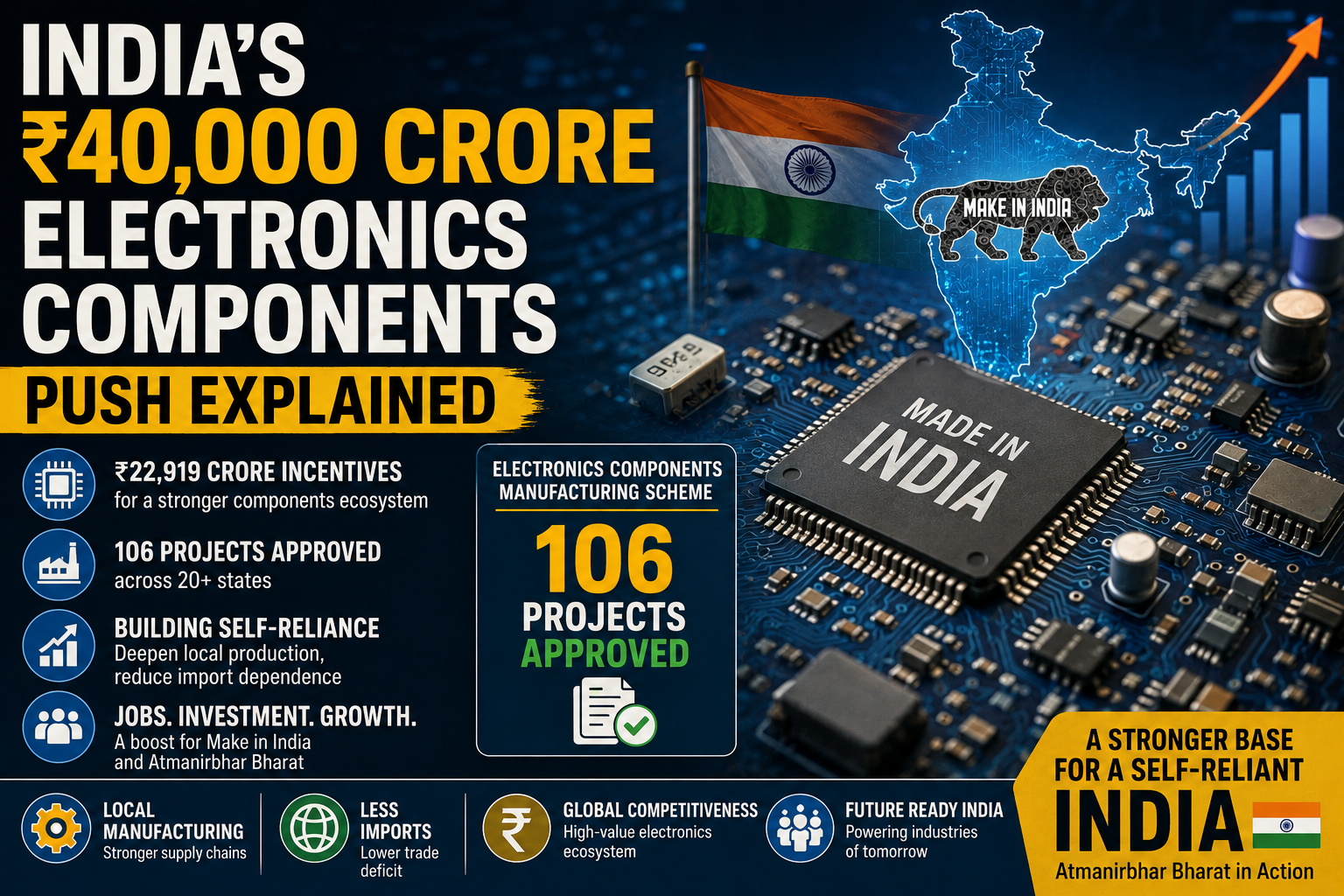
India’s ₹40,000 Crore Electronics Components Push Explained

India’s Electronics Component Incentives: The Next Phase of Make in India
India has become a major global manufacturer of smartphones and electronic products. The next challenge is more difficult: manufacturing the components, materials and machinery that go inside those devices.
That is the purpose of the Electronics Components Manufacturing Scheme, or ECMS.
Launched in 2025 after the success of the electronics Production Linked Incentive scheme, ECMS aims to move India beyond final assembly and create a deeper domestic supply chain.
Industry interest has already exceeded initial expectations. By April 2026, 75 applications had been approved. According to the latest government update from August 2026, the number has now reached 106 approved projects—far above the original plan of approximately 60.
How the Electronics PLI Scheme Transformed India
India launched the PLI Scheme for Large-Scale Electronics Manufacturing in 2020. It encouraged companies to expand production by offering incentives linked to incremental manufacturing.
The results have been significant.
According to Ministry of Electronics and IT data, the large-scale electronics PLI had generated:
- ₹17,519 crore in investment by February 2026
- More than ₹11 lakh crore in cumulative production
- Over ₹6.2 lakh crore in exports
- Approximately 1.85 lakh direct jobs
India is now the world’s second-largest mobile-phone manufacturer. Smartphone exports have also become one of the country’s most valuable export categories.
However, much of the initial success came from assembling finished devices. Several sophisticated components, sub-assemblies, materials and manufacturing machines continued to be imported.
ECMS is designed to address this missing layer.
What Is the Electronics Components Manufacturing Scheme?
The Electronics Components Manufacturing Scheme was notified on April 8, 2025, with an original government outlay of ₹22,919 crore.
Following a stronger-than-expected industry response, the Union Budget 2026–27 increased the allocation to ₹40,000 crore. The scheme will operate for six years, with an optional one-year gestation period for eligible projects.
Unlike incentives primarily focused on finished smartphones, ECMS targets the supporting component ecosystem, including:
- Printed circuit boards
- Camera modules
- Connectors and oscillators
- Passive electronic components
- Mobile and IT hardware enclosures
- Optical transceivers
- Electromechanical components
- Display and battery-related materials
- Electronics-manufacturing machinery
These components are used not only in smartphones but also in automobiles, telecom equipment, medical devices, computers, defence systems, renewable-energy equipment and consumer appliances.
From 70 Applications to 106 Approved Projects
The scheme’s progress has been faster than early projections suggested.
The government has now approved 106 projects across 15 states, representing a proposed investment of ₹69,548 crore. Of these, 38 plants have reportedly started manufacturing, while another 16 are at advanced construction or machinery-installation stages.
The approved projects are expected to create around 74,628 direct jobs and approximately 2.5 lakh indirect employment opportunities. These figures are projections and will depend on projects being completed and achieving their production targets.
Recent approvals include proposals for the first domestic manufacturing of components such as filters, coils and speakers, along with important materials such as acetylene black and electrolyte additives.
This indicates that the programme is beginning to move beyond visible products into the less glamorous—but strategically essential—parts of the electronics supply chain.
How ECMS Can Make India More Self-Reliant
1. Higher Domestic Value Addition
Assembling a smartphone in India does not necessarily mean that most of its value was created in India. Expensive components may still be imported before final assembly.
Local production of circuit boards, camera modules, connectors, enclosures and battery materials can increase the Indian share of each product’s value.
2. Lower Exposure to Supply Disruptions
The COVID-19 pandemic, semiconductor shortages and geopolitical tensions demonstrated the risks of depending heavily on a small number of foreign suppliers.
A stronger domestic component industry cannot eliminate every external dependency, but it can make Indian factories more resilient during international disruptions.
3. More Competitive Indian Exports
Locally available components can reduce logistics costs, shorten delivery times and improve coordination between suppliers and final manufacturers.
This could make India more competitive as a global export base for smartphones, computers, telecom equipment, electric vehicles and industrial electronics.
4. Growth of Indian Suppliers and MSMEs
Large electronics factories need networks of smaller suppliers for tools, testing, packaging, materials, repair and specialised manufacturing.
ECMS could therefore create opportunities for Indian MSMEs while helping them enter the supply chains of major global companies.
5. Better Jobs and Technical Skills
Component manufacturing generally requires expertise in precision engineering, materials science, automation, quality control and electronics design.
If companies build research, engineering and product-development teams in India—not just production lines—the scheme could generate higher-value technical employment.
The Ecosystem Is Finally Coming Together
India’s electronics strategy now has several interconnected parts:
- PLI supports large-scale manufacturing of finished products
- ECMS supports components, materials and capital equipment
- The India Semiconductor Mission supports chips and packaging
- Electronics Manufacturing Clusters provide industrial infrastructure
- Skill-development programmes prepare workers and engineers
Together, these programmes can create a full value chain in which more of an electronic product is designed, manufactured, tested and assembled in India.
Challenges India Still Must Overcome
Incentives alone will not guarantee complete self-reliance.
India still needs reliable power, efficient ports, faster customs clearance, specialised workers and greater investment in research and development. Manufacturers must also achieve global standards of quality, price and delivery speed.
The country will continue importing some advanced components and raw materials. The realistic objective should be strategic self-reliance and diversified supply chains—not attempting to manufacture everything domestically regardless of cost.
Conclusion
India’s electronics PLI scheme successfully created manufacturing scale. The Electronics Components Manufacturing Scheme is intended to create manufacturing depth.
With 106 approved projects, ₹69,548 crore in proposed investment and dozens of plants already operating or under construction, ECMS has moved beyond an early-stage proposal.
If the projects deliver on their commitments, India could capture a much larger share of the value generated by smartphones, computers, automobiles and other electronic products. This would reduce critical import dependence, support exports, create skilled employment and make India a stronger part of global technology supply chains.
The next chapter of Make in India will not be defined only by devices assembled in the country. It will be defined by how many of their critical components, materials and machines are also made in India.
Frequently Asked Questions
When was ECMS launched?
The Electronics Components Manufacturing Scheme was officially notified on April 8, 2025.
What is the current ECMS budget?
The original outlay was ₹22,919 crore. The Union Budget 2026–27 increased it to ₹40,000 crore.
How many ECMS projects have been approved?
As of August 17, 2026, the government had approved 106 projects. Earlier reports mentioning more than 70 applications reflected an older stage of the programme.
Will ECMS make India completely independent of imports?
Not immediately. It can reduce dependence on critical imported components and improve supply-chain resilience, but some advanced materials, machinery and technologies will continue to be imported.
How is ECMS different from the electronics PLI scheme?
The large-scale electronics PLI primarily helped expand production of finished products such as smartphones. ECMS focuses more deeply on components, sub-assemblies, materials and manufacturing equipment.
Disclaimer: This article is based on publicly available government releases and industry information available at the time of publication. Investment, production and employment numbers associated with approved ECMS projects are projections unless specifically described as completed outcomes. Policy allocations, project approvals and implementation status may change. Readers should consult the Ministry of Electronics and Information Technology and Press Information Bureau for the latest official updates.