























Pakistan-Saudi-Turkey Defence Pact: Is a New Power Bloc Rising in West Asia?

A New Defence Pact Shakes West Asia
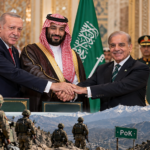
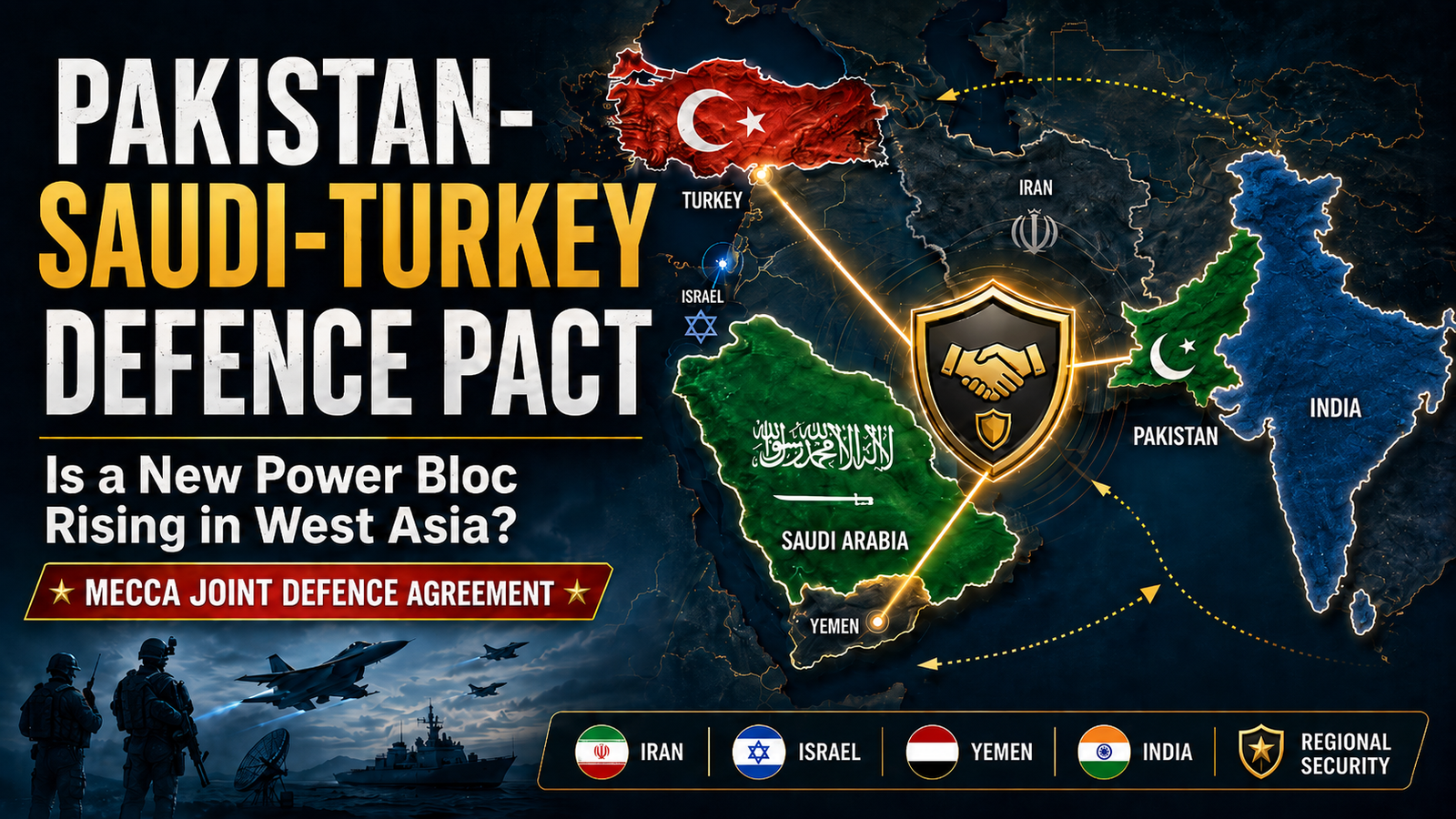
Saudi Arabia, Pakistan and Turkey have signed the Mecca Joint Defence Agreement, a major defence pact that says an armed attack on one country will be treated as an attack on all three. The agreement was signed in Mecca by Saudi Crown Prince Mohammed bin Salman, Turkish President Recep Tayyip Erdogan and Pakistan Prime Minister Shehbaz Sharif.
This is one of the most important security developments in West Asia because it brings together three very different powers: Saudi money and oil influence, Pakistan’s nuclear status and military manpower, and Turkey’s NATO-trained military with a growing defence industry.
On paper, the pact is defensive. But geopolitically, it sends a message to Iran, Israel, the United States and India.
Why Saudi Arabia Wanted This Pact
Saudi Arabia is no longer fully comfortable depending only on the United States for security. Its oil facilities, tankers and critical infrastructure have come under pressure during the widening Iran war, and Iran-backed Houthi forces in Yemen have renewed attacks linked to Saudi targets. AP reported that Saudi Arabia has been looking to diversify defence partnerships because its critical infrastructure and oil facilities have come under attack during the Iran war.
This is why Riyadh is building extra security layers.
The pact does not mean Saudi Arabia is breaking from the West. Saudi officials stressed that the agreement is not a religious bloc, not a military axis and not aimed at nuclear escalation. But the timing makes the message clear: Saudi Arabia wants backup if the region becomes more dangerous.
Is Pakistan Really Ready to Defend Saudi Arabia?
This is the biggest question.
Pakistan has repeatedly promised support for Saudi sovereignty and security. After Houthi missile attacks, Pakistan’s Foreign Office said Islamabad was fully committed to implementing its agreements with Saudi Arabia, including the mutual defence pact.
But words and war are different.
Pakistan is already facing economic pressure, internal security problems and IMF dependence. The IMF said Pakistan has made progress in stabilizing the economy, but also warned that the Middle East war clouds the country’s near-term outlook.
This means Pakistan may support Saudi Arabia diplomatically, provide troops, air defence assistance, training or intelligence cooperation, but a full-scale war against Iran or the Houthis would be much harder.
Even AP cited a regional analyst saying Turkey and Pakistan are unlikely to send large numbers of troops for Saudi Arabia, and that the pact may mainly increase diplomacy, defence production and technology transfer.
So yes, Pakistan supports Saudi Arabia. But whether Pakistan will fight a major war for Saudi Arabia is still uncertain.
Turkey’s Role: More Than Symbolism
Turkey’s entry makes the pact more serious.
Turkey has NATO’s second-largest army and a fast-growing defence industry. It has advanced drones, ships, missiles and battlefield experience from Syria, Libya, Azerbaijan and other theatres.
Turkey and Pakistan have also grown closer militarily. Chatham House noted that Turkey and Pakistan have a history of cooperation in shipbuilding and fighter pilot training, and that Turkey sided with Pakistan during India-Pakistan tensions last year.
Turkey is also a strong critic of Israel, especially over Gaza and regional conflicts. Pakistan also has no diplomatic relations with Israel and remains one of Israel’s strongest ideological critics.
That makes this pact important for Israel too. It does not mean Turkey or Pakistan will automatically enter a war against Israel. But it creates a new diplomatic and military coordination platform among countries that are not aligned with Israeli regional interests.
Is This an “Islamic NATO”?
Calling it an “Islamic NATO” may sound attractive for headlines, but it is not fully accurate.
NATO has deep military integration, command structures, joint planning and decades of institutional trust. The Saudi-Pakistan-Turkey pact is still new and its operational details are unclear.
Saudi Arabia itself said the agreement is not a sectarian or religious bloc. Chatham House also argued that the “Islamic NATO” label is misleading because many Muslim countries are outside the pact and religion is not the main driver of regional foreign policy.
A better description is this: it is a Sunni-majority strategic security triangle designed to increase deterrence and reduce dependence on the United States.
What It Means for Iran
Iran has already reacted sharply. AP reported that an Iranian lawmaker criticized the pact, saying a “paper agreement” with Turkey and Pakistan would not bring Saudi Arabia security.
Iran’s message is simple: Tehran does not believe this pact can stop its missiles, proxies or regional strategy.
But Iran will still watch carefully. If Saudi Arabia starts receiving deeper military support from Pakistan and Turkey, Iran may see it as a hostile encirclement. That could increase tensions in Iraq, Yemen, Syria and the Gulf.
Implications for India
For India, this pact is important but not a reason to panic.
India has deep ties with Saudi Arabia. In FY 2024-25, India-Saudi bilateral trade stood at $41.88 billion, and India imported 33.14 million metric tonnes of crude oil from Saudi Arabia, equal to 13.58% of India’s crude oil imports.
India also has major interests in the Gulf through energy, trade, remittances and millions of Indian workers. India-GCC trade reached $178.56 billion in FY 2024-25, and Indians in GCC countries contributed almost 38% of India’s total remittances that year.
So India cannot view Saudi Arabia only through the Pakistan lens. Riyadh is a crucial partner for India.
But New Delhi must watch three risks.
First, Pakistan may use the pact to project itself as a wider Islamic military power. Second, Turkey’s formal entry could strengthen Pakistan’s defence ecosystem through drones, missiles and naval cooperation. Third, if a future India-Pakistan crisis occurs, Islamabad may try to use this pact diplomatically to pressure India.
However, Saudi Arabia is unlikely to damage its growing relationship with India for Pakistan’s agenda. India is a major energy buyer, trade partner and rising global power. Saudi Arabia will have to balance both sides carefully.
India’s Best Strategy
India should respond with calm strength.
New Delhi should deepen defence and energy ties with Saudi Arabia and the UAE, strengthen relations with Israel without making it look anti-Arab, monitor Turkey-Pakistan defence cooperation, and continue building self-reliance in drones, missiles, air defence and naval power.
India should also increase strategic petroleum reserves and diversify energy supplies so Gulf instability does not directly hit Indian inflation.
The answer is not panic. The answer is preparedness.
Final Thoughts
The Pakistan-Saudi-Turkey defence pact is a major geopolitical signal.
It shows that Saudi Arabia wants more security options, Turkey wants regional influence, and Pakistan wants relevance beyond South Asia. It also shows that the Iran war, Houthi attacks and doubts over U.S. reliability are reshaping West Asia.
But this pact is not automatically a game-changer. Pakistan’s internal struggles, Turkey’s NATO commitments, Saudi Arabia’s economic priorities and unclear military obligations will limit how far it can go.
For India, the pact should be taken seriously but not emotionally.
India must protect its national interest, strengthen Gulf diplomacy, monitor Pakistan-Turkey military cooperation and keep building its own defence power.
In the new world order, alliances are shifting fast. India’s advantage will come from strategic patience, economic strength and military self-reliance.
FAQs
What is the Pakistan-Saudi-Turkey defence pact?
It is the Mecca Joint Defence Agreement, under which an armed attack on one member is to be treated as an attack on all three.
Is this pact aimed at Iran?
The three countries say the pact is defensive and not aimed at any specific country, but it comes during rising Iran-related regional tensions.
Will Pakistan fight for Saudi Arabia?
Pakistan has promised support for Saudi Arabia, but large-scale military action against Iran or Yemen would be difficult because of Pakistan’s internal and economic challenges.
What does this mean for India?
India should monitor Pakistan-Turkey defence cooperation, protect energy security, and maintain strong relations with Saudi Arabia and other Gulf partners.
Is this an Islamic NATO?
Not exactly. It is more accurate to call it a new strategic security triangle, not a NATO-style alliance with deep institutional integration.
Disclaimer: This article is for informational and geopolitical commentary only. It does not promote hostility toward any country or community. Defence pacts, regional conflicts and diplomatic positions may change quickly, and readers should follow verified official updates.