
















































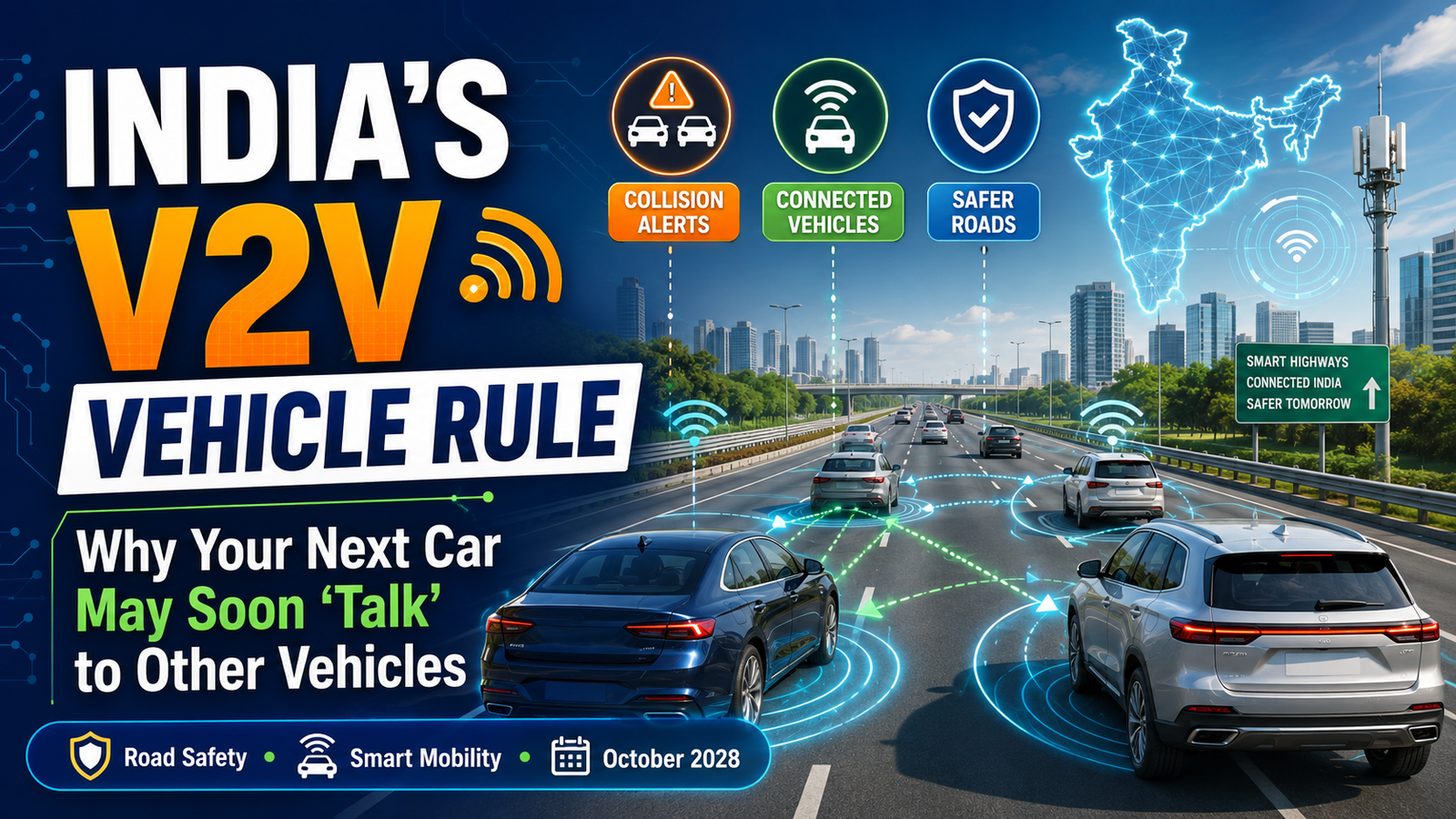
India’s V2V Vehicle Rule: Why Your Next Car May Soon “Talk” to Other Vehicles

India’s Roads Are Getting a Smart Upgrade
India may soon enter a new era of connected vehicles.
The Ministry of Road Transport and Highways has proposed making Vehicle-to-Vehicle communication, or V2V, mandatory in new vehicles from October 1, 2028. According to Economic Times, the draft notification proposes that all new L, M and N category vehicles manufactured on or after that date should be fitted with V2V communication systems. Vehicles already fitted with the system will need to comply with standards from October 1, 2027.
In simple words, India wants future vehicles to “talk” to each other before accidents happen.
This could become one of the biggest road safety reforms after airbags, ABS, Bharat NCAP and ADAS.
What Is V2V Technology?
V2V means Vehicle-to-Vehicle communication.
It allows nearby vehicles to wirelessly exchange real-time information such as speed, location, direction, acceleration and movement. Economic Times reported that this data can help warn drivers or vehicle systems about sudden braking, forward-collision risk, unsafe lane changes and approaching emergency vehicles.
For example, imagine a truck suddenly brakes ahead of you, but you cannot see it because another vehicle is blocking your view. With V2V, your car can still receive an alert before your eyes notice the danger.
That is the real power of this technology: it gives vehicles information beyond the driver’s direct line of sight.
Which Vehicles Will Be Covered?
The proposed rule covers L, M and N category vehicles manufactured on or after October 1, 2028. That means the rule is expected to apply to new two-wheelers, three-wheelers, passenger vehicles and goods vehicles, including buses and trucks.
This is important because India’s road mix is very different from Western countries.
Indian roads have cars, bikes, scooters, buses, trucks, autos, pedestrians, animals, bicycles and roadside vendors sharing the same space. If V2V works properly in this complex environment, it can become a game changer.
Why India Needs V2V Urgently
India has one of the world’s toughest road safety challenges.
Government data has repeatedly shown high accident and fatality numbers. A PIB release said India recorded 4,61,312 road accidents and 1,68,491 fatalities in 2022. Another PIB release in 2026 said India recorded around 4.73 lakh road accidents and 1.70 lakh deaths in 2024.
These are not just statistics. They are families destroyed, breadwinners lost, hospital bills created and futures cut short.
India cannot fix road safety with one solution. It needs better roads, stricter enforcement, safer vehicles, faster emergency care and smarter technology.
V2V can become one part of that larger safety system.
How V2V Can Prevent Accidents
V2V can help in many real-world driving situations.
It can warn drivers when a vehicle ahead brakes suddenly. It can alert vehicles about an unseen car approaching an intersection. It can help prevent unsafe lane-change collisions. It can warn about emergency vehicles. It can support future intelligent transport systems and connected mobility.
Unlike normal sensors, V2V does not depend only on cameras or radar seeing what is directly in front of the car. It can receive information from other vehicles nearby.
That makes it a strong partner for ADAS, or Advanced Driver Assistance Systems.
The 5.9 GHz Connection
The technology also needs spectrum.
Economic Times reported that the Department of Telecommunications has allocated the 5.875 GHz to 5.925 GHz frequency band for V2V and other intelligent transportation system applications.
TRAI also released a consultation paper on the regulatory framework for Vehicle-to-Everything communication, or V2X, on April 30, 2026, after the Department of Telecommunications requested recommendations on the regulatory mechanism.
This shows that India is not only thinking about vehicles talking to vehicles. It is moving toward a bigger connected transport ecosystem where vehicles can communicate with roads, traffic signals, emergency systems and infrastructure.
V2V Is Not Magic
V2V is promising, but it is not a magic solution.
India still needs better lane discipline, road engineering, pothole control, driver training, traffic enforcement and emergency response. If roads are chaotic and drivers ignore alerts, the benefit will be limited.
There are also important questions around cost, data privacy, cybersecurity, repair standards and whether small vehicle buyers will face higher prices.
The government must ensure that V2V does not become only a premium feature for expensive cars. If the rule applies to mass-market vehicles, the technology must be affordable, secure and reliable.
Big Opportunity for Make in India
This rule can also create a major opportunity for Indian manufacturing.
V2V systems will need chips, sensors, software, communication modules, testing labs, cybersecurity systems and automotive suppliers. If India builds this ecosystem locally, it can support Make in India, generate skilled jobs and reduce dependence on imported automotive electronics.
Indian startups can also build applications around connected mobility, accident alerts, fleet safety, emergency response, insurance technology and smart traffic management.
This is not just a safety reform. It is an industrial opportunity.
Final Thoughts
India’s proposed V2V rule could change the future of driving.
From October 2028, new vehicles may no longer be isolated machines. They may become part of a connected road network where cars, bikes, buses and trucks share safety information in real time.
For a country with India’s accident burden, this technology could save lives if implemented properly.
But the success of V2V will depend on execution. India needs strong standards, cybersecurity rules, affordable hardware, local manufacturing and public awareness.
The future of road safety will not depend only on better drivers. It will also depend on smarter vehicles.
And soon, your next vehicle in India may not just move — it may also communicate.
FAQs
What is V2V communication?
V2V communication allows vehicles to exchange real-time information such as speed, location, direction and movement to improve safety.
When will V2V become mandatory in India?
The government has proposed mandatory V2V systems in new L, M and N category vehicles manufactured on or after October 1, 2028.
Will old vehicles also need V2V?
The current proposal focuses on vehicles manufactured on or after October 1, 2028. Vehicles already fitted with V2V systems must comply with standards from October 1, 2027.
How can V2V reduce accidents?
It can warn drivers about sudden braking, collision risks, unsafe lane changes and emergency vehicles before the danger becomes visible.
Is V2V the same as ADAS?
No. ADAS uses onboard sensors like cameras and radar, while V2V allows vehicles to communicate directly with each other. Both can work together.
Disclaimer: This article is for informational and educational purposes only. The V2V mandate is based on a proposed draft notification and may change after stakeholder consultation. It is not legal, automotive or investment advice.