












































Vizhinjam Port Fully Operational: Why It Matters for India

Vizhinjam Port Fully Operational: A Game-Changer for India’s Economy and Global Trade
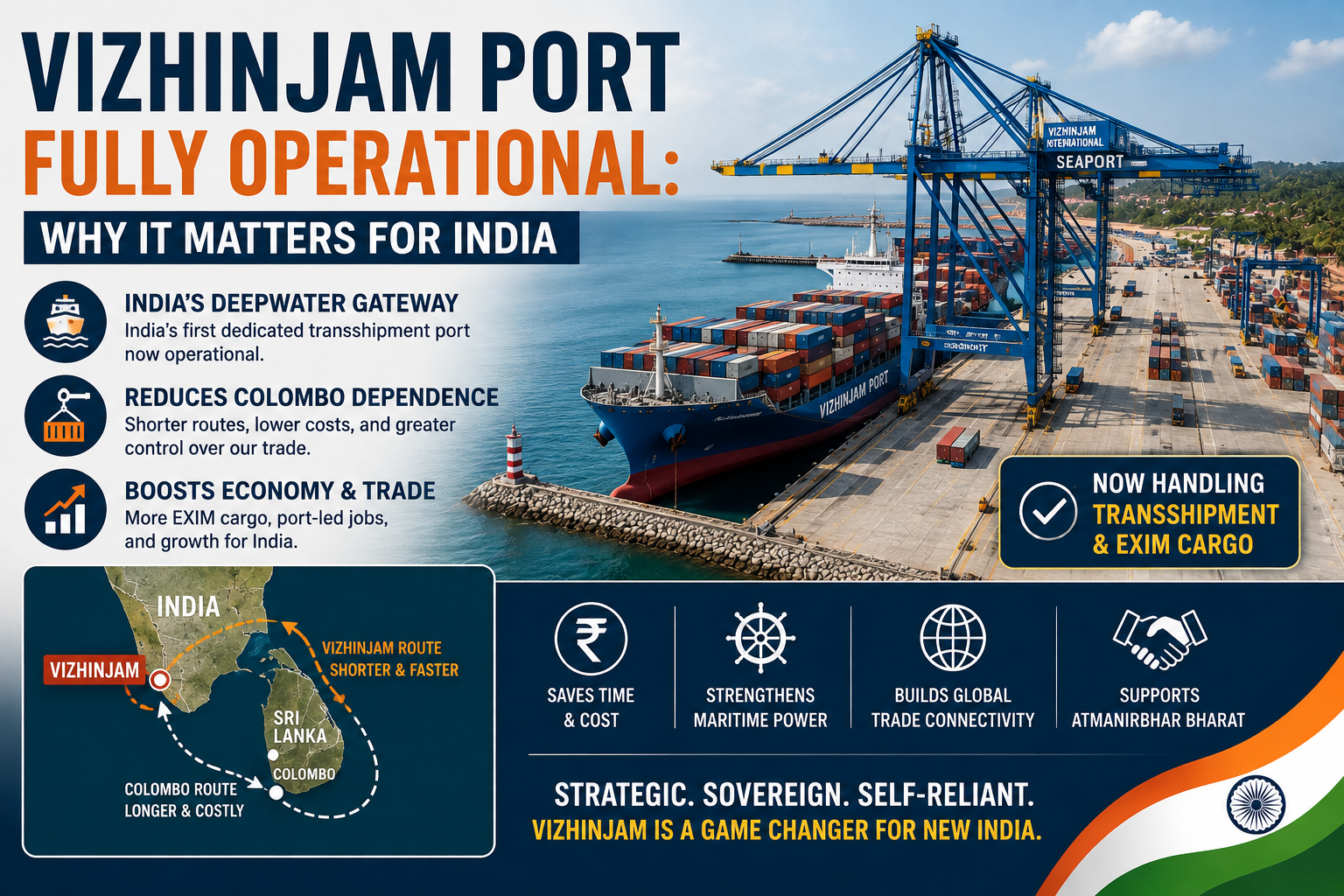
India has crossed a major maritime milestone. Kerala’s Vizhinjam International Seaport is now operational not only as a global transshipment hub but also as a direct export-import gateway.
Gateway EXIM operations officially began on August 18, 2026, allowing eligible Indian cargo to be imported and exported through Vizhinjam. Until then, the port had primarily transferred containers between large international ships and smaller feeder vessels.
This transition gives India something it has pursued for decades: a world-class deep-water port capable of competing with Colombo, Singapore and Port Klang.
However, “fully operational” does not mean the entire Vizhinjam project is complete. Its core transshipment and initial EXIM services are operating, while major capacity expansion, rail connectivity and supporting logistics infrastructure are still under development.
Why Is Vizhinjam Port So Important?
Vizhinjam’s biggest strength is its location.
The port is situated only about 10 nautical miles from the East–West international shipping route connecting Europe, the Middle East, Africa and East Asia. Ships using this route can call at Vizhinjam without making a lengthy diversion.
It also offers a natural draft of approximately 18 to 20 metres. This allows the port to accommodate ultra-large container vessels that cannot enter many traditional Indian ports without extensive dredging.
Vizhinjam currently has:
- An annual capacity of approximately 1.6 million TEUs
- An 800-metre container berth
- A nearly 2.9-kilometre breakwater
- Eight quay cranes and 24 automated yard cranes
- Advanced digital and automated cargo-handling systems
A TEU, or Twenty-Foot Equivalent Unit, is the standard measurement used for shipping containers.
The port handled about 1.3 million TEUs and 615 vessels during FY2025–26. It also became the fastest Indian port to cross one million TEUs and surpassed two million TEUs within 18 months of commercial operations. Adani Ports
Reducing India’s Dependence on Colombo Port
For years, India lacked a deep-water transshipment hub capable of consistently attracting the world’s largest container ships.
As a result, containers travelling to or from India were frequently sent first to foreign ports such as Colombo, Singapore, Port Klang, Dubai and Salalah. Large “mother ships” unloaded the containers there, after which smaller feeder vessels carried them to Indian ports.
Historically, about 75% of India’s transshipped containers were handled outside the country. Colombo, Singapore and Port Klang managed more than 85% of this traffic, with Colombo alone handling a significant share of Indian cargo.
This dependence created several disadvantages:
- Indian businesses paid additional handling charges
- Cargo faced longer transit times
- Foreign ports earned revenue from Indian trade
- Exporters faced higher logistics costs
- Supply chains depended on another country’s port capacity
According to Maritime India Vision 2030 estimates cited by ET Infra, foreign transshipment can add approximately $80 to $100 in handling costs for each container. ET Infra
Vizhinjam can retain more of this activity—and its associated revenue—inside India.
It will not eliminate Colombo’s role overnight. Shipping companies choose ports based on pricing, reliability, connectivity and cargo volumes. However, India now has a credible domestic alternative.
Vizhinjam Becomes a Direct Export-Import Gateway
The start of gateway EXIM services is equally important.
Businesses can now route eligible cargo directly through Vizhinjam instead of using the port only to transfer containers between ships. This can benefit exporters in Kerala and neighbouring states dealing in food products, seafood, spices, textiles, engineering goods and other manufactured products.
Initial EXIM operations remain subject to Customs conditions because Vizhinjam does not yet have a dedicated Container Freight Station. Imports are currently restricted to eligible Full Container Load shipments using Direct Port Delivery. Containers must be moved to the importer’s premises within 48 hours.
Even with these restrictions, the launch is an important first step towards transforming Vizhinjam from a transfer terminal into a complete trade and logistics gateway. The Economic Times
How Vizhinjam Can Support India’s GDP
A port does not automatically increase GDP simply by opening. Its economic contribution comes through the activity it enables.
Vizhinjam can support economic growth by:
Lowering Logistics Costs
Faster cargo handling and reduced dependence on foreign hubs can make Indian exports more price-competitive.
Retaining Foreign Exchange
Port-handling fees that previously went to overseas terminals can increasingly remain within India’s maritime economy.
Attracting Global Investment
In June 2026, MSC Group’s terminal subsidiary agreed to invest approximately $1.4 billion for a 49% interest in the Vizhinjam operating company, subject to approvals. Reuters described it as the largest foreign private investment in Indian port infrastructure. Reuters
Creating Employment
The port can generate direct jobs in terminal operations, Customs, security and maintenance, alongside indirect employment in trucking, warehousing, ship services, freight forwarding and manufacturing.
Encouraging Port-Led Industrialisation
Logistics parks, warehouses, cold-storage facilities, processing units and export-oriented industries are expected to develop around Thiruvananthapuram and southern Kerala.
The result can be higher investment, greater tax revenue and stronger regional economic activity. The impact on national GDP will depend on how successfully India connects the port with its factories, farms and domestic transport network.
Connecting India More Directly With the World
Vizhinjam’s deep draft allows major shipping lines to bring their largest vessels directly to India.
This can create more frequent connections with Europe, Africa, the Americas, the Middle East and Asia. It also positions India to compete for transshipment cargo from Bangladesh, East Africa and other regional markets.
The port’s partnership with MSC—the world’s largest container shipping group—provides stronger visibility over future cargo volumes. Vizhinjam can become part of major global shipping networks rather than remaining a terminal dependent only on occasional vessel calls.
This supports India’s broader ambition to become an export, manufacturing and maritime-services powerhouse.
Expansion to 5.7 Million TEUs by 2028
Vizhinjam has already reached full utilisation during peak operating periods. The next challenge is expanding before congestion restricts growth.
Adani Ports plans to invest approximately ₹16,000 crore to increase annual capacity from 1.6 million TEUs to about 5.7 million TEUs by December 2028.
The expansion includes:
- Extending the container berth
- Expanding the breakwater
- Installing additional cranes
- Creating larger container yards
- Building a railway yard
- Developing liquid and multipurpose terminals
- Improving bunkering and ship-support facilities
Vizhinjam’s success will also depend on completing road and railway links, establishing a Container Freight Station and developing an efficient logistics network connecting the port with southern India.
India’s New Maritime Opportunity
Vizhinjam represents more than a new port. It marks India’s attempt to recover a strategically important part of its own trade ecosystem.
For decades, Indian containers generated business for foreign transshipment hubs. Vizhinjam provides an opportunity to retain that revenue, reduce logistics costs and bring the world’s largest ships directly to Indian shores.
Its early performance proves that global shipping companies are willing to use the facility. The beginning of direct EXIM operations now expands its role from a transshipment terminal to an international trade gateway.
The infrastructure surrounding the port is not yet complete, and Colombo will remain a powerful competitor. But Vizhinjam has already changed the maritime map of South Asia.
If India completes the planned expansion and connectivity projects on schedule, Vizhinjam could become one of the most important engines of India’s trade-led growth.
Frequently Asked Questions
Is Vizhinjam Port fully operational?
Vizhinjam is operational for international transshipment and initial gateway EXIM cargo. However, future expansion phases, rail connectivity and some supporting logistics facilities remain under construction.
Is Vizhinjam India’s first transshipment port?
Vizhinjam is widely described as India’s first dedicated deep-water mega container transshipment port and the country’s first automated port. Kochi’s Vallarpadam terminal also handles transshipment cargo, but Vizhinjam has greater natural depth for ultra-large vessels.
How will Vizhinjam reduce dependence on Colombo?
It allows large international ships to transfer India-bound containers at an Indian port instead of routing them through Colombo or other overseas hubs.
What is Vizhinjam Port’s current capacity?
The port currently has an annual capacity of approximately 1.6 million TEUs. Expansion is expected to raise this to around 5.7 million TEUs by December 2028.
Will Vizhinjam increase India’s GDP?
It can support GDP through lower logistics costs, foreign investment, employment, port revenue, exports and port-led industrial development. The eventual impact will depend on connectivity and cargo growth.
Editorial Note: Capacity, cargo and investment figures are based on government, port-operator and published industry information available in August 2026. Future projections may change as expansion work progresses.