



































China–Turkey Military Flights to Pakistan: Is War With India Near?

China–Turkey Military Flights to Pakistan: Is Islamabad Preparing for War?
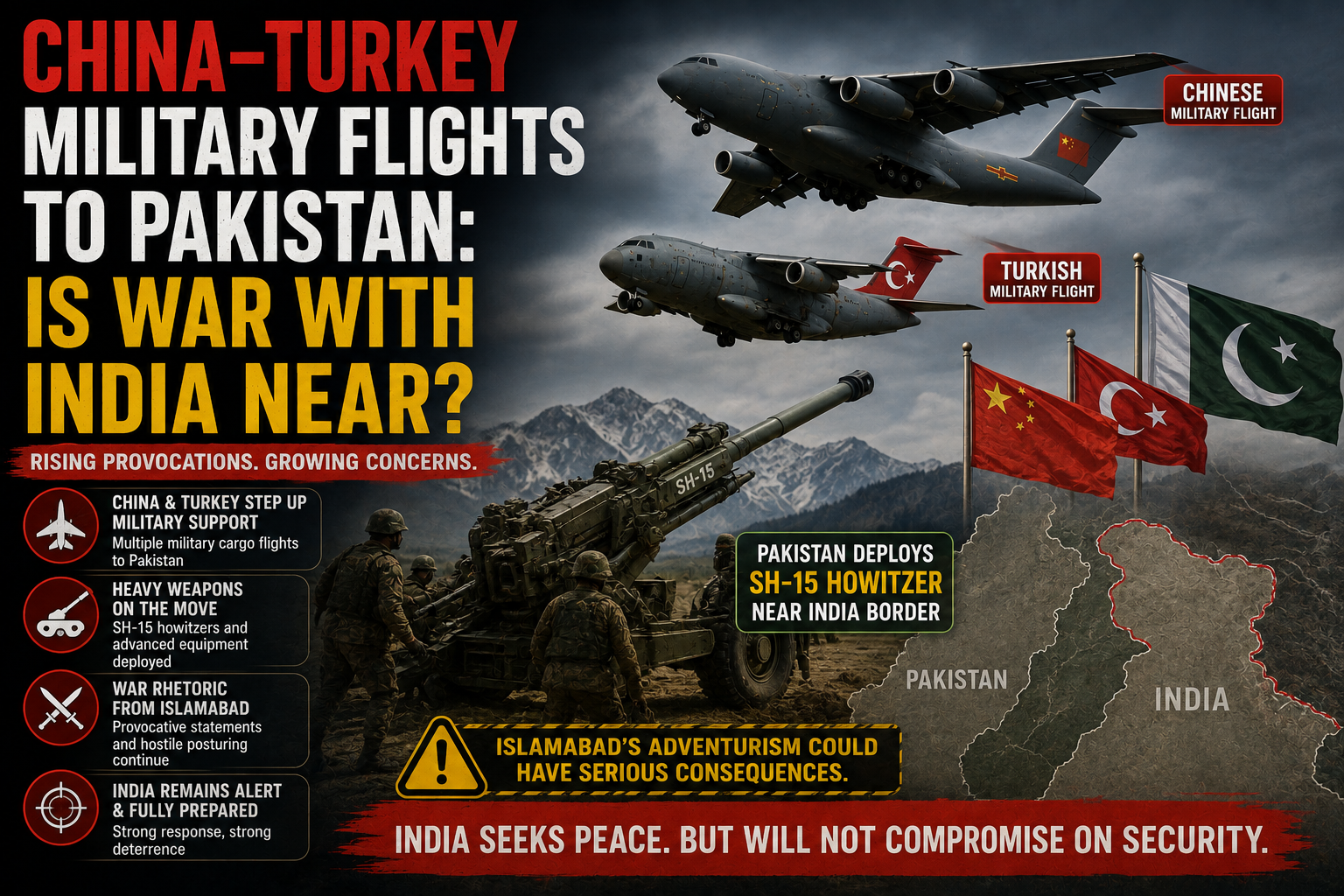
A sudden increase in Chinese and Turkish military transport flights to Pakistan has triggered serious questions in India. The concern has grown following reports that Pakistan deployed hundreds of China-made SH-15 howitzers near its India-facing frontier.
Does this mean Pakistan is preparing to start another war?
The developments deserve close attention. However, military reinforcement is not the same as a confirmed decision to attack.
What Do We Know About the Military Flights?
Indian media reports citing security sources claim that Chinese military transport aircraft made repeated trips to Pakistan over approximately 60 hours. Some reportedly landed at Nur Khan Airbase near Rawalpindi and Masroor Airbase in Karachi.
A Turkish military transport aircraft was also reportedly involved in the activity. The flights have been linked to possible deliveries of drones, weapons and other defence equipment.
However, the exact nature and quantity of the reported cargo have not been independently confirmed. China, Türkiye and Pakistan have not publicly provided a complete cargo list.
Therefore, claims that the flights prove an immediate attack is coming should be treated cautiously.
Pakistan Deploys Chinese Howitzers Near India
The more visible development is Pakistan’s reported deployment of approximately 250 Chinese-made SH-15 self-propelled howitzers along formations facing India.
The SH-15 is a mobile 155mm artillery system mounted on a truck. It can quickly fire and relocate, making it harder to target during combat. Its mobility could significantly strengthen Pakistan’s artillery capabilities along the border and Line of Control.
Pakistan reportedly ordered these systems several years ago, meaning their deployment is part of a longer military-modernisation programme—not necessarily a sudden wartime purchase.
Still, positioning such a large number of modern artillery systems near India sends a clear strategic signal. India’s Ministry of External Affairs said the country would take all necessary measures to safeguard its national interests.
Why Are China and Türkiye Supporting Pakistan?
China has been Pakistan’s most important defence supplier for years. According to SIPRI’s latest international arms-transfer data, China provided around 80% of Pakistan’s imported weapons during 2021–25.
Pakistan’s Chinese-origin arsenal includes:
- J-10 fighter aircraft
- Jointly produced JF-17 fighters
- SH-15 artillery systems
- Air-defence equipment
- Frigates and Hangor-class submarines
Türkiye has also expanded its defence partnership with Pakistan, especially in drones, naval systems, training and technology cooperation. Pakistan is working with Turkish companies on the local development and assembly of unmanned aircraft.
These relationships give Beijing and Ankara strategic influence in South Asia while helping Pakistan reduce its reliance on Western military suppliers.
Is Pakistan Preparing for War With India?
Pakistan appears to be strengthening its readiness for a future confrontation. But publicly available evidence does not prove that its leadership has decided to begin a full-scale war.
More conclusive warning signs would include:
- Large-scale troop mobilisation
- Reserve soldiers being called into service
- Civilian evacuations near the border
- Unusual movement of fuel and ammunition
- Military hospitals preparing for casualties
- Airspace restrictions and widespread flight cancellations
These indicators have not been publicly verified on the scale normally associated with an imminent conventional war.
The current activity could represent military modernisation, deterrence, preparation for future crises or a response to lessons learned during the 2025 India-Pakistan confrontation.
The Bigger Danger Is Escalation
A full-scale war would carry enormous risks for both nuclear-armed countries. Pakistan must also consider its economic difficulties, security problems near Afghanistan and India’s capacity to launch a powerful retaliation.
The more immediate threat may instead come from drone intrusions, cross-border firing, terrorism, limited military strikes or an incident that rapidly escalates.
Modern drones and mobile artillery allow countries to apply pressure without immediately beginning a conventional invasion. But this also increases the danger of miscalculation. One attack, false alarm or misunderstood military movement could create a much larger crisis.
India Must Remain Alert—Without Creating Panic
India should closely monitor military air traffic, artillery deployments, drone activity and developments at Pakistani airbases. It must also strengthen counter-drone systems, intelligence sharing, border surveillance and protection of critical infrastructure.
At the same time, unverified social-media posts should not be presented as confirmed evidence of war. Exaggerated claims can create unnecessary fear and may even support hostile disinformation campaigns.
Conclusion
The reported Chinese and Turkish military flights, combined with Pakistan’s deployment of SH-15 howitzers, show that Islamabad is improving its military capabilities and preparing for possible future confrontations.
They do not yet prove that Pakistan has made a decision to attack India.
The correct assessment is neither complacency nor panic: Pakistan is building military options, China and Türkiye are helping expand those options, and India must remain prepared for both limited provocations and a wider escalation.
Frequently Asked Questions
Has Pakistan declared war on India?
No. Pakistan has not declared war, and there is no publicly verified evidence of an immediate full-scale invasion.
Did China and Türkiye send weapons to Pakistan?
Military transport flights have been reported, but the complete cargo and quantity of any defence equipment have not been independently confirmed.
What is the SH-15 howitzer?
The SH-15 is a Chinese-made, truck-mounted 155mm artillery system designed for rapid deployment, firing and relocation.
Could India and Pakistan fight another limited conflict?
Yes. Drone activity, terrorism, border firing or retaliatory strikes could produce another limited confrontation, even if neither side initially wants a full-scale war.