

















































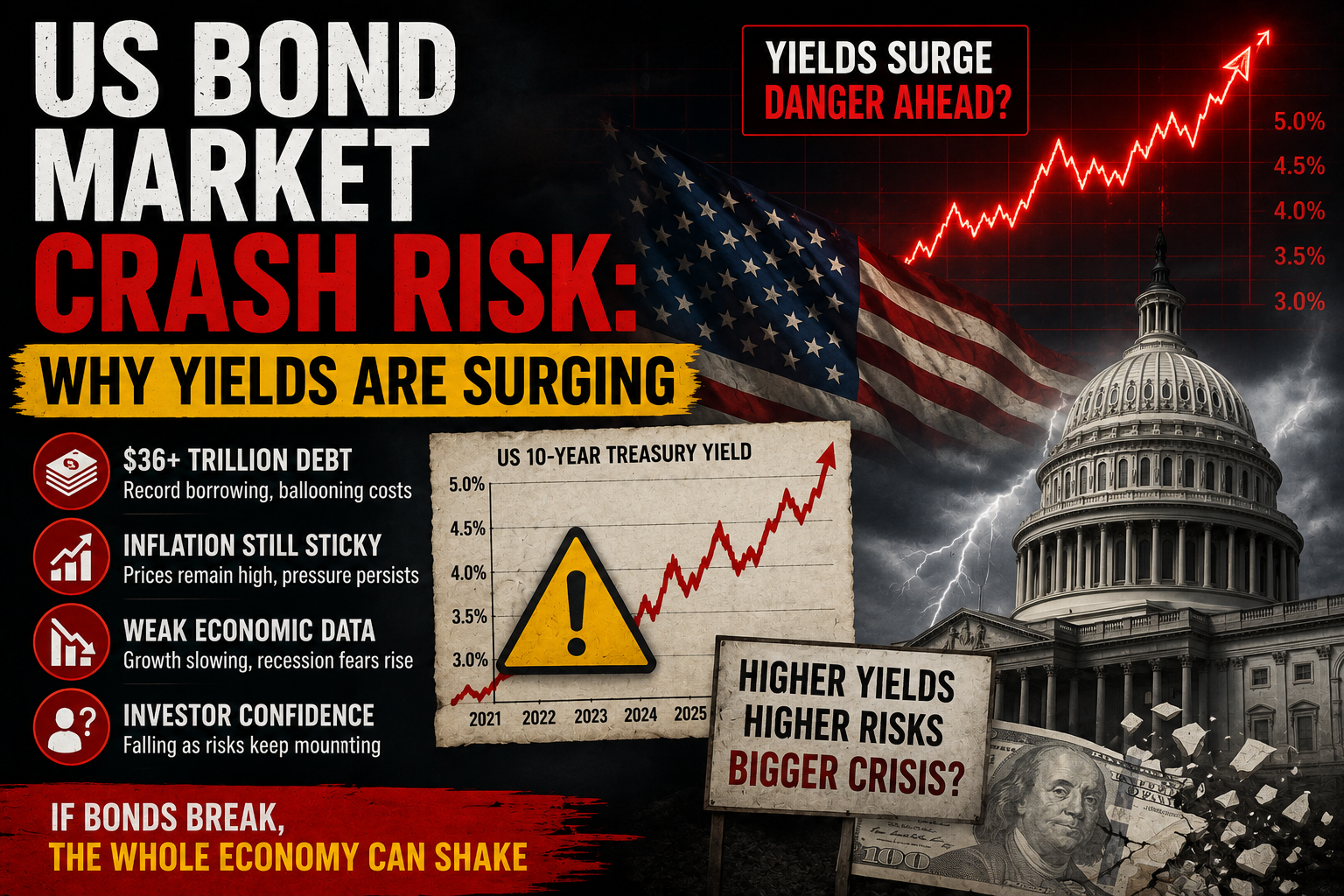

US Bond Market Crash Risk: Why Long-Term Treasury Yields Are Surging
The United States may not be experiencing a complete bond market crash yet, but warning signs are becoming difficult to ignore.
Long-term US Treasury bonds have suffered a major selloff, pushing borrowing costs to levels not seen since before the 2008 financial crisis. On August 19, the 30-year Treasury yield briefly reached approximately 5.34%—its highest level since 2007—before falling after the US Treasury announced expanded bond buybacks. Reuters
The message from investors is increasingly clear: if Washington wants to borrow enormous amounts for decades, it must offer a much higher return.
Why Are US Treasury Yields Rising?
Bond prices and yields move in opposite directions. When investors sell existing bonds or demand better returns at new auctions, bond prices fall and yields rise.
Several problems are driving the current US Treasury selloff:
- America’s gross national debt has crossed $40 trillion
- Persistent budget deficits require continuous borrowing
- Inflation remains above the Federal Reserve’s target
- Investors fear that long-term debt will lose purchasing power
- Competing bonds in Europe and Japan have become more attractive
- Political and geopolitical uncertainty is increasing the risk premium
The Congressional Budget Office projects a federal deficit of approximately $1.9 trillion in fiscal year 2026. It also expects net interest costs to exceed $1 trillion, creating a dangerous cycle in which the government borrows more partly to service existing debt. Congressional Budget Office
This does not mean the United States is about to default. It means financing America’s debt is becoming significantly more expensive.
Are Foreign Countries Refusing to Buy US Bonds?
Claims that no foreign investors are buying American bonds are incorrect. The real story is more complicated—and potentially more concerning over the long term.
US Treasury data shows that foreign residents purchased $262.8 billion of long-term American securities in May 2026. Total foreign Treasury holdings also remained above $9 trillion earlier in the year. US Treasury
At the August 19 auction of 20-year bonds, foreign and indirect buyers reportedly purchased 62.9% of the offering. Overall demand was solid, but investors required a yield of 5.204%—considerably above the recent auction average. Barron’s
Therefore, foreign buyers have not disappeared. Instead, three important changes are occurring:
1. Buyers Are Becoming More Price-Sensitive
Investors will still purchase US debt, but many now demand higher interest rates as compensation for inflation, rising debt and fiscal uncertainty.
2. Private Investors Are Replacing Some Central-Bank Demand
Foreign asset managers, banks and investment funds remain active buyers. However, official institutions and central banks have become more uneven in their purchases.
3. Major Countries Are Diversifying
China has reduced its direct Treasury holdings over several years, while central banks worldwide have increased their gold reserves and explored alternative payment systems. This is gradual diversification—not a complete abandonment of the dollar.
The danger is not that foreign demand suddenly falls to zero. The danger is that demand fails to grow as quickly as America’s borrowing requirements.
Is Washington Pressuring US Banks to Buy Treasuries?
The US government has not issued a direct order forcing banks to purchase Treasury bonds. However, regulators have changed capital rules in ways that make it easier for major banks to hold and trade government debt.
A revised enhanced supplementary leverage ratio took effect in April 2026. The Federal Reserve said the change would reduce regulatory disincentives for large banks to participate in low-risk, low-return activities such as Treasury-market intermediation. Federal Reserve
In simple terms, banks have received more balance-sheet flexibility to absorb, finance and trade government debt.
Supporters say this will improve liquidity in the world’s largest bond market. Critics argue that Washington is becoming increasingly dependent on domestic financial institutions to manage its rapidly expanding debt supply.
Banks are not being forced to buy. But policymakers clearly want them to play a larger role.
Why Is the Treasury Buying Back Its Own Bonds?
The Treasury has announced that it will double some buyback operations for bonds with maturities of 10 to 30 years—from $2 billion to at least $4 billion per operation.
These buybacks are intended to improve liquidity by purchasing older, less frequently traded securities. They are not the same as the Federal Reserve printing money through quantitative easing, and they do not eliminate the national debt. The Treasury generally finances its operations through other borrowing and cash management.
The buyback announcement brought temporary relief, pushing the 10-year yield towards 4.64% and the 30-year yield towards 5.18%. However, the expanded purchases remain small compared with the Treasury market’s enormous size.
They may calm the market temporarily, but they cannot solve the underlying deficit.
Wall Street Is High, but Main Street Is Struggling
Supporters of the US economy frequently point to stock indexes trading near record highs. That is a valid indicator of investor confidence—but it does not represent every American household.
Large technology and artificial-intelligence companies have contributed heavily to stock-market gains. Families without major stock holdings may experience an entirely different economy.
Recent data reveals a widening gap:
- US payrolls unexpectedly fell by 23,000 in July
- Earlier job estimates for May and June were reduced by 103,000
- Labour-force participation declined to 61.4%
- Real GDP growth slowed from 2.1% in the first quarter to 1.5% in the second
- Household debt remained close to $18.8 trillion
- Credit-card balances increased to approximately $1.26 trillion
The official GDP report also showed that the price index for domestic purchases rose at a 5.7% annualised rate during the second quarter. Bureau of Economic Analysis
Meanwhile, the New York Federal Reserve reported that many households remain heavily indebted, with credit-card and auto-loan delinquencies elevated even if they are not currently accelerating into a full consumer-credit crisis. Federal Reserve Bank of New York
A record stock market can therefore exist alongside employment weakness, expensive housing, high grocery bills and growing financial insecurity.
Is the US Bond Market Already Crashing?
Not yet—not by the traditional definition.
A genuine Treasury-market crash would probably involve failed auctions, disappearing liquidity, forced selling, severe bank losses and emergency Federal Reserve intervention. Current auctions are still attracting substantial domestic and foreign demand.
What America may be facing is a slow-motion bond repricing. Investors are no longer willing to finance Washington at the exceptionally low interest rates available during the 2010s.
That change has major consequences:
- Mortgage rates may remain high
- Business loans become more expensive
- Government interest payments consume more tax revenue
- Bond losses can weaken bank balance sheets
- High yields create competition for stock-market investments
- Refinancing the national debt becomes increasingly costly
Could a US Bond Crash Trigger a Global Crisis?
US Treasuries serve as collateral, reserves and safe assets throughout the global financial system. A disorderly selloff could therefore affect banks, currencies, pension funds and stock markets worldwide.
The greatest risk would be a sudden loss of confidence caused by uncontrolled deficits, persistent inflation or political interference with monetary policy.
For now, the United States can still attract buyers. But it must pay them more—and every additional percentage point increases the cost of maintaining a $40 trillion debt burden.
Final Verdict
The US bond market has not collapsed, and foreign investors have not stopped buying Treasury securities.
However, the warning signals are real. Long-term yields have reached levels unseen since 2007, government debt has crossed $40 trillion, economic growth has slowed and Washington is using regulatory changes and expanded buybacks to strengthen Treasury-market liquidity.
The central problem is not whether America can sell bonds today. It is how much interest America must offer tomorrow.
If debt and deficits continue rising faster than investor confidence, the current selloff could develop into a much more serious US bond market crisis.
Frequently Asked Questions
Is the US bond market crashing?
Long-term bonds have experienced a significant selloff, but the Treasury market continues to function and auctions are still attracting buyers. It is presently market stress rather than a complete crash.
Have foreign countries stopped buying US Treasury bonds?
No. Foreign investors continue purchasing US securities, although demand varies and buyers increasingly require higher yields.
Is the US forcing banks to buy government bonds?
No direct order has been issued. Regulatory changes have made it easier for large banks to hold and intermediate Treasury securities.
Why are long-term Treasury yields so high?
Investors are concerned about inflation, massive government borrowing, fiscal deficits and the purchasing power of future interest payments.
Can the stock market rise while the economy weakens?
Yes. Stock indexes can be driven by a relatively small number of major companies, while employment, household debt and living costs reflect broader economic conditions.
Financial Disclaimer: This article is for general information and commentary only. It does not constitute investment, legal or financial advice.