
















































UPI in Israel Soon: What the India–Israel Payment Link Means for Indians

India’s Unified Payments Interface is preparing to enter another important international market.
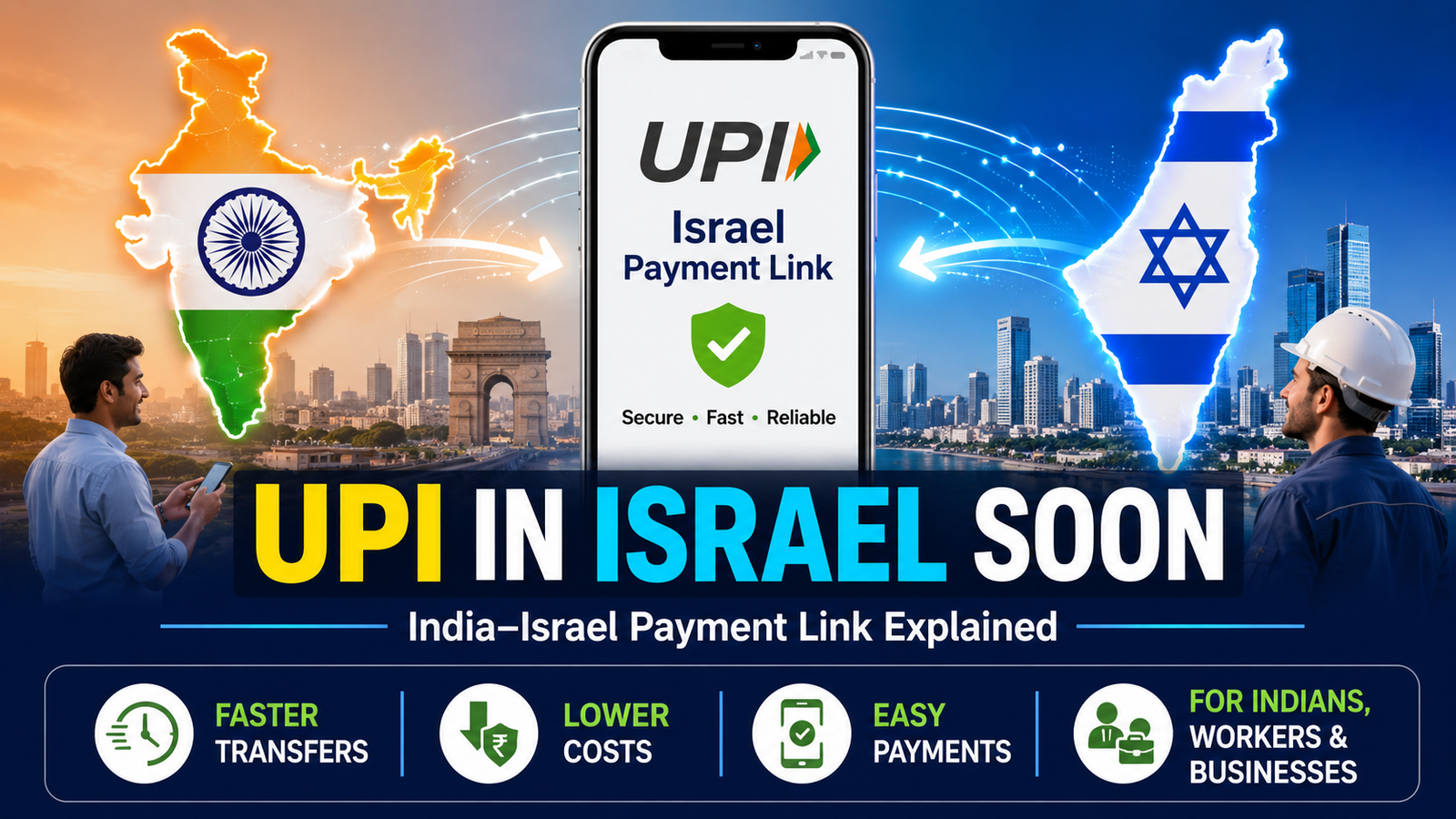
India and Israel have agreed to connect UPI with Israel’s domestic payment infrastructure, potentially making money transfers between the two countries faster, simpler and more affordable.
The agreement adds Israel to India’s expanding digital-payment network and strengthens UPI’s position as a growing alternative to conventional cross-border payment channels.
However, UPI is not yet fully operational across Israel. An implementation agreement has been signed, but the final launch date and customer-level details are still awaited.
What Has India and Israel Announced?
During Prime Minister Narendra Modi’s visit to Israel in February 2026, NPCI International Payments Limited and Israel’s MASAV signed a memorandum of understanding for implementing UPI.
According to the official list of outcomes published by the Prime Minister’s Office, the agreement aims to enable cross-border remittances between India and Israel through UPI.
Prime Minister Modi also announced that an agreement had been reached for the use of UPI in Israel as part of the broader India–Israel strategic partnership.
This is an implementation agreement—not confirmation that every Israeli shop currently accepts UPI.
As of August 17, 2026, the authorities have not publicly confirmed:
- An official activation date
- Participating Indian and Israeli banks
- Supported UPI applications
- Transaction limits
- Foreign-exchange rates
- Transfer fees
- Merchant QR acceptance arrangements
These details are expected as NPCI International and MASAV complete the technical and regulatory work.
What Is MASAV?
MASAV, or the Banking Settlement Center, operates important payment infrastructure in Israel.
According to the Bank of Israel, MASAV processes electronic credits, debits and account-to-account transfers. Its faster-payment system can make funds available to recipients within seconds for domestic transactions.
Linking UPI with MASAV could create a direct connection between India’s instant-payment ecosystem and Israel’s banking network.
The final service will still need to manage currency conversion, customer verification, anti-money-laundering requirements and settlement between Indian rupees and Israeli shekels.
How Could UPI in Israel Work?
The official agreement currently focuses on cross-border remittances.
Once the service becomes operational, an eligible user may be able to initiate a payment through a supported bank or UPI application. The payment network would process the transfer, convert the currency and credit the recipient’s linked account in Israel or India.
The exact process may differ from ordinary domestic UPI payments. International transactions often require additional information, including the recipient’s identity, transfer purpose and compliance details.
Merchant payments could be added later, but travellers should not assume that Indian UPI QR codes already work at Israeli stores.
Who Will Benefit From UPI in Israel?
Indian Workers in Israel
Indian workers could become some of the biggest beneficiaries.
A faster UPI-linked remittance service may help them send money to families in India without depending entirely on traditional bank transfers or remittance companies.
The actual savings will depend on exchange rates and fees announced at launch.
Indian Tourists and Business Travellers
If merchant acceptance is included in a future phase, Indian visitors may eventually be able to make payments using supported UPI applications instead of relying only on cash or international cards.
Until that feature is officially activated, travellers should continue carrying internationally accepted payment options.
Israeli Businesses
Israeli companies working with Indian suppliers, professionals and service providers could benefit from faster payment settlement and easier financial connectivity.
Small businesses may particularly benefit if the system reduces paperwork, intermediary charges and payment delays.
Families Receiving Remittances
Families in India and Israel could receive eligible transfers more quickly. UPI’s account-to-account structure may offer a more convenient alternative to traditional international transfers, subject to the final rules.
Why This Agreement Matters for India
UPI has become the foundation of India’s digital-payment economy.
According to NPCI’s official statistics, UPI processed more than 23 billion transactions worth approximately ₹29.9 lakh crore in May 2026 alone.
Taking UPI abroad is therefore about more than convenience. It allows India to export its digital public infrastructure and strengthen financial links with other economies.
International UPI partnerships can:
- Reduce dependence on expensive payment intermediaries
- Support faster remittances
- Help Indian travellers and businesses
- Promote the rupee in cross-border transactions
- Expand India’s influence in global financial technology
- Create more competition in international payments
UPI is gradually evolving from an Indian payment platform into an internationally connected financial network.
A Boost for India–Israel Economic Relations
The UPI agreement was announced alongside wider cooperation in trade, artificial intelligence, cybersecurity, agriculture and emerging technologies.
India and Israel have also elevated their relationship to a “Special Strategic Partnership for Peace, Innovation and Prosperity.”
Digital payments could support this partnership by making smaller commercial and personal transfers more efficient. It may also complement the countries’ ongoing Free Trade Agreement negotiations by reducing payment friction for businesses.
For India, Israel is an important technology and innovation partner. For Israel, India provides a large market, skilled workforce and rapidly expanding digital economy.
UPI could become the financial bridge connecting these strengths.
Could UPI Reduce Dependence on the Dollar?
The Israel agreement is primarily designed to improve cross-border payments, not to replace the US dollar.
However, direct connections between national payment systems can gradually reduce the need to route every transaction through dollar-based intermediaries.
If transfers are settled directly between rupees and Israeli shekels, users may face fewer conversion stages. Whether this happens will depend on the final settlement arrangement.
UPI’s global expansion is part of a wider movement toward interconnected national payment systems, local-currency settlement and lower-cost international transfers.
Important Safety Advice
Fraudsters may misuse news of the Israel launch to circulate fake registration links or payment applications.
Users should remember:
- Do not share your UPI PIN, OTP or banking password.
- Never enter a UPI PIN to receive money.
- Download apps only from official app stores.
- Confirm international services through your bank or NPCI.
- Avoid unverified “UPI Israel activation” links.
- Check fees and exchange rates before confirming a transfer.
No legitimate bank employee will ask for your UPI PIN.
When Will UPI Officially Launch in Israel?
No confirmed public launch date has been announced.
The February 2026 agreement established the framework for connecting NPCI International with MASAV. Technical testing, bank participation, regulatory approval and currency-settlement arrangements must be completed before customers can use the service widely.
Users should wait for an official announcement from NPCI International, MASAV, participating banks or government authorities.
Frequently Asked Questions
Is UPI currently working in Israel?
A formal implementation agreement has been signed, but nationwide customer access and merchant acceptance have not yet been officially confirmed.
Can Indians send money from Israel through UPI now?
The cross-border remittance service is still being implemented. Users should check with their bank before attempting a transfer.
Will PhonePe, Google Pay and Paytm work in Israel?
Supported applications have not yet been announced. Availability will depend on agreements between NPCI International, banks and payment providers.
Will UPI payments in Israel be free?
Fees and foreign-exchange charges have not been disclosed. International transfers may carry conversion or processing costs even if domestic UPI payments remain free.
Can tourists scan UPI QR codes in Israel?
Merchant QR acceptance has not yet been confirmed as part of the initial rollout. Travellers should continue carrying cards or other accepted payment methods.
Final Takeaway
The UPI–MASAV agreement is an important milestone in India’s digital-payment expansion.
Its immediate focus is cross-border remittances, which could benefit Indian workers, families and businesses connected with Israel. Future merchant acceptance could make travel payments easier, but those details remain subject to implementation.
The real significance is larger: India is no longer only using global payment technologies. It is exporting its own.
If successfully implemented, UPI in Israel could make financial transfers faster, strengthen bilateral trade and bring India’s digital-payment network one step closer to becoming a truly global platform.
Editorial Note: This article reflects publicly available information as of August 17, 2026. The agreement has been signed, but a public activation date and complete operational details remain unannounced.