

















































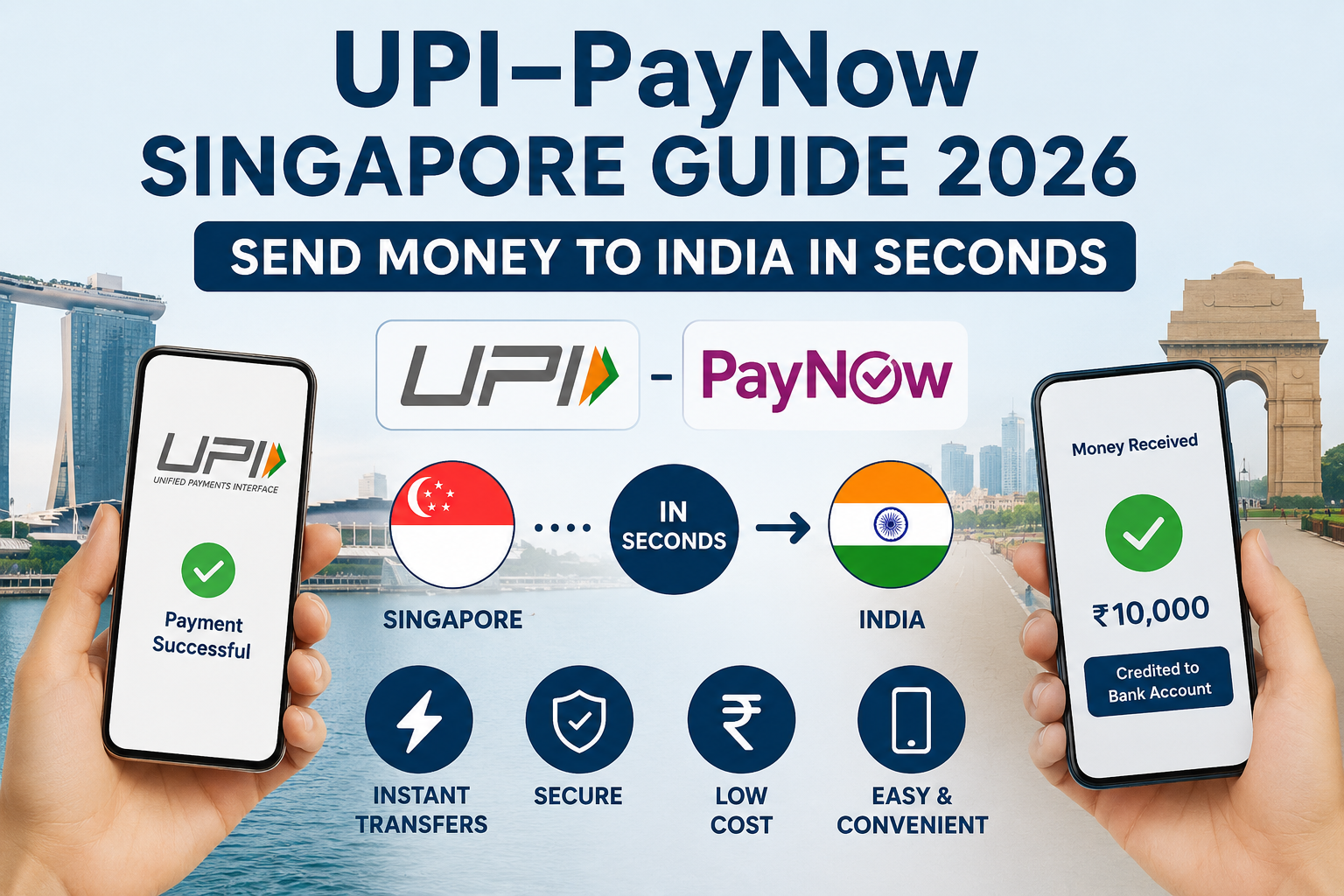
UPI–PayNow Singapore Guide 2026: Send Money to India in Seconds

Key Highlights
- UPI–PayNow connects Singapore’s PayNow with India’s UPI system.
- Eligible Singapore users can send money to an Indian UPI ID within seconds.
- The service is designed for smaller person-to-person remittances.
- The generally reported daily limit is S$1,000, subject to provider rules.
- Nineteen Indian banks can receive transfers through the expanded network.
- Fees and exchange rates should always be checked before confirming a payment.
Sending money from Singapore to India once required bank account numbers, IFSC codes and waiting for transfers to be processed.
UPI–PayNow has changed that experience.
The real-time payment link allows eligible users to send money between Singapore and India using simple identifiers such as a registered mobile number or UPI ID. Funds can reach the recipient’s bank account within seconds, making the service useful for families, students and workers making smaller transfers.
With the network now supporting more Indian banks, UPI–PayNow is becoming an important part of the financial connection between Singapore and India.
What Is UPI–PayNow?
UPI–PayNow is a cross-border payment connection between India’s Unified Payments Interface and Singapore’s PayNow system.
The service was launched in February 2023 through cooperation between the Reserve Bank of India, the Monetary Authority of Singapore and the payment-system operators in both countries.
The Reserve Bank of India describes the linkage as a way for users to make instant, low-cost, person-to-person payments across the two countries.
Instead of entering lengthy international banking details, users may send money through a supported provider using:
- An Indian UPI ID
- A registered Singapore mobile number
- A supported Virtual Payment Address
This makes the transfer experience feel closer to a domestic digital payment.
Who Can Use UPI–PayNow in Singapore?
On the Singapore side, the service is available through participating providers, including DBS/POSB and Liquid Group.
Customers should check their provider’s mobile application to confirm whether the India transfer option is available for their account.
On the Indian side, the network was expanded in July 2025 to support remittances into accounts held with 19 participating banks. These include:
- State Bank of India
- HDFC Bank
- ICICI Bank
- Axis Bank
- Bank of Baroda
- Bank of India
- Canara Bank
- Central Bank of India
- Federal Bank
- IDFC FIRST Bank
- Indian Bank
- Indian Overseas Bank
- IndusInd Bank
- Karur Vysya Bank
- Kotak Mahindra Bank
- Punjab National Bank
- South Indian Bank
- UCO Bank
- DBS Bank India
Recipients generally need a working UPI ID connected to an account at a participating bank.
The expanded network allows recipients to use supported UPI applications such as BHIM, Google Pay, PhonePe or their bank’s application. Economic Times
How to Send Money From Singapore to India
The exact menu may vary by provider, but the general process is straightforward.
Step 1: Open Your Banking or Payment App
Log in to your participating Singapore bank or payment application.
Step 2: Select India as the Destination
Look for the overseas transfer, PayNow international or UPI–PayNow option.
Step 3: Enter the Recipient’s UPI ID
Enter the UPI ID linked to the recipient’s participating Indian bank account.
Check the displayed name carefully. Do not continue if the name does not match your intended recipient.
Step 4: Enter the Transfer Amount
Enter the amount in Singapore dollars. The application should display the conversion rate and estimated amount the recipient will receive in Indian rupees.
Step 5: Review the Total Cost
Check:
- The SGD-to-INR exchange rate
- Any transfer fee
- The final rupee amount
- The recipient’s name
- The expected transfer time
Step 6: Confirm the Transfer
Authenticate the transaction using your provider’s security method. Successful transfers can normally be credited within seconds.
Save the transaction reference until the recipient confirms that the money has arrived.
What Is the UPI–PayNow Transfer Limit?
The commonly reported daily limit is S$1,000 for transfers from Singapore, with an equivalent limit of approximately ₹60,000 for transfers originating from India.
Banks and payment providers may apply their own transaction or customer-level restrictions. Limits can also change because of regulatory requirements.
Users should therefore confirm the current limit inside their provider’s application before sending money.
UPI–PayNow is best suited to small and frequent transfers rather than large payments such as property purchases, tuition fees or business invoices.
Are UPI–PayNow Transfers Free?
UPI–PayNow was created to make cross-border payments faster and more affordable, but users should not assume that every transfer is completely free.
The total cost can include:
- A visible transfer fee
- A foreign-exchange margin
- Differences between the displayed rate and the mid-market rate
A provider may advertise zero transfer fees while earning revenue through its exchange rate.
The best comparison is not simply the advertised fee. Check how many Indian rupees the recipient will actually receive after all charges.
For larger transfers, compare UPI–PayNow with bank remittance services and MAS-regulated money-transfer providers.
Why UPI–PayNow Matters to Singapore
Singapore is a major financial and technology hub with strong economic and personal connections to India.
Thousands of Indian professionals, workers and students live in Singapore, while many Singapore businesses work with Indian suppliers, technology companies and service providers.
UPI–PayNow offers several benefits:
- Faster transfers between family members
- Easier support for relatives in India
- Less dependence on traditional international bank transfers
- Greater transparency before payment
- Access through familiar mobile applications
- Transfers outside conventional banking hours
The linkage also demonstrates how two national instant-payment systems can connect without forcing users to depend on traditional card networks or slow correspondent-banking chains.
Can Indian Tourists Use UPI at Singapore Shops?
Cross-border remittances and merchant payments are related but separate services.
UPI is accepted at selected Singapore merchants through authorised payment partners. However, tourists should not assume that every PayNow or SGQR code automatically supports an Indian UPI application.
Look for a clearly displayed UPI acceptance sign or ask the merchant before scanning.
Indian visitors should continue carrying an international card or another backup payment method.
UPI–PayNow vs Traditional Bank Transfers
UPI–PayNow is generally more convenient for eligible small personal transfers because it can use a UPI ID instead of full bank details.
Traditional bank transfers may remain more suitable when:
- The amount exceeds the UPI–PayNow limit
- The payment is for business or investment purposes
- Formal banking documents are required
- The recipient’s bank is not supported
- A specific transfer purpose is not eligible
The right option depends on the amount, exchange rate, transfer purpose and urgency.
Important Scam-Prevention Tips
Fast payments also require greater caution because completed transactions can be difficult to reverse.
Before sending money:
- Verify the recipient’s UPI ID independently.
- Confirm the recipient’s displayed name.
- Never share an OTP, bank password or UPI PIN.
- Do not transfer money after an unsolicited call or message.
- Avoid “test transfers” requested by unknown individuals.
- Use only official banking and payment applications.
- Contact your provider immediately if you suspect fraud.
Singapore users can learn more about how PayNow works through the Association of Banks in Singapore.
Frequently Asked Questions
Can I send money from Singapore to India using only a UPI ID?
Yes, eligible customers of participating Singapore providers can send money to a supported Indian UPI ID.
How quickly does a UPI–PayNow transfer arrive?
Successful transactions can reach the recipient within seconds, although technical or compliance checks may occasionally cause delays.
What is the daily limit?
The generally reported limit is S$1,000 per day from Singapore, subject to the participating provider’s current rules.
Can I send money to any Indian bank?
The recipient’s bank must support the UPI–PayNow linkage. The expanded network currently covers 19 Indian banks.
Can businesses use UPI–PayNow?
The main linkage is designed for person-to-person remittances. Businesses should use payment services appropriate for commercial transfers.
Is UPI–PayNow better than other remittance services?
It can be faster and more convenient for smaller transfers. Compare the exchange rate, final rupee amount, transfer limit and fees before deciding.
Final Takeaway
UPI–PayNow is making smaller money transfers between Singapore and India faster and easier.
For Singapore residents supporting relatives, sending gifts or making eligible personal transfers, the ability to use a UPI ID can remove much of the complexity associated with traditional international payments.
The service is not ideal for every transaction. Its S$1,000 daily limit and participating-bank requirements make it most useful for smaller, frequent remittances.
As more financial institutions join, UPI–PayNow could become one of the most practical digital bridges between Singapore and India—and a model for faster cross-border payments across Asia.
Editorial Note: Banking partners, transaction limits, fees and exchange rates may change. Readers should verify current details with their financial institution before transferring money