






































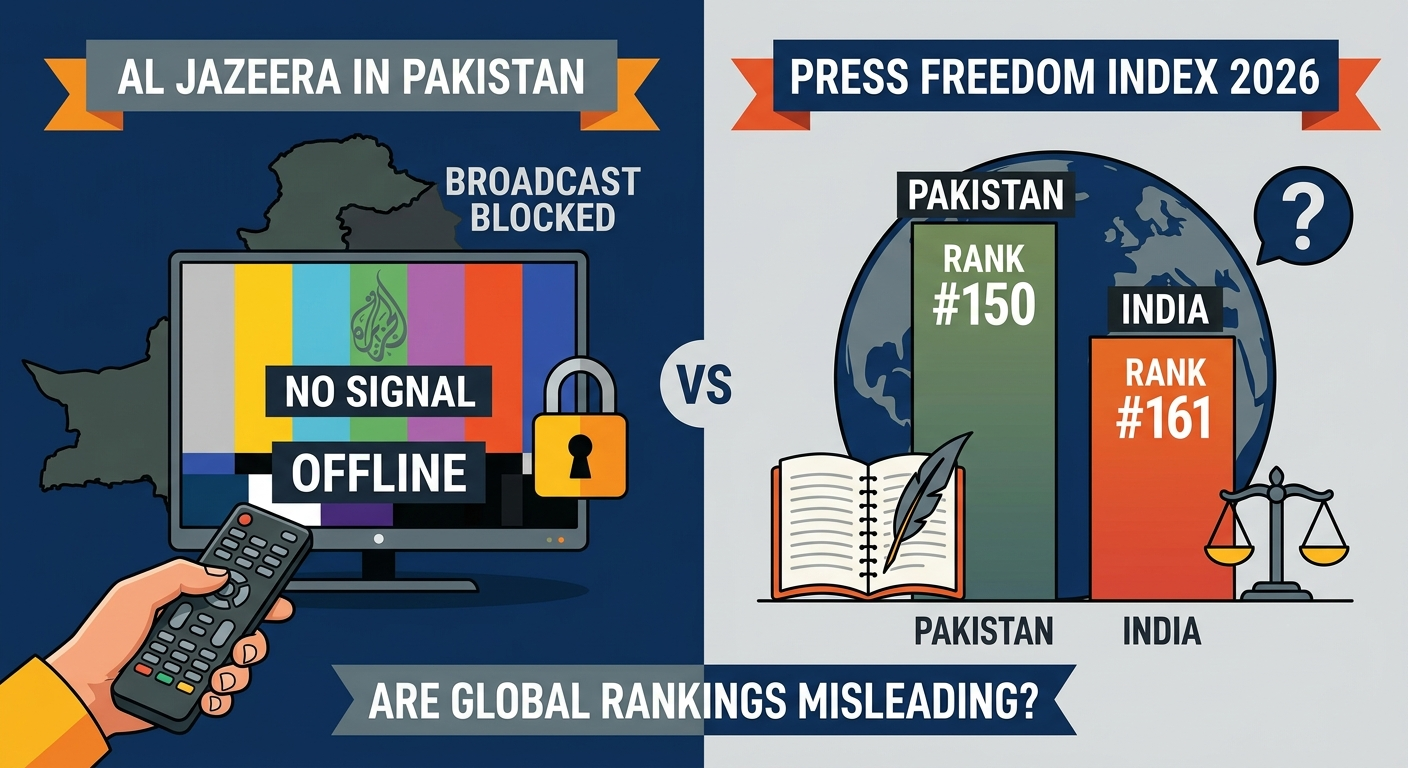
Al Jazeera Goes Dark in Pakistan—Yet Pakistan Ranks Above India in Press Freedom

West frequently lectures India about democracy and freedom of expression. Yet when Al Jazeera reported on protests and elections in Pakistan-administered Kashmir, its English-language website suddenly became inaccessible across Pakistan.
The timing was difficult to ignore.
Pakistan’s Information Ministry had accused the Qatar-based network of selective reporting and “yellow journalism.” Soon afterwards, users on multiple internet connections could no longer access its website. However, neither Pakistan’s telecom regulator nor Al Jazeera had officially confirmed a government-ordered ban when the disruption was first reported. Journalism Pakistan
That distinction matters—but so does the silence surrounding the incident.
Would the Reaction Be Different if This Happened in India?
If Al Jazeera suddenly became inaccessible in India after publishing critical political coverage, the story would likely attract immediate international attention. India would face headlines about censorship, authoritarianism and declining democracy.
Yet the Pakistan episode received comparatively limited global coverage. Al Jazeera itself had not published a separate report or public response about the disruption at the time of writing.
This apparent imbalance becomes even more striking when compared with the 2026 World Press Freedom Index.
Reporters Without Borders ranked:
- Pakistan: 153rd, score 32.61
- Palestine: 156th, score 32.09
- India: 157th, score 31.96
India was therefore placed below both Pakistan and Palestine—despite Pakistan’s documented military influence over media and Palestine being described by RSF itself as the world’s most dangerous territory for journalists. RSF Pakistan, RSF Palestine, RSF India
Why Rankings Can Create a Misleading Picture
The ranking does not rely only on verified censorship cases. RSF combines recorded abuses with questionnaires answered by journalists, academics, researchers and human-rights defenders. It then evaluates political, legal, economic, social and security conditions. RSF methodology
This approach contains valuable information, but qualitative assessments can also reflect respondent selection, perception and interpretation.
The score difference between Pakistan and India is only 0.65 points. India trails Palestine by merely 0.13 points. Converting such tiny differences into dramatic rankings can create the impression of a much larger gap than the underlying scores demonstrate.
Indians Should Question—Not Blindly Reject—Global Indexes
India should not dismiss every international criticism. Journalists must remain free to investigate governments, corporations and political parties without intimidation.
However, Indians should also stop treating every foreign ranking as unquestionable truth. Before accepting an index, readers should examine its methodology, contributors, data period, scoring assumptions and consistency across countries.
A ranking is an organization’s assessment—not a scientific certificate of democracy.
Pakistan’s apparent restriction of Al Jazeera shows exactly why global indexes must be scrutinized. When real-world events appear inconsistent with the rankings, credibility suffers.
India should learn from valid criticism, but it should never outsource its understanding of democracy to a numbered list created abroad.
Editorial Note: Reports confirmed that Al Jazeera’s website was inaccessible through multiple Pakistani networks, but no official government ban had been acknowledged at the time of publication.