

















































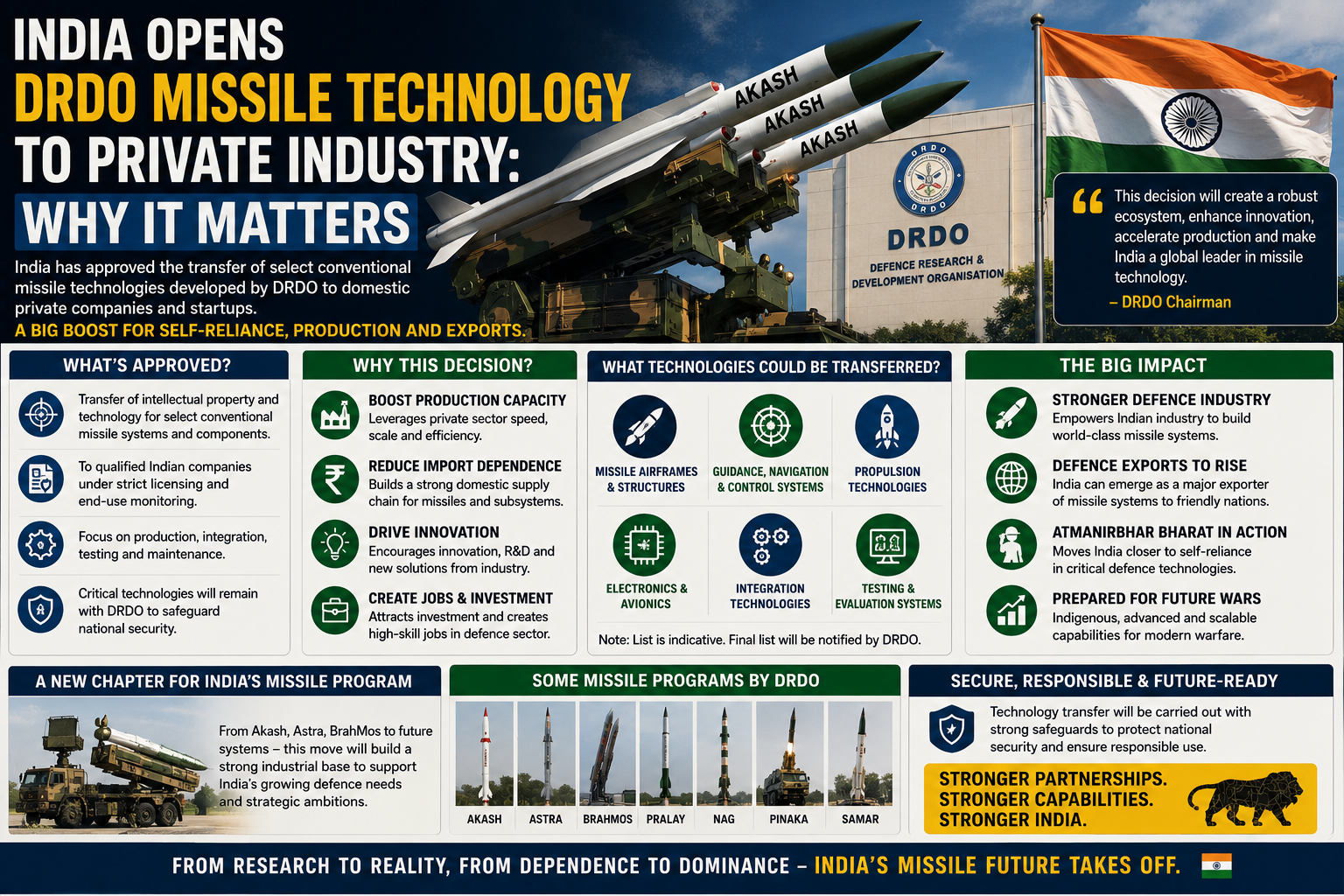
India Opens DRDO Missile Technology to Private Industry: Why It Matters

India Opens DRDO Missile Technology to Private Industry: A Game-Changer for Defence?
India has taken a major step towards building a stronger domestic defence industry.
Defence Minister Rajnath Singh has approved the transfer of technologies developed by the Defence Research and Development Organisation for all conventional missile systems to qualified Indian defence companies.
The decision could allow domestic manufacturers—including eligible private companies—to move beyond supplying individual components and participate more deeply in missile production.
It does not mean sensitive missile information will be handed to every company. Firms must meet the required technical qualifications, certifications and regulatory conditions.
Nevertheless, the policy could reshape how quickly India converts DRDO-designed weapons into systems manufactured at scale.
What Has the Government Approved?
According to the Ministry of Defence announcement, Indian industries will be allowed to obtain DRDO-developed technologies for conventional missile systems and manufacture them domestically.
The government expects the initiative to:
- Accelerate the transition from development to production
- Expand India’s missile-manufacturing capacity
- Reduce dependence on imported defence equipment
- Increase domestic value addition
- Create opportunities for MSMEs and specialised suppliers
- Strengthen the country’s defence-industrial base
The approval covers conventional missile systems, not India’s strategic nuclear-weapons programme.
However, the Ministry has not released a public list identifying every missile covered by the decision.
Systems such as Akash, Astra, Nag and Pralay have been mentioned in media discussions, but their individual inclusion and technology-transfer conditions should not be considered officially confirmed until specific agreements are announced.
Why Is This Decision Important?
DRDO develops advanced defence technologies, but a research organisation cannot independently manufacture every weapon in the quantities required by the Armed Forces.
Large-scale production requires factories, specialised machinery, trained workers, quality-control systems and extensive supplier networks.
Until now, public-sector companies such as Bharat Dynamics and Bharat Electronics have played leading roles in producing several Indian missile systems. Private companies have also supplied launchers, propulsion components, explosives, electronics and other subsystems.
The new policy could widen the number of qualified production partners.
This matters because developing a successful missile is only half the challenge. India must also be able to produce, maintain and replenish those missiles rapidly.
Could Private Companies Manufacture Complete Missiles?
Potentially—but not automatically.
A technology transfer normally provides an approved manufacturer with the technical knowledge and production documentation required to manufacture a system or its specified components.
Before receiving missile technology, a company would still need to demonstrate:
- Secure manufacturing facilities
- Advanced engineering capabilities
- Financial and production capacity
- Compliance with defence-security regulations
- Reliable quality-control procedures
- Successful testing and certification
- Protection of sensitive technical information
The Armed Forces would also continue to place orders through authorised procurement processes. Therefore, the announcement does not guarantee immediate contracts for every defence company.
It creates an opportunity for qualified manufacturers—not unrestricted access to classified technology.
How It Can Improve India’s War Preparedness
Recent global conflicts have shown that modern warfare consumes precision weapons, air-defence missiles and guided munitions at an extraordinary rate.
A country may possess highly capable systems but still face difficulties if its factories cannot replace missiles quickly during a prolonged confrontation.
Expanding production across multiple domestic facilities could help India:
- Build larger ammunition and missile reserves
- Replace weapons consumed during operations
- Reduce delays caused by foreign suppliers
- Maintain production during international sanctions or disruptions
- Introduce upgrades more quickly
- Repair and support systems throughout their service life
Multiple qualified production partners can also reduce dependence on a single factory.
However, greater participation will only improve readiness if companies can maintain strict standards. A missile’s reliability, guidance accuracy and safety cannot be compromised to increase production speed.
A Major Opportunity for Indian MSMEs
A missile system depends on far more than its warhead and propulsion unit. It requires electronics, sensors, composite materials, cables, batteries, navigation equipment, specialised alloys, launch mechanisms and testing systems.
Large private manufacturers may assemble complete systems, while hundreds of smaller companies could supply critical components.
This could create a wider defence-manufacturing ecosystem involving:
- Precision-engineering companies
- Electronics and semiconductor firms
- Advanced-material manufacturers
- Artificial-intelligence and software companies
- Drone and sensor developers
- Testing and certification providers
The policy may therefore create opportunities far beyond India’s largest defence corporations.
Can It Boost Indian Defence Exports?
Missile technology transfer could also support India’s ambition to become a major defence exporter.
Government data shows that Indian defence exports reached a record ₹38,424 crore in FY2025–26, compared with ₹686 crore in FY2013–14. The government aims to increase exports to ₹50,000 crore by 2029, according to a recent PIB defence-sector factsheet.
Greater production capacity could help India deliver systems to partner countries without affecting supplies for its own Armed Forces.
Exports would still require government approval and compliance with international obligations. Not every missile or technology transferred for domestic production would necessarily be cleared for foreign sale.
What Are the Risks?
Allowing more companies into missile production also creates challenges.
The government must prevent the theft, leakage or unauthorised transfer of sensitive technology. Companies will need strong cybersecurity, employee-vetting and physical-security systems.
India must also avoid creating excess production capacity without sufficient orders. Missile factories require long-term procurement plans to remain commercially viable.
Another concern is quality. Competition can lower costs and improve innovation, but the government must ensure that every manufacturer follows identical safety and performance standards.
Is India Privatising DRDO?
No.
DRDO will continue researching and developing defence technologies. The Armed Forces will continue defining operational requirements, conducting trials and approving systems.
The policy changes how successfully developed technologies can move into industrial production.
A practical division of responsibility could allow DRDO scientists to concentrate on future technologies while Indian companies handle manufacturing, upgrades and lifecycle support.
Conclusion
India’s decision to transfer DRDO-developed conventional missile technologies to qualified domestic companies could become one of the country’s most important defence-manufacturing reforms.
Its success will not be measured by the announcement alone. The real test will be whether India can create multiple secure production lines, maintain strict quality standards, deliver weapons on schedule and increase exports without compromising national security.
If implemented carefully, the policy could help India move from being primarily a developer and buyer of missiles to becoming a large-scale manufacturer with a resilient domestic supply chain.
In modern warfare, possessing advanced missile designs is important. Having the industrial capacity to manufacture them rapidly and reliably may be even more decisive.
Quick FAQs
Has India transferred all missile secrets to private companies?
No. Only qualified Indian companies meeting applicable security, certification and regulatory requirements will be eligible for technology transfers.
Does the decision include nuclear missiles?
The government announcement specifically covers conventional missile systems. It does not state that strategic nuclear-missile technologies are included.
Which DRDO missiles are covered?
The Ministry of Defence has not released a complete system-by-system list. Specific missiles should be considered included only after formal technology-transfer agreements are announced.
Will companies immediately begin manufacturing missiles?
Not necessarily. Companies must qualify, obtain technology, establish production facilities and receive orders before manufacturing can begin.
How can the decision help the Indian Armed Forces?
It could expand production capacity, shorten delivery timelines, strengthen reserves and reduce dependence on foreign supply chains.
Disclaimer: This article is based on the Ministry of Defence announcement and publicly available information as of August 26, 2026. The government has not published a complete list of missile systems or companies covered by future technology-transfer agreements. References to possible systems and industry benefits are analytical and should not be treated as confirmation of specific contracts. This content is intended solely for news, education and public-interest discussion.