

















































Nepal Flash Flood 2026: What Caused the Disaster and How India Is Helping
A catastrophic flash flood has devastated communities along Nepal’s border with Tibet, sweeping away homes, roads, bridges, vehicles and hydropower facilities.
The disaster struck the Bhote Koshi–Trishuli river system on August 26 with extraordinary speed. Nepal’s Ministry of Foreign Affairs said that 359 bodies had been recovered by 8:00 p.m. Nepal time on August 27, while hundreds of residents, workers, tourists and pilgrims remained missing.
Among those affected are Indian nationals travelling through Nepal and Tibet on the Kailash Mansarovar pilgrimage route.
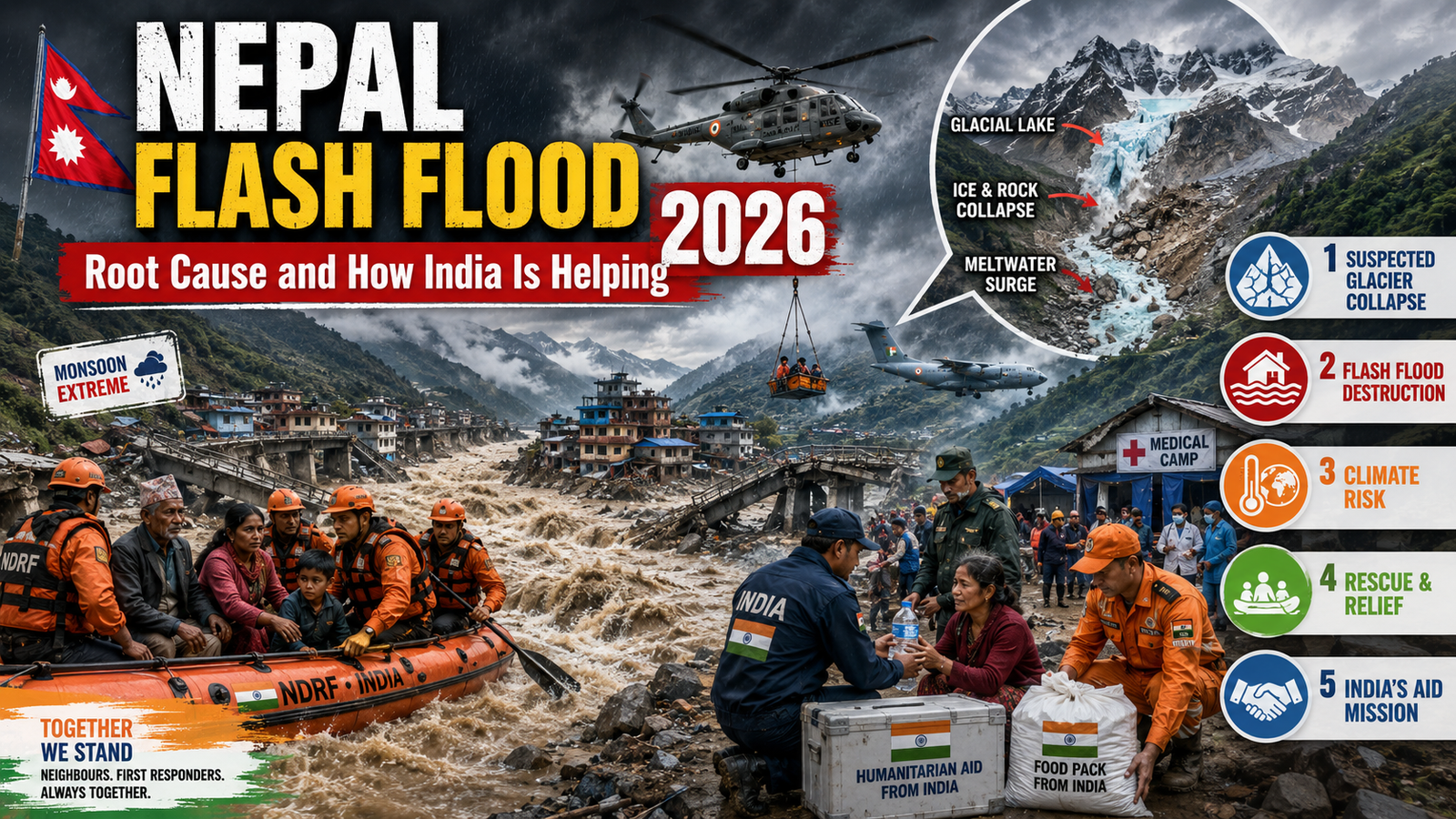
This was not an ordinary river flood caused only by monsoon rain. Satellite evidence indicates that a massive section of a high-altitude glacier collapsed, producing an ice-and-rock avalanche that transformed into a fast-moving wall of water, boulders and sediment.
Nepal Flood: What Happened?
The disaster began close to the Nepal–Tibet border near the Langtang Lirung mountain region.
Satellite images examined by scientists indicate that the lower section of a glacier broke away at an elevation of approximately 5,200 metres. The collapsing mass fell more than one kilometre into the valley below.
It then travelled through the Lhende Khola and entered the Bhote Koshi–Trishuli river system.
The avalanche did not carry only ice. As it accelerated down the steep Himalayan terrain, it collected:
- Rock and loose soil
- Glacial sediment
- Snow and meltwater
- Trees and construction debris
- River water and large boulders
The result was a destructive debris flow far heavier than normal floodwater.
According to a Reuters satellite analysis, the debris may have travelled at around 50 metres per second in its upper reaches, leaving people with almost no time to escape.
The flood altered river channels more than 100 kilometres downstream.
The Root Cause: A Chain of Himalayan Hazards
The disaster appears to have resulted from several connected processes rather than one simple cause.
1. A Glacier and Mountainside Collapsed
Before-and-after satellite images show that a large section of the glacier near Langtang Lirung disappeared between August 24 and August 26.
Scientists believe rock beneath or beside the glacier may have failed, carrying ice and debris down the mountain.
This type of event is known as an ice-rock avalanche. It can release enormous energy when material falls through a great vertical distance.
2. The Avalanche Entered a Narrow River Valley
When the avalanche reached the valley, it displaced water and mixed with sediment.
The steep, narrow Himalayan channel concentrated the flow instead of allowing it to spread gradually. This produced a fast-moving surge capable of destroying buildings, bridges and roads.
The International Centre for Integrated Mountain Development reported that the Trishuli River rose by as much as nine metres within 30 minutes at Galchhi. At Malekhu, the reported rise was approximately seven metres.
These measurements show why the disaster overwhelmed communities so quickly.
3. Debris May Have Temporarily Blocked the River
Scientists are investigating whether rock and ice created a temporary natural dam at a narrow point in the valley.
When landslides block a river, water accumulates behind the debris. If the unstable blockage breaks, the stored water can be released suddenly, creating a second and even more destructive flood wave.
ICIMOD said a blockage remained upstream after the initial disaster, creating a continuing risk. Nepal and China have also warned about newly formed lakes that could produce additional flooding.
4. Settlements and Infrastructure Were in the Flood Corridor
Roads, border facilities, villages and hydropower projects are concentrated along Nepal’s river valleys because flat land is extremely limited in mountainous regions.
Unfortunately, these locations are directly exposed to flash floods, avalanches and landslides.
Hundreds of buildings were reportedly located inside the path of the debris flow. Damage to roads, bridges, electricity facilities and monitoring stations has also made rescue operations more difficult.
Was an Earthquake Responsible?
Initial reports suggested that a magnitude-4.4 earthquake might have triggered the glacier collapse.
However, the US Geological Survey later concluded that the detected seismic signal was probably generated by the enormous mass of rock and ice striking the valley—not necessarily by an earthquake occurring first.
Therefore, the most likely explanation is that the collapse created the seismic signal.
Investigations are continuing, and the final scientific assessment may take time.
Was It a Glacial Lake Outburst Flood?
Some reports have described the event as a glacial lake outburst flood, or GLOF. That description has not yet been conclusively established.
A traditional GLOF occurs when a lake held behind ice or glacial debris suddenly releases its water.
The current evidence instead points more strongly towards an ice-rock avalanche entering a river and generating a cascading debris flood. A temporary blockage may have increased its power, but scientists have not yet confirmed every stage of the event.
Did Climate Change Play a Role?
Climate change cannot yet be identified as the sole or direct cause of this individual collapse. However, warming is increasing the underlying instability of the Himalayan region.
Higher temperatures can:
- Accelerate glacier melting
- Remove ice that supports steep rock faces
- Thaw frozen ground and weaken mountainsides
- Increase meltwater inside cracks
- Change snowfall and freeze-thaw cycles
- Expand unstable glacial lakes
Satellite experts also observed substantial snow loss in the area shortly before the disaster, suggesting unusually warm conditions may have contributed to instability.
Reuters reported that Nepal’s mountains lost close to one-third of their ice over approximately three decades. Glacier melting reportedly accelerated sharply during the most recent decade.
Scientists are clear about one distinction: climate change is creating conditions that can make these disasters more likely, but a detailed investigation is still required before attributing this specific collapse directly to global warming.
Why the Death Toll Is So High
Several factors made the disaster exceptionally deadly:
- The flood arrived with little warning
- Debris moved at extremely high speed
- The valley contained settlements and infrastructure
- The area was busy with tourists and pilgrims
- Roads and bridges were immediately destroyed
- Communication networks were disrupted
- Mud and boulders made rescue access difficult
The affected border crossing is an important route for travellers heading towards Kailash Mansarovar. This explains why citizens from dozens of countries were present in the region.
Official counts remain difficult to reconcile. Nepal’s government and foreign governments are using different lists, reporting times and verification methods.
India’s Ministry of External Affairs said on August 27 that 288 Indian nationals remained uncontactable, including 73 workers associated with the Trishuli-1 hydropower project. Being “uncontactable” does not automatically mean a person has died or is physically missing, because telecommunications have been severely disrupted.
How Is India Assisting Nepal?
India began sending emergency assistance within hours of the disaster.
The first Indian aircraft delivered approximately 10 tonnes of Humanitarian Assistance and Disaster Relief supplies. A second flight carried another 37.5 tonnes.
According to India’s Ministry of External Affairs briefing, India has delivered a total of 47.5 tonnes of emergency assistance through the two flights.
The supplies include:
- Essential medicines
- Food packets
- Temporary shelters
- Blankets
- Hygiene kits
- Solar lamps
- Emergency relief materials
The shipments reportedly contain approximately eight tonnes of medicines and one tonne of food items.
Indian officials are maintaining continuous contact with Nepalese authorities to determine what additional assistance is required.
India Is Also Trying to Locate and Evacuate Its Citizens
India’s External Affairs Ministry, the Indian Embassy in Kathmandu, state governments, tour operators and project authorities are working together to identify affected Indians.
The government is also coordinating with China regarding approximately 200 Indians reportedly stranded on the Tibetan side of the border.
A special control room has been established to:
- Receive information from families
- Verify lists of missing travellers
- Coordinate with tour operators
- Track Indian workers and pilgrims
- Support evacuation when routes become available
- Communicate with Nepalese and Chinese authorities
State governments, including Tamil Nadu, West Bengal, Karnataka and Kerala, are separately collecting information about residents who travelled to Nepal.
Could the Flood Affect India?
The original flood wave travelled through Nepal’s river network towards areas closer to the Indian border. Indian authorities placed parts of Bihar and Uttar Pradesh on alert and positioned disaster-response resources as a precaution.
As of August 27, the National Disaster Response Force had reported no major adverse impact from this particular flood in Indian border areas. Monitoring remains necessary because additional landslide-dammed lakes or heavy rainfall could create fresh downstream surges.
What Nepal and India Must Do Next
The immediate priority is saving lives. The longer-term challenge is preventing another disaster of this scale.
Nepal, India and China need stronger cooperation in:
- Satellite monitoring of glaciers and unstable slopes
- Cross-border river-data sharing
- Real-time avalanche and flood alerts
- Community warning systems
- Mapping of high-risk infrastructure
- Climate-resilient roads and hydropower projects
- Evacuation planning for tourists and pilgrims
Water and debris do not recognise national borders. A glacier collapse in one country can threaten communities across an entire river basin.
Conclusion
Nepal’s 2026 flash flood was most likely triggered by a massive glacier and rock collapse near the Tibetan border. The avalanche entered a steep river valley, collected sediment and boulders, and produced a devastating debris flood that left communities almost no time to escape.
Climate change may have contributed to the unstable conditions, but scientists have not yet established it as the direct cause of this specific collapse.
India’s rapid delivery of 47.5 tonnes of relief supplies, combined with its efforts to locate Indian citizens and coordinate with Nepal, demonstrates the importance of regional cooperation during Himalayan disasters.
The tragedy is also a warning. As glaciers retreat and mountain slopes become less stable, India, Nepal and China will need to share information before disasters occur—not only coordinate after lives have already been lost.
Quick FAQs
What caused the Nepal flash flood?
Preliminary satellite analysis indicates that a large section of a glacier collapsed and created an ice-rock avalanche. The avalanche entered the river system and generated a powerful debris flood.
Was the flood caused by an earthquake?
Current evidence suggests the recorded seismic signal was produced by the glacier and rock collapse. An earthquake has not been confirmed as the initial trigger.
How many people have died?
Nepal’s Ministry of Foreign Affairs reported that 359 bodies had been recovered as of 8:00 p.m. Nepal time on August 27. The toll may change as search operations continue.
How many Indians are affected?
India’s Ministry of External Affairs said 288 Indian nationals remained uncontactable as of August 27. Communication failures mean this figure should not automatically be interpreted as confirmed deaths or disappearances.
How much relief has India sent?
India has sent 47.5 tonnes of emergency supplies through two flights, including medicines, food, shelters, blankets, hygiene materials and lighting equipment.
Disclaimer: This article is based on official Nepalese and Indian government updates, scientific assessments and credible reporting available on August 27, 2026. Casualty, missing-person and rescue figures are changing rapidly and may differ between agencies because of disrupted communications and verification delays. The precise cause of the glacier collapse remains under scientific investigation. This article is intended for news, education and public-safety awareness only.