








































FARA for America, FCRA for India: Why Washington’s Objections Look Like a Double Standard

America considers foreign influence serious enough to regulate through an 88-year-old law. Yet when India strengthens oversight of overseas money entering its civil society, voices in Washington describe the move as dangerous and oppressive.
That contradiction raises an unavoidable question: Why should the United States be allowed to protect its democracy from foreign influence while India is expected to remain open to it?
America Has Its Own Foreign-Influence Firewall
The United States enacted the Foreign Agents Registration Act (FARA) in 1938. It requires certain people and organizations working on behalf of foreign principals in political or influence-related activities to disclose their relationships, funding, activities and expenditure.
The US also prohibits foreign nationals from financing or participating in decision-making connected with federal, state and local elections. The Federal Election Commission explicitly describes preventing foreign electoral influence as an important legal objective.
In other words, America accepts a basic principle: foreign money can influence domestic opinion, political decisions and national policy.
India’s Foreign Contribution (Regulation) Act, or FCRA, is based on the same national-security concern, although it is substantially more restrictive than FARA. It regulates how NGOs, associations and religious organizations receive and use foreign contributions.
What Does the 2026 FCRA Amendment Propose?
The Foreign Contribution (Regulation) Amendment Bill, 2026, introduced in the Lok Sabha on March 25, remains pending in Parliament.
It proposes a Designated Authority to supervise foreign contributions and assets created from them when an organization’s FCRA registration is cancelled, surrendered or not renewed.
According to the government, only foreign-funded assets would come under this framework. Vesting would initially be provisional, assets would be restored if registration returned, and the religious character of places of worship would have to be preserved. The government’s FCRA factsheet says the objective is to close an administrative gap—not confiscate every asset belonging to an NGO.
Critics nevertheless argue that the provisions are too broad and could punish organizations for technical or regulatory failures. PRS Legislative Research has also identified due-process and appeal-related concerns that Parliament should examine carefully.
Did the Entire US Congress Oppose the Amendment?
No. Claims that the entire US House formally opposed the FCRA amendment are exaggerated.
However, objections have emerged from both sides of Capitol Hill. Republican Congressman Chris Smith urged Secretary of State Marco Rubio to press India to withdraw the amendments. Senator James Risch also described the proposed expansion as deeply concerning, while Democratic congressional sources reportedly raised similar objections.
Smith’s argument focused particularly on American-linked Christian charities and ministries. He warned that churches, hospitals and schools could lose control over assets if their registrations ended. His published statement demonstrates that protecting foreign-supported Christian institutions is central to his opposition.
This is where India is entitled to ask difficult questions.
Charity Must Not Become a Cover for Influence
Foreign-supported organizations have performed valuable work in healthcare, education, disaster relief and poverty reduction. They should not be treated as suspicious merely because they receive international donations.
But charitable work does not place an organization above Indian law.
India has repeatedly investigated whether some foreign contributions were diverted from declared purposes. In 2015, the Home Ministry reported adverse findings and regulatory action involving Greenpeace India and several Tamil Nadu-based organizations. The cases concerned alleged FCRA violations and activities affecting national or economic interests. The official parliamentary response documented the investigations.
A leaked 2014 Intelligence Bureau report also alleged that foreign-funded campaigns targeted nuclear power, coal, mining and major industrial projects. The report’s conclusions—including its estimate of economic damage—were contested by NGOs and were not equivalent to judicial findings.
That distinction matters. Peaceful environmental protest is a democratic right. But if an overseas donor secretly finances campaigns to shape India’s energy, infrastructure or religious landscape, transparency becomes a legitimate national concern.
Similarly, religious freedom protects voluntary belief, worship and charitable service. It does not create an unrestricted right for overseas organizations to finance coercive, deceptive or inducement-based conversion—if such conduct is established through evidence and lawful proceedings.
Why Washington’s Position Appears Hypocritical
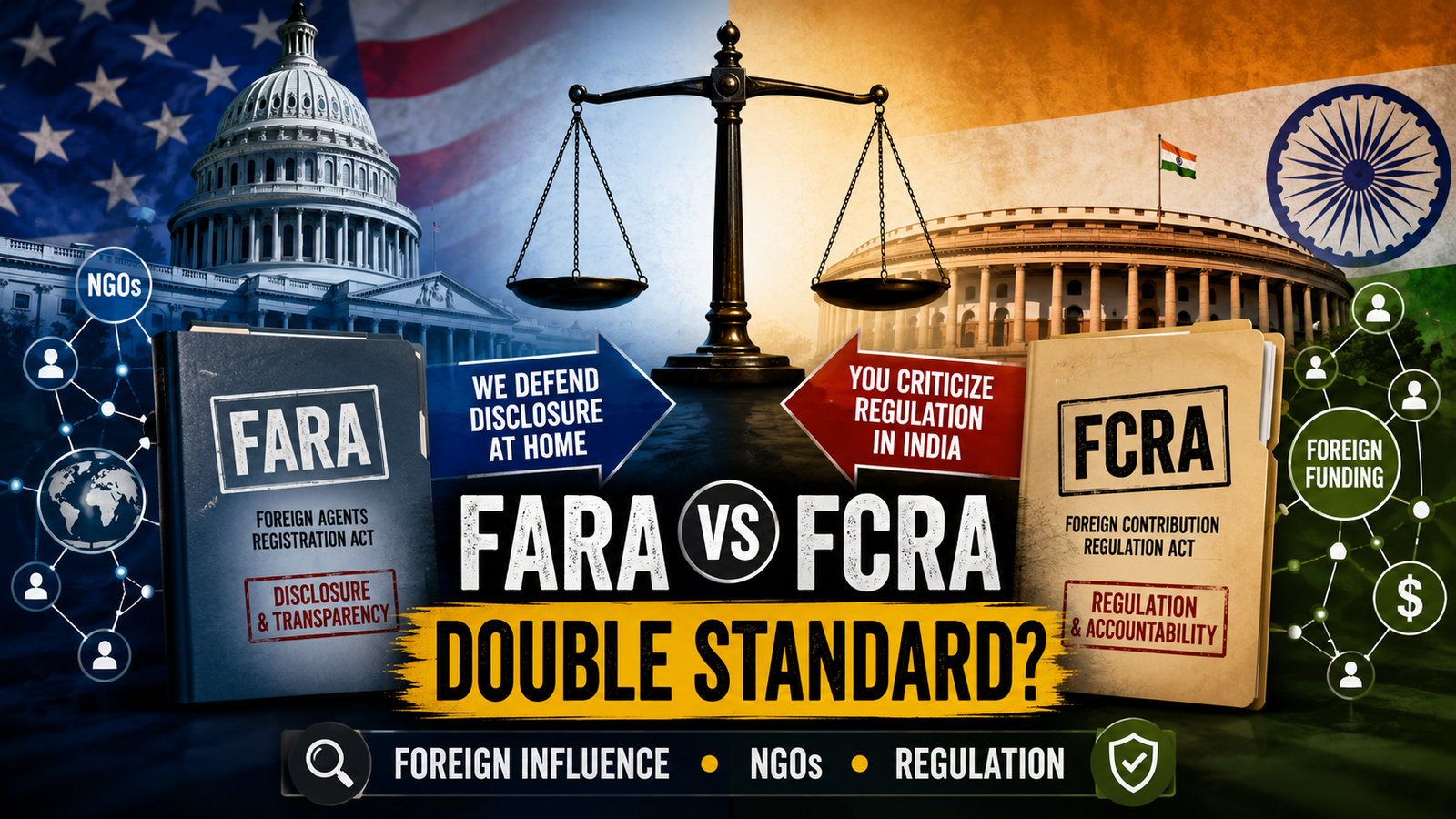
The double standard is not that FARA and FCRA are identical—they are not. FARA primarily emphasizes disclosure, while FCRA directly regulates access to foreign contributions.
The contradiction lies in the underlying principle.
America insists on knowing when foreign interests attempt to influence American politics. It bans foreign election money and can investigate undisclosed foreign agents. Yet some American political voices object when India demands stronger accountability from organizations receiving millions from overseas donors.
If foreign influence is dangerous in Washington, it cannot automatically become harmless in Delhi.
Concern for religious freedom should also not become a diplomatic shield protecting every foreign-funded organization from financial scrutiny. India has the sovereign right to decide how external money may be used within its borders.
India Must Combine Security With Due Process
Defending FCRA does not mean defending unlimited executive power. India should ensure:
- Clear reasons for cancellation or non-renewal
- Proportionate penalties for technical violations
- Independent and timely appeals
- Protection for legitimately domestic assets
- Equal enforcement across all religions and ideologies
- Public disclosure of major foreign donors and beneficiaries
These safeguards would protect genuine charities while making politically motivated foreign funding harder to hide.
Final Verdict: One Standard for Every Democracy
The United States is justified in protecting itself against foreign interference. India possesses exactly the same right.
Washington may raise legitimate concerns about due process, religious freedom and proportionality. But demanding that India weaken its foreign-funding controls—especially while America enforces FARA and prohibits foreign election financing—looks less like principled advocacy and more like selective sovereignty.
Foreign-funded NGOs should be free to serve India, but they should never become unaccountable instruments for political pressure, unlawful religious activity or campaigns directed by interests outside the country.
India does not need to close itself to international cooperation. It simply needs to ensure that foreign generosity does not become foreign control.
Frequently Asked Questions
Are FARA and FCRA the same?
No. FARA requires disclosure by certain agents of foreign principals in the US. India’s FCRA more directly controls the receipt and use of foreign contributions.
Has the FCRA Amendment Bill 2026 become law?
No. As of August 1, 2026, the Bill remains pending in Parliament, although separate amended FCRA Rules notified on June 22 are already in force.
Does FCRA ban all foreign-funded NGOs?
No. Eligible organizations may receive foreign contributions after registration or prior permission, subject to reporting and utilization requirements.
Are all foreign-funded religious charities involved in conversion?
No. Many provide genuine education, healthcare and humanitarian services. Allegations against any organization must be supported by evidence and examined through due process.
Editorial Note: This opinion article distinguishes documented government actions from contested allegations. It does not claim that all NGOs, Christian organizations or foreign donors engage in unlawful activities.