











































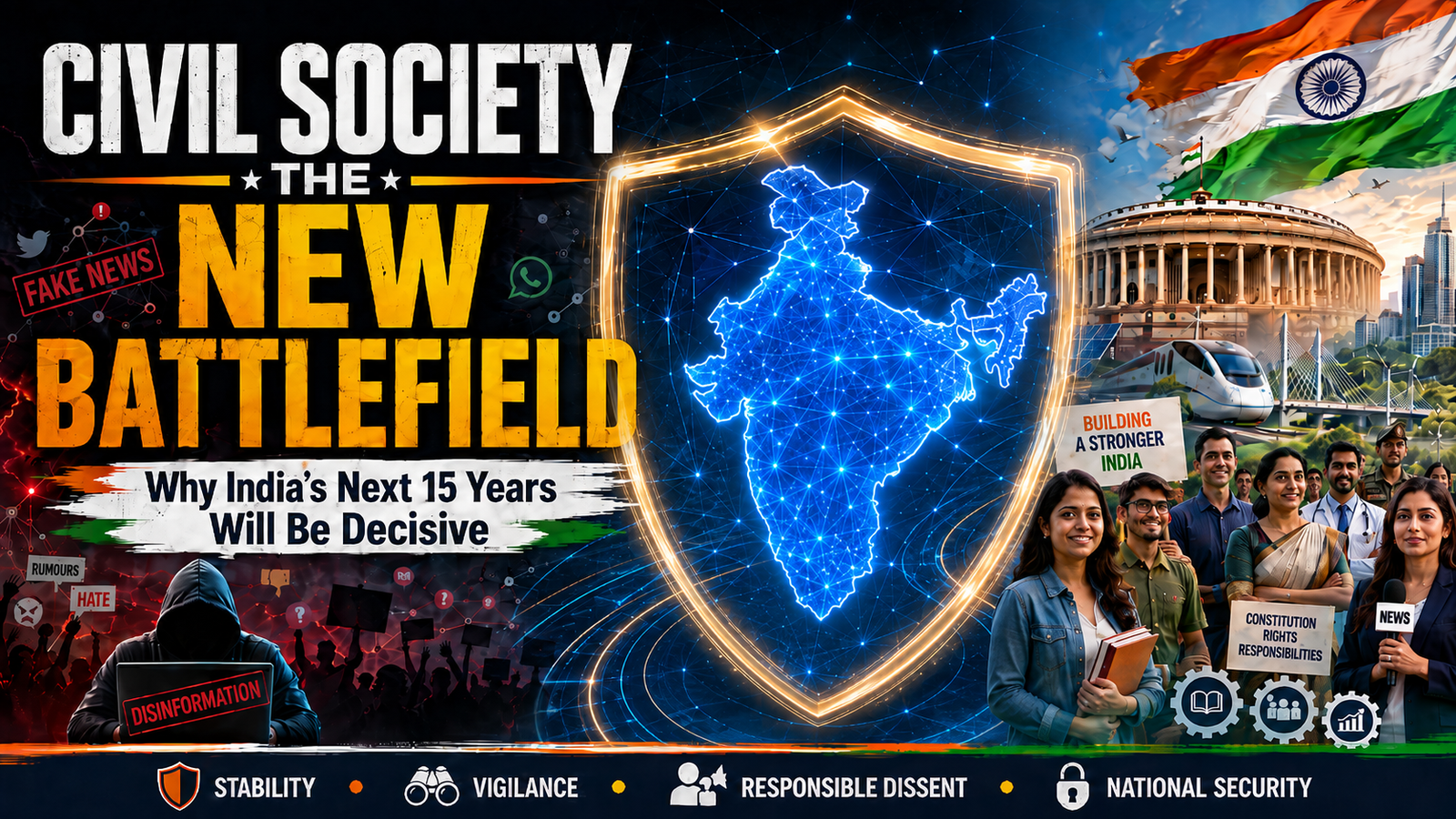
Civil Society Is the New Battlefield: Why India’s Next 15 Years Will Be Decisive

India’s National Security Advisor Ajit Doval has issued a warning that deserves serious attention: modern wars are no longer fought only with soldiers, tanks and missiles. Societies themselves can become the battlefield.
In 2021, Doval described civil society as a frontier of “fourth-generation warfare,” warning that it could be “subverted, divided and manipulated” to damage national interests. His argument was not that civil society is India’s enemy, but that public anger, social divisions and democratic institutions can be exploited by hostile actors. NDTV reported his complete remarks.
Why India’s Rise Creates Resistance
India is emerging as a major economic, technological and military power. It is strengthening domestic manufacturing, digital infrastructure, defence production and global diplomatic influence.
Not every country, corporation or ideological interest will necessarily welcome this transformation. A stronger India can disrupt established supply chains, geopolitical alliances and global power structures.
After receiving the Lokmanya Tilak National Award in August 2026, Doval called the present period a rare “window of opportunity” that India cannot afford to lose. He urged young Indians to place national development above narrow personal interests. Hindustan Times
The CJP Protests Offer an Important Lesson
The rapid rise of the Cockroach Janta Party—or CJP—demonstrated how social media can transform genuine student grievances into a nationwide political movement within weeks.
Concerns over examination failures deserved investigation, and peaceful protest remains a constitutional right. However, the speed of online mobilization also showed how emotionally charged videos, unverified claims and political narratives can rapidly influence millions.
Some political figures alleged foreign involvement in the protests, but this has not been established publicly. The Ministry of External Affairs said it had no information to share on those allegations, according to its official media briefing. Therefore, CJP should be viewed as an example of modern digital mobilization—not proof of a foreign conspiracy.
Why Stable Government Matters
Doval argued in 2018 that India required a strong, stable and decisive government to achieve its strategic objectives. Long-term projects involving infrastructure, defence, energy and manufacturing require policy continuity that unstable coalitions may struggle to provide.
Stability, however, must coexist with accountability. A strong democracy listens to legitimate grievances, protects peaceful dissent and investigates covert foreign influence using evidence.
India’s next 10–15 years may determine whether it becomes a developed global power or loses its present momentum. The country must remain united—but never unquestioning; vigilant—but never paranoid.
Editorial Note: This opinion article does not characterize peaceful protesters or civil-society organizations as anti-national. Allegations of foreign involvement require verifiable evidence and due process.