






































Why India Urgently Needs a Digital Firewall Against Foreign Influence

India’s next major security challenge may not arrive at the border. It could appear on millions of smartphone screens.
A fabricated video, divisive hashtag or false report can spread nationally within hours. Thousands of coordinated accounts can make a fringe opinion appear popular, provoke social tension and weaken public trust.
This is modern information warfare—and India urgently needs stronger digital defences.
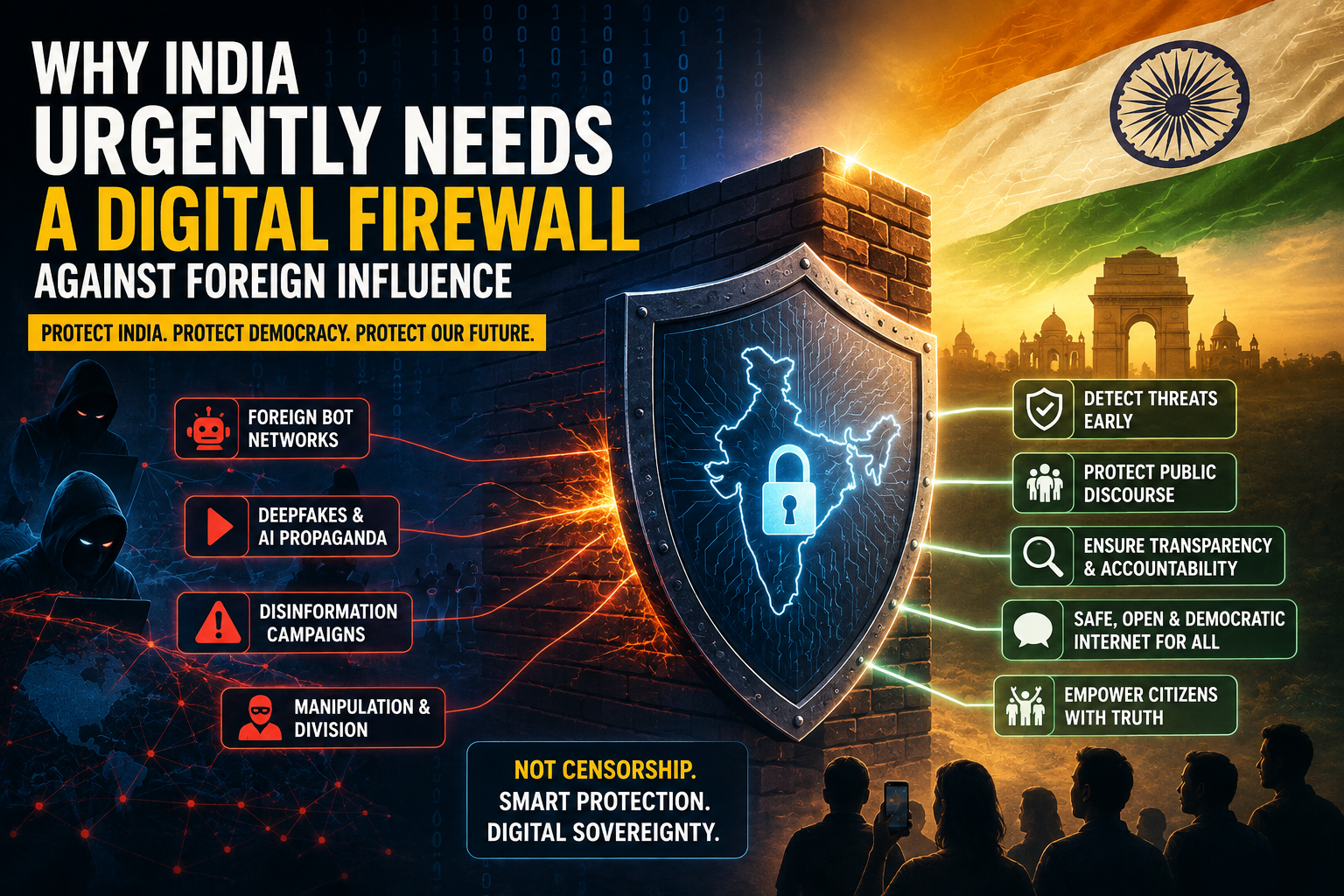
However, the answer should not be a copy of China’s Great Firewall. India needs a democratic digital firewall: one that identifies foreign manipulation, bots and deepfakes while protecting legitimate debate and constitutional freedoms.
Social Media Has Become a Modern Battlefield
Information warfare does not require tanks or missiles. Its objective is to influence how citizens think, divide communities and reduce confidence in national institutions.
A coordinated network can:
- Spread fabricated stories about elections or security incidents
- Amplify religious, regional and linguistic divisions
- Circulate manipulated videos during a crisis
- Impersonate Indian citizens, journalists or officials
- Attack Indian companies and development projects
- Create artificial anger through bots and fake engagement
These campaigns can originate from governments, intelligence-linked organisations, extremist groups, political consultancies or commercial bot farms.
India should avoid making unsupported accusations against entire countries or their citizens. Attribution must be based on technical evidence. But documented cases prove that the threat is real.
Meta previously removed a network originating in Pakistan that used fake accounts and pages to discuss Indian political and military issues. Meta said the activity was linked to employees of Pakistan’s Inter-Services Public Relations. Meta investigation
OpenAI has also disrupted China-origin influence networks and an Israel-based campaign that began targeting Indian audiences. These operations used AI to produce articles, comments and fake engagement. OpenAI threat report
Foreign manipulation is therefore not limited to one country or political ideology.
Why Indian Youth Are Particularly Vulnerable
Young Indians increasingly receive news through reels, short videos, influencers and messaging groups rather than newspapers or official sources.
Algorithms reward emotional content because anger, fear and outrage generate engagement. A misleading video often travels faster than the correction published hours later.
Generative AI makes this problem more dangerous. Foreign operators can now create convincing content in Hindi, Bengali, Tamil, Punjabi and other Indian languages at very low cost.
The goal is not always to make people believe one specific story. Sometimes it is simply to create confusion until citizens no longer know whom to trust.
India Already Has Blocking Powers—but They Are Not Enough
India can block online content under Section 69A of the Information Technology Act when national security, public order or other legally defined interests are threatened.
But removing content after it becomes viral is a reactive approach.
India needs a permanent system capable of detecting coordinated behaviour before a false narrative reaches millions of people. It must examine account networks, automation patterns, advertising payments and repeated messages—not merely decide whether an individual opinion is unpopular.
What an Indian Digital Firewall Should Include
Rapid Bot-Network Detection
Social media companies should be required to detect and remove coordinated fake accounts targeting Indian users. During elections, wars or communal emergencies, suspicious networks should face faster review.
Transparency for Foreign Political Content
High-reach political accounts should disclose their country of operation and funding. State-controlled media, paid influencers and foreign political advertisements must be clearly labelled.
Deepfake Authentication
Government statements, election messages and major news footage should use verifiable digital signatures. Platforms should visibly label AI-generated or manipulated political media.
An Independent Information-Warfare Centre
India needs a specialised institution bringing together cybersecurity experts, intelligence agencies, researchers, platforms and fact-checkers. Its findings should be evidence-based and open to independent review.
Digital Literacy in Schools
Students should learn how to check sources, recognise manipulated media and identify emotionally engineered propaganda. The Election Commission already maintains a Myth vs Reality portal, but similar public education is needed throughout the year.
Strong Platform Accountability
Platforms earning revenue from Indian users must maintain local response teams, preserve evidence of foreign campaigns and publish regular transparency reports covering bot removals, political advertising and government requests.
Why India Should Not Copy China Completely
China’s firewall gives the state extensive control over websites, platforms and public discussion. Such a model could restrict legitimate journalism, research, criticism and innovation in India.
A system powerful enough to block foreign propaganda could also be misused against Indian citizens.
India’s firewall must therefore include:
- Clear legal definitions
- Judicial or independent oversight
- Published transparency reports
- Time-limited blocking orders
- An appeal process for wrongful removals
- Equal rules for foreign and domestic manipulation
Criticism of a government is not automatically foreign propaganda. The firewall should target deceptive conduct—fake identities, undisclosed funding, bots and manipulated media—not peaceful disagreement.
The Real Choice Facing India
The choice is not between an unrestricted internet and total censorship.
India can remain an open democracy while defending its information space. Banks detect suspicious financial transactions without banning money. Cybersecurity systems block malware without shutting down the internet. Social platforms can similarly identify coordinated manipulation without silencing genuine users.
India’s size, diversity and growing global influence make it an obvious target for information warfare.
A democratic digital firewall is no longer optional. It is essential national infrastructure.
But its purpose must remain clear: protect Indians from hidden manipulation, give citizens reliable information and preserve their freedom to think and speak for themselves.
Frequently Asked Questions
Does India currently have an internet firewall?
India can order websites and online content to be blocked under existing laws, but it does not operate a single nationwide firewall identical to China’s system.
Would a digital firewall ban social media?
It should not. A democratic firewall would focus on bots, foreign-funded influence operations, deepfakes and coordinated fake accounts.
Are all anti-India posts created by foreign governments?
No. Disagreement, criticism and misinformation can come from foreign or domestic sources. Attribution requires technical evidence.
How can users identify social media manipulation?
Check the original source, publication date, account history and coverage from multiple credible outlets. Be cautious when many new accounts suddenly post identical messages.
Editorial Note: This article addresses coordinated foreign and domestic influence operations, not ordinary citizens of any nationality. Attribution should always rely on credible technical evidence.