







































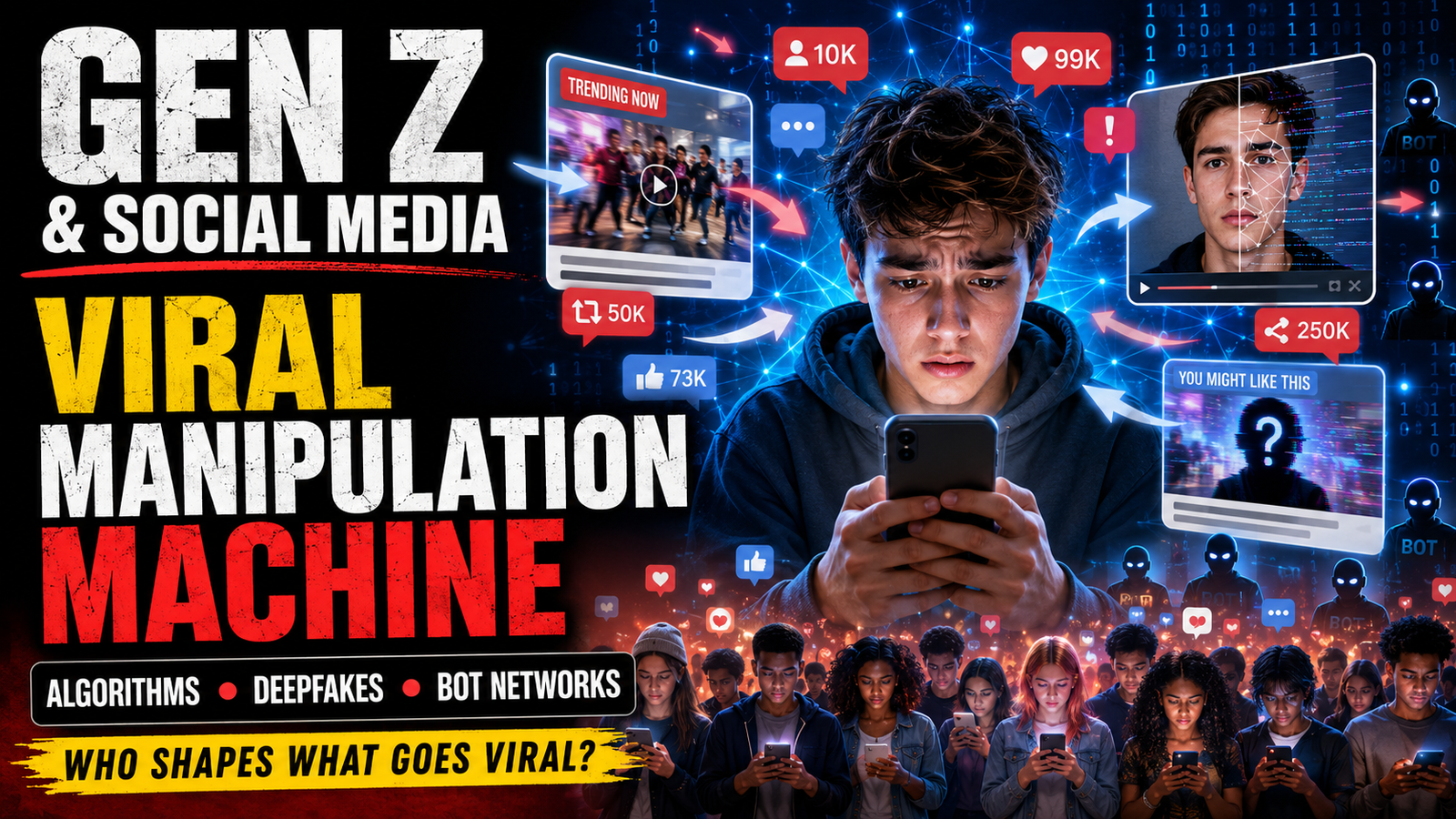
Is Gen Z Being Indoctrinated Through Social Media? Inside the Viral Manipulation Machine

A 30-second video appears on Instagram. It contains dramatic music, disturbing images and a confident voice accusing a government, community or public figure of something shocking.
Within hours, it receives millions of views. Influencers react to it. Anonymous accounts repeat its claims. Hashtags begin trending. Anyone who asks for evidence is accused of supporting injustice.
Days later, fact-checkers discover that the footage came from another country, the audio was generated using artificial intelligence, or a critical section of the video was deliberately removed.
But the correction receives only a fraction of the original engagement.
This is how modern propaganda works. It does not always ask people to study an ideology. It delivers an emotional conclusion before they have time to understand the ground reality.
Generation Z is not unintelligent or uniquely gullible. It is, however, the first generation to grow up inside a digital information system designed to capture attention continuously. That makes young users an important target for political groups, foreign influence operations, commercial influencers and coordinated propaganda networks.
The Smartphone Has Become the New Political Classroom
Young people once encountered political information mainly through newspapers, television, schools and discussions with family members. Today, many first encounter major events through short videos, memes, influencers and trending hashtags.
The Reuters Institute’s Digital News Report 2025 found that social-video news consumption across surveyed markets increased from 52% in 2020 to 65% in 2025. In countries including India, more respondents preferred watching news to reading it.
In the United States, Pew Research Center found that 43% of adults under 30 regularly obtained news from TikTok in 2025, compared with only 9% in 2020.
This transformation creates an obvious vulnerability: a complicated conflict involving history, law, religion, economics and geopolitics is compressed into a few emotionally charged seconds.
A viral reel may show real suffering while hiding:
- What happened before the recording began
- Whether the video is recent
- Where the incident actually occurred
- Whether the subtitles are accurate
- Who uploaded the original footage
- What evidence contradicts its narrative
- Who benefits politically from its circulation
The viewer receives an emotional verdict without the information required to evaluate it.
Indoctrination Does Not Always Look Like Indoctrination
Modern online indoctrination rarely arrives as a formal lecture. It works through repetition, identity and social pressure.
A user watches one angry political video. The recommendation system then supplies several similar videos because anger keeps people watching, commenting and returning. Soon, the user’s feed creates the impression that nearly everyone agrees with the same conclusion.
The process usually follows a recognizable pattern:
- A genuine grievance or disturbing incident attracts attention.
- Important context is removed.
- Emotional language divides people into heroes and enemies.
- Large accounts and coordinated profiles repeat the framing.
- Algorithms interpret the engagement as public interest.
- Neutral or opposing information disappears from the user’s feed.
- Repetition begins to feel like proof.
This does not require a secret “master” controlling every trend. Several actors can benefit simultaneously: political campaigners, ideological organizations, influencers seeking followers, content farms earning advertising revenue and foreign networks seeking social instability.
The algorithm is not necessarily loyal to one ideology. Its strongest loyalty is to engagement.
Why Falsehood Often Defeats the Truth
The truth is frequently slow, complicated and conditional. Propaganda is fast, simple and emotionally satisfying.
A major study published in Science found that false stories on Twitter spread “farther, faster, deeper, and more broadly” than truthful ones. False information was approximately 70% more likely to be retweeted, partly because it appeared novel and generated emotions such as surprise and disgust. Importantly, humans—not only automated bots—were central to this amplification. MIT’s summary of the research explains why sensational claims can outperform careful reporting.
A fact-checker may need hours to locate the original video, contact authorities and verify satellite images. A propagandist needs only seconds to add a false caption.
By the time the truth arrives, the misinformation may already have shaped public opinion.
Who Makes a Video Go Viral?
Viral content can spread organically, but some apparent public excitement is manufactured. This practice is often called coordinated inauthentic behaviour or astroturfing—creating the appearance of grassroots support where little may initially exist.
A coordinated campaign may use:
- Hundreds of newly created or repurposed accounts
- Automated liking, reposting and commenting
- Influencers paid without transparent sponsorship labels
- WhatsApp, Telegram or Discord groups coordinating engagement
- Identical captions posted by apparently unrelated users
- Fake news pages that imitate legitimate publications
- Artificially generated profile photographs
- Edited videos distributed across several platforms
- Hashtag campaigns launched at a predetermined time
The first wave of artificial engagement can push content into recommendation systems. Real users then encounter it, react emotionally and carry it further.
Bots may light the match, but ordinary users often spread the fire.
How Deepfakes Exploit Human Instinct
Deepfakes can place fabricated words in the mouth of a politician, military officer, actor, doctor or religious leader. AI can also generate fake crowds, riots, explosions, speeches and news broadcasts.
The most dangerous deepfakes are not always completely fabricated. Effective disinformation often combines authentic material with one deceptive element:
- Real video with fake audio
- Real speech with misleading subtitles
- Genuine footage assigned to the wrong country
- An old protest presented as a current uprising
- A cropped interview that reverses the speaker’s meaning
- Video-game footage presented as a military attack
When users recognize a familiar face and hear a convincing voice, their instinct is to believe their senses. The emotional reaction occurs before technical verification.
Deepfakes also create the liar’s dividend: once fabricated videos become common, guilty individuals can dismiss authentic evidence by claiming that it was generated by AI.
Have Facebook, Instagram, X and YouTube Failed?
These platforms have policies against impersonation, manipulated media and coordinated fake activity. YouTube requires creators to disclose realistic altered or AI-generated material, while X prohibits inauthentic activity intended to manipulate the platform. Meta also removes certain harmful misinformation and coordinated networks.
Yet enforcement remains incomplete and frequently reactive.
The platforms face several structural problems:
- Billions of posts are uploaded faster than humans can review them.
- Detection tools may struggle with regional languages and cultural context.
- Slightly editing or re-uploading a removed video can evade detection.
- Satire, political persuasion and deliberate deception can be difficult to separate.
- Removing borderline content creates legitimate free-speech concerns.
- Engagement-producing content benefits the platforms commercially.
- A warning label may appear only after millions have watched the video.
Google’s own threat investigators continue to identify large networks after they have already operated. In its Q4 2025 Threat Analysis Group bulletin, Google reported terminating thousands of YouTube channels connected to coordinated influence operations, including networks linked to China, Pakistan and Bangladesh.
That enforcement is necessary, but it also reveals the scale of content that entered the information ecosystem before being detected.
Do Pakistan, China, Türkiye and Bangladesh Operate “Bot Factories”?
The phrase bot factory is useful shorthand, but it can be misleading. Not every coordinated account is automated, and not every operation can be attributed directly to a national government.
Networks may be operated by state agencies, political parties, contractors, marketing firms, ideological volunteers or financially motivated content farms. Therefore, responsible reporting should distinguish a campaign linked to actors in a country from one conclusively directed by its government.
Pakistan-linked networks
In 2019, Meta removed 103 Facebook and Instagram Pages, groups and accounts from a Pakistan-origin network. Meta said the operation used fake accounts and was linked to employees of the Pakistani military’s Inter-Services Public Relations. Approximately 2.8 million accounts followed at least one of its Pages. Meta’s investigation found that the network posted about Kashmir, India, political leaders and military issues.
Google’s 2025 reporting also recorded the removal of 170 YouTube channels from a Pakistan-linked operation that published content supportive of Pakistan and critical of India.
China-linked operations
China-linked influence networks operate at a much larger scale. Google reported removing thousands of channels associated with coordinated PRC-linked activity during multiple 2025 enforcement waves.
Meta has also documented a China-origin operation targeting audiences outside China, including American domestic politics. The network operated across multiple social platforms, demonstrating why removing accounts from one service does not eliminate an entire campaign. Meta’s China network report provides details.
Türkiye-linked networks
In 2020, Twitter disclosed a network of 7,340 accounts engaged in coordinated inauthentic activity aimed primarily at Turkish audiences. The platform said technical indicators connected it to the youth wing of the ruling AK Party and that it amplified narratives favourable to the party and President Recep Tayyip Erdoğan. Twitter’s archived disclosure described both fake and compromised accounts.
This was largely a domestic influence operation, illustrating that organized manipulation is used not only against foreign rivals but also to shape opinion at home.
Bangladesh-linked networks
Google’s Q4 2025 bulletin documented multiple Bangladesh-linked campaigns. It terminated 64 channels in one operation and 27 in another. The latter promoted a Bangladeshi civil-society leader while criticizing India and actors within Bangladesh.
Attribution must remain precise: these findings establish coordinated campaigns linked to Bangladesh, not proof that every campaign was ordered by the Bangladeshi state.
This Is Not Only a Foreign Problem
India should take foreign information warfare seriously, particularly during elections, communal tensions, military confrontations and major protests.
However, blaming outsiders for every viral falsehood would be dishonest. India also has domestic political networks, paid influencers, partisan IT cells and commercial pages capable of manipulating debate.
The same 2019 Meta investigation that exposed the Pakistan-linked network also removed Indian networks connected to individuals associated with a Congress IT cell and an Indian IT company.
Information manipulation is not limited to one country, religion or political ideology. Any actor can exploit it when secrecy is cheap and attention is profitable.
How Gen Z Can Resist Digital Manipulation
The answer cannot be banning every controversial opinion. Excessive censorship can itself become a political weapon.
The stronger defence is digital literacy combined with transparent enforcement.
Before sharing a viral political video, users should ask:
- Who uploaded the original version?
- Is the account authentic and historically reliable?
- Can the event be confirmed by multiple independent sources?
- Is the date and location verified?
- Does the clip begin suspiciously late or end abruptly?
- Are the audio and lip movements synchronized?
- Is the post provoking anger before providing evidence?
- Are hundreds of accounts repeating identical language?
- Has an official agency or reputable fact-checker addressed it?
Young people should also deliberately follow credible voices with different perspectives. A person cannot understand the ground reality if an algorithm shows only one side of every dispute.
What Governments and Platforms Must Do
Governments should invest in media literacy, deepfake-detection laboratories and rapid multilingual fact-checking. Political advertising and paid influencer campaigns should carry clear disclosures.
Platforms should:
- Detect coordinated activity before it reaches trending sections
- Preserve visible correction notices on re-uploaded misinformation
- Improve moderation in Indian and regional languages
- Label realistic AI-generated political content prominently
- Publish country-wise enforcement data
- Identify who paid for political promotions
- Reduce recommendation of unverified crisis footage
- Offer researchers controlled access to study viral manipulation
Such measures must include independent oversight so that fighting misinformation does not become an excuse for silencing criticism.
Final Verdict: Viral Does Not Mean True
Gen Z has unprecedented access to knowledge, but access is not the same as understanding.
A young person can watch hundreds of videos about a war, protest or social conflict without learning its history, constitutional framework or ground-level complexity. Repetition can create confidence without knowledge.
The greatest danger is not that every young user will believe one particular ideology. It is that millions may gradually lose the habit of verification—reacting instantly, joining digital crowds and mistaking algorithmic popularity for public truth.
A democracy cannot function if citizens form permanent political beliefs from edited clips selected by systems they do not understand.
The next time a video makes you immediately angry, frightened or morally certain, pause before sharing it. That emotional urgency may be exactly what its creators designed.
Frequently Asked Questions
Is Gen Z more vulnerable to social-media misinformation?
Gen Z consumes more news through social and video platforms than older generations, increasing exposure to decontextualized clips and influencer commentary. However, misinformation can affect every age group, and younger users may also possess stronger digital instincts in some areas.
What is a social-media bot factory?
It is an informal term for an organized operation using automated, fake, compromised or centrally controlled accounts to amplify content, attack opponents or create artificial public consensus.
Why don’t platforms immediately remove deepfake videos?
Detection remains imperfect, particularly when content is partially altered, presented as satire, uploaded in regional languages or repeatedly re-edited. Platforms must also distinguish harmful deception from legitimate political expression.
Are all viral political trends artificially created?
No. Many trends develop organically around genuine public concerns. Warning signs include identical posts, sudden activity from new accounts, unusual engagement patterns and coordinated publication across unrelated profiles.
How can someone verify a viral video?
Locate the earliest upload, conduct a reverse-image search, compare coverage from independent outlets, inspect the date and location, and check official or reputable fact-checking sources before sharing.
Disclaimer: This article discusses documented coordinated networks and broader information-warfare risks. A campaign linked to accounts operating from a country should not automatically be interpreted as representing its government or citizens.