








































New UPI Payment Charges Explained: No, Ordinary Users Are Not Being Charged

The Truth Behind the New UPI Charges Debate
A major fake narrative is spreading on social media that UPI payments will no longer be free for ordinary users.
This is misleading.
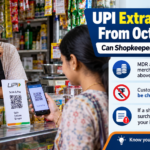
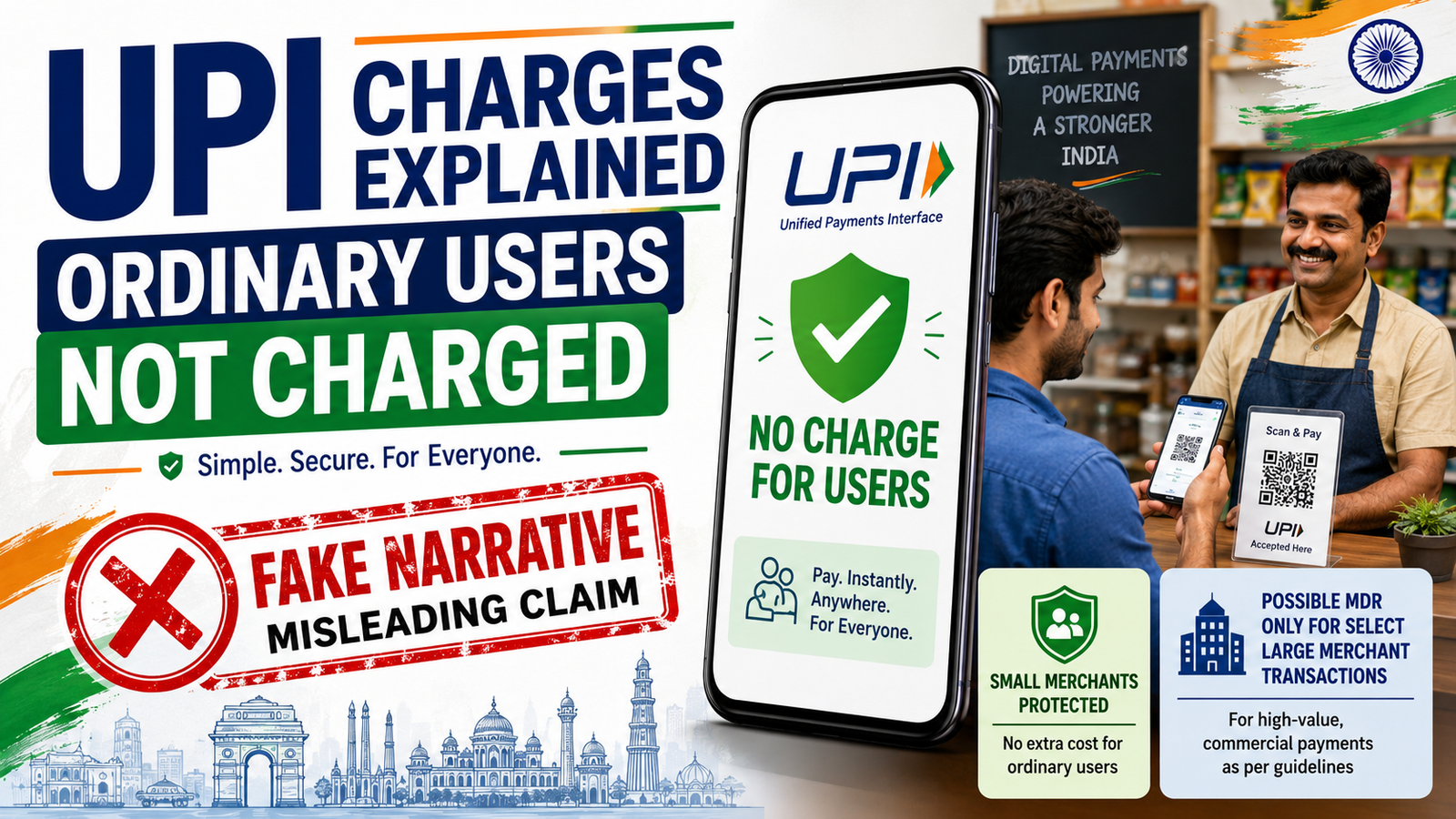
The government has clarified that normal UPI users will not be charged for making payments. Finance Minister Nirmala Sitharaman said Merchant Discount Rate, or MDR, applies to merchants and not to end users or customers. She also said MDR is meant to help banks and fintech companies invest more in infrastructure, innovation and security.
So the simple answer is: you will not pay a fee for sending money to your friend, family member, driver, shopkeeper or vendor through normal UPI.
What Is MDR?
MDR means Merchant Discount Rate. It is a small processing fee paid by a merchant to banks or payment companies for accepting digital payments.
This is not unique to UPI. Card payments already have MDR. Reuters reported that credit cards in India typically attract MDR of around 1.5%, while debit cards can attract up to 0.9%. UPI is currently free for merchants.
The current debate is not about charging common people. It is about whether a small merchant-side charge should be allowed in limited cases so that India’s huge UPI system remains financially sustainable.
What Has Actually Changed?
The government has moved to create a legal framework that could allow MDR on digital payments in the future. Reuters reported that proposed changes to India’s Payment and Settlement Systems Act would create the legal basis for charging MDR, but no final decision has been made on the exact fee level or where it will apply.
That means social media posts saying “UPI charges have started for everyone” are wrong.
As of now, this is a policy discussion and legal enabling move, not a universal customer charge.
Who May Actually Pay?
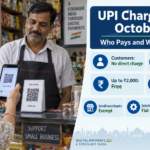
According to Reuters, one proposal being considered would apply MDR only to large merchants, while keeping UPI payments free for consumers and small businesses. The reported proposal is a 0.3% to 0.5% MDR on transactions above ₹2,000 for merchants with annual turnover exceeding ₹1.5 crore.
This is important.
It does not mean your normal ₹50 tea payment, ₹200 grocery payment or ₹500 local shop payment will suddenly be charged.
It also does not mean every small merchant will be forced to pay.
The government’s latest clarification also says that if MDR is introduced in future, it will be nominal, limited to a specific set of merchant transactions, and the majority of merchant transactions will remain exempt.
Why Is the Government Considering This?
UPI has become one of the world’s biggest payment systems.
The Ministry of Finance said UPI had 55.49 crore users onboarded as of June 2026. UPI transactions grew to 24,161.69 crore in volume and ₹314.23 lakh crore in value in FY 2025–26.
Reuters reported that UPI processed 23.6 billion transactions worth ₹29.9 trillion in July alone.
Running such a massive system is not free. Banks, payment apps, cybersecurity teams, servers, fraud detection systems and customer support all cost money.
That is why policymakers are discussing whether a tiny merchant-side MDR on a small category of high-value commercial payments can support the ecosystem.
The Fake Narrative: “Every UPI Payment Will Be Charged”
This is false.
All person-to-person UPI payments are expected to remain free. Customers making payments are not supposed to face any fee. Times of India reported that the government has assured users that P2P transactions will remain free and consumers making payments will not face charges.
So if you send money to your friend, pay rent to a person, transfer money to family, or make a normal UPI payment from your bank account, the fear of direct customer charges is not supported by the government’s clarification.
The Second Fake Narrative: “All Merchants Will Pay”
This is also misleading.
The current discussion is not about charging every merchant. The Payments Council of India said UPI will remain free for consumers and that small merchants, including kirana stores, will not be charged for accepting digital payments.
The reported policy direction is focused on select high-value merchant transactions or large merchants, not small shopkeepers.
This distinction is important because fake social media posts are creating panic among ordinary users and small businesses.
Remember the 2023 Confusion?
This is not the first time UPI charges have been misunderstood.
In 2023, there was confusion after an interchange fee was introduced for certain PPI wallet-based merchant transactions above ₹2,000. NPCI clarified at that time that the fee applied only to prepaid payment instrument merchant transactions and that customers would not be charged for normal UPI payments.
That old confusion is now being recycled again.
Normal bank-account-to-bank-account UPI payments are not the same as wallet-based merchant transactions or future merchant-side MDR discussions.
Why UPI Must Stay Free for Common People
UPI became successful because it was fast, simple and free for users.
A street vendor, student, taxi driver, homemaker, small shopkeeper and office worker could all use the same payment system without worrying about charges. That trust made UPI a part of daily Indian life.
The government should protect this foundation.
If ordinary users start fearing hidden charges, people may move back to cash. That would hurt Digital India, small merchants and financial inclusion.
That is why the correct policy should be simple: keep UPI free for common users and small merchants, while exploring limited charges only for large commercial transactions if needed.
Why the Payment Ecosystem Needs Money
At the same time, India cannot pretend that payment infrastructure has zero cost.
UPI needs constant investment in cybersecurity, fraud prevention, uptime, server capacity, customer support and innovation. The government has already supported low-value UPI transactions through incentives. PIB noted that the Cabinet approved a ₹1,500 crore incentive scheme for FY 2024–25 to promote low-value BHIM-UPI P2M transactions and support small merchants.
PIB also said the scheme ensured zero MDR for UPI transactions and gave incentives for transactions up to ₹2,000 made to small merchants.
This shows the government understands that UPI must remain affordable while the ecosystem also needs support.
Final Verdict
The viral claim that “UPI will become chargeable for everyone” is false.
The real position is more balanced:
Common users will not pay.
Person-to-person UPI transfers will remain free.
Small merchants are expected to remain protected.
Any future MDR may be nominal.
It may apply only to select large merchant transactions above a threshold.
No final universal charge has been imposed on ordinary users.
UPI is India’s digital public success story. It should not be damaged by panic, misinformation or political half-truths.
The real debate is not whether common people should pay. They should not.
The real debate is how to keep UPI free for users, affordable for small merchants and financially sustainable for banks and fintech companies.
That is a policy discussion worth having honestly.
FAQs
Will ordinary users have to pay UPI charges?
No. The government has clarified that MDR applies to merchants, not ordinary users or customers.
Will person-to-person UPI transfers remain free?
Yes. P2P UPI transfers are expected to remain free.
Will all merchants have to pay UPI MDR?
No. Current reports and government clarifications indicate that any future MDR may apply only to a limited set of merchant transactions.
Will small shopkeepers and kirana stores be charged?
The Payments Council of India has said small merchants, including kirana stores, will not be charged for accepting digital payments.
What is the proposed UPI MDR?
Reuters reported that one proposal being considered is a 0.3% to 0.5% MDR on transactions above ₹2,000 for merchants with annual turnover above ₹1.5 crore, but no final decision has been made.
Disclaimer: This article is for informational and educational purposes only. UPI policy, MDR rules and government notifications may change. Readers should follow official updates from the Ministry of Finance, RBI and NPCI for final rules.