














































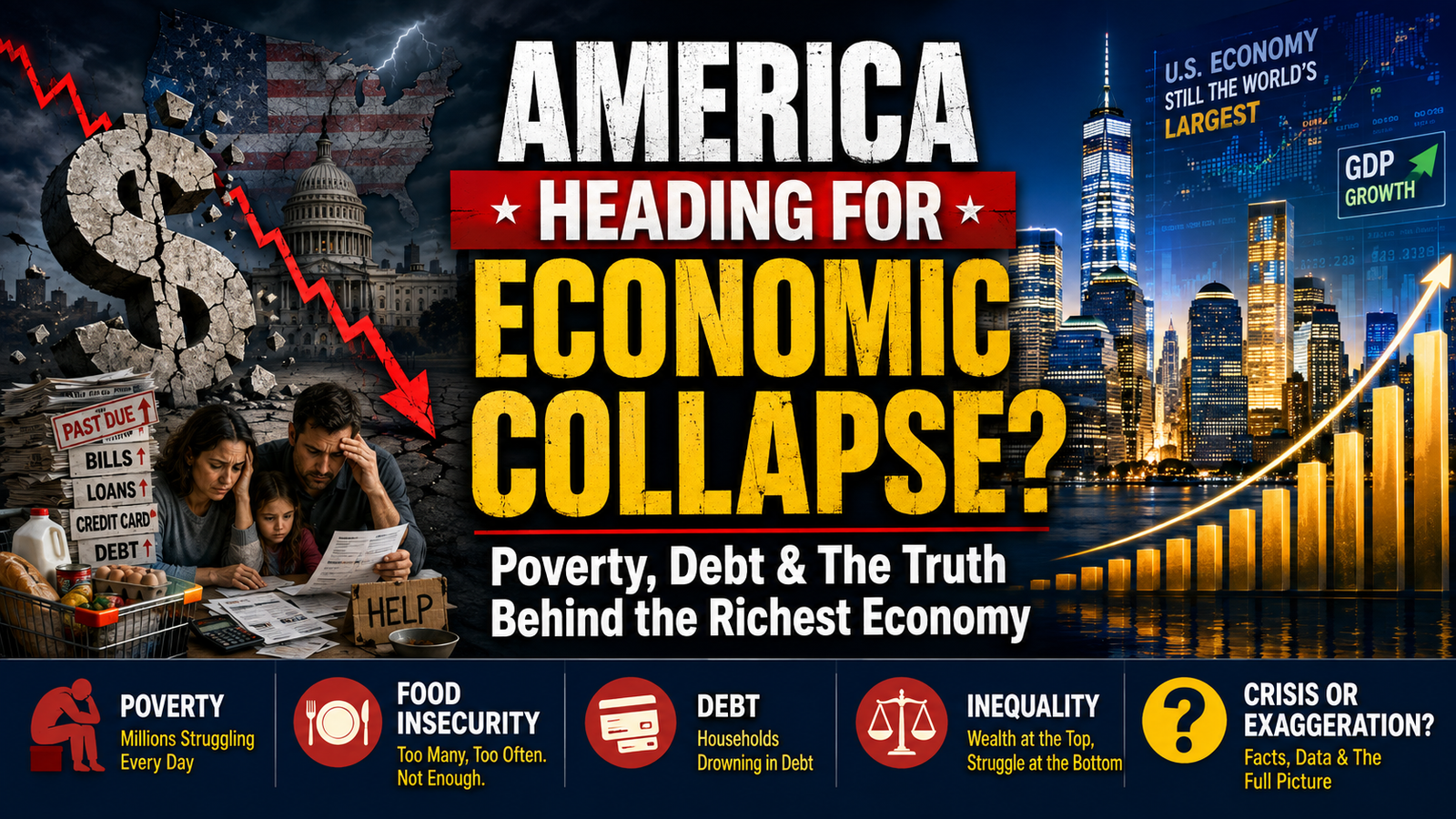
Is America Heading for Economic Collapse? Poverty, Debt and the Truth Behind the World’s Richest Economy

The United States is home to Wall Street, Silicon Valley and some of the world’s most valuable corporations. Its dollar dominates international trade, its government can borrow trillions, and its economy remains the largest in the world by nominal GDP.
Yet behind this extraordinary wealth lies a disturbing contradiction.
Tens of millions of Americans live in poverty. Nearly 48 million live in households that experience food insecurity. Millions cannot pay every monthly bill, while credit-card debt has climbed above $1.2 trillion.
How can the richest country in history leave so many citizens financially vulnerable? Is America using the dollar’s global power to postpone its problems—and could the next financial crisis produce a Soviet-style collapse?
The risks are serious, but the answer is more complicated than the viral headlines suggest.
Are More Than 40 Million Americans Living in Poverty?
The figure depends on how poverty is measured.
According to the latest available US Census Bureau data, the official poverty rate was 10.6% in 2024, representing 35.9 million people.
However, the official measure does not fully account for taxes, medical expenses, housing costs or regional differences in the cost of living.
The Supplemental Poverty Measure—which includes these factors—produced a higher poverty rate of 12.9%. In 2023, the same measure placed approximately 42.8 million Americans below the poverty threshold.
Therefore, saying that more than 40 million Americans experience poverty is reasonable under the broader measurement, even though the official figure is lower.
For a country with enormous national wealth, either number should be troubling.
Nearly 48 Million Americans Experienced Food Insecurity
The contradiction becomes even sharper when food is considered.
The US Department of Agriculture reported that 47.9 million people lived in food-insecure households in 2024. Approximately 18.3 million households had difficulty obtaining enough food at some point because they lacked sufficient money or resources.
Among them, 7.2 million households experienced very low food security, meaning normal eating patterns were disrupted or food consumption was reduced. USDA food-security statistics show that this is not an isolated problem affecting only a tiny population.
America produces an abundance of food. Its problem is not necessarily food availability—it is affordability and unequal access.
Housing, healthcare, transportation, childcare and insurance can consume so much of a household’s income that groceries become another financial emergency.
Is Everyone Really Living Paycheck to Paycheck?
“Paycheck to paycheck” is not an official economic category. Commercial surveys produce dramatically different numbers depending on how they define it.
The latest Federal Reserve survey provides a more reliable picture.
In 2025, 73% of adults said they were doing okay or living comfortably financially. However, only 63% said they could cover a $400 emergency using cash, savings or a credit card paid off immediately.
Another 16% of adults could not pay all their bills in full during the month before the survey. Among people earning less than $25,000, that figure reached 34%. Federal Reserve household data confirms that financial stress is widespread, but not that every American is on the edge of bankruptcy.
Claims that millions are specifically taking loans to buy groceries mainly come from private surveys rather than an authoritative national count. Nevertheless, borrowing pressure is real.
The New York Federal Reserve reported that total household debt reached $18.8 trillion in early 2026, including $1.25 trillion in credit-card balances. About 4.8% of outstanding household debt was in some stage of delinquency. New York Fed
Is America “Scamming” the World Through the Dollar?
Calling the global dollar system a scam is emotionally powerful, but economically inaccurate.
The United States unquestionably receives major advantages from issuing the world’s dominant reserve currency. Global demand for dollars and US Treasury bonds allows Washington to borrow more easily and often at lower interest rates than other governments.
America can also pay foreign obligations using a currency that it controls. Most developing countries do not enjoy that privilege.
However, foreign governments, banks and businesses hold dollars because US financial markets remain large, liquid and relatively transparent—not because they are legally forced to do so.
The dollar accounted for 57.13% of reported global foreign-exchange reserves in the first quarter of 2026, according to the International Monetary Fund. That dominance gives America extraordinary financial power, but it is not unlimited.
If Washington abuses this privilege through uncontrolled money creation, repeated sanctions, political defaults or permanently unsustainable debt, countries may gradually diversify into gold, the euro and other currencies.
The dollar system is better described as an arrangement that strongly benefits America—not a guaranteed fraud against the world.
America’s Debt Is the Real Long-Term Warning
The most dangerous issue is not the current number of dollars owed. It is the direction of the debt and the growing cost of servicing it.
The Congressional Budget Office projects a $1.9 trillion federal deficit in 2026. Federal debt held by the public is expected to equal 101% of GDP this year and climb to 120% by 2036.
Net federal interest costs are projected to exceed $1 trillion in 2026 and reach $2.1 trillion by 2036. At that point, interest would consume resources that could otherwise support infrastructure, defence, healthcare, education or tax relief. Congressional Budget Office
The IMF has also warned that persistent deficits and the growing share of short-term government debt create a financial-stability risk for both America and the global economy. Nevertheless, it currently assesses the risk of US sovereign stress as low. IMF 2026 US assessment
High debt does not automatically cause a nation to collapse. A crisis becomes more likely when investors lose confidence in the government’s ability or willingness to control inflation, raise revenue and honour its obligations.
Inequality and Racial Divisions Weaken Social Trust
America’s economic problem is not simply insufficient national wealth. It is also how unevenly security and opportunity are distributed.
The Census Bureau found that post-tax income inequality increased between 2009 and 2024. The income ratio between the top and bottom of the distribution rose from 8.6 to 9.9 during that period. Census inequality analysis
Financial well-being also varies sharply by race. In the Federal Reserve’s 2025 survey, 79% of White adults and 82% of Asian adults said they were doing okay or living comfortably, compared with 62% of Hispanic adults and 60% of Black adults.
These differences do not prove that every outcome results from racism. However, they show that the benefits of America’s economic strength are not experienced equally.
The FBI recorded 11,679 reported hate-crime incidents in 2024. Political polarization, racial hostility and declining trust can make economic reforms harder precisely when cooperation is most necessary.
Protectionism Is Returning
American leaders increasingly argue that tariffs and industrial policy are necessary to bring manufacturing home and protect domestic workers.
Some economic nationalism may strengthen strategic industries. However, excessively high tariffs can also increase consumer prices, provoke retaliation and reduce trade.
The IMF warned in 2026 that greater American tariffs and trade-policy uncertainty could weaken US economic activity while producing negative effects for other countries.
Protectionism may win political support during periods of economic insecurity, but it cannot solve housing shortages, medical costs, weak savings or government debt by itself.
Could America Collapse Like the Soviet Union?
A direct comparison with the Soviet Union is misleading.
The Soviet system suffered from a rigid centrally planned economy, declining productivity, political fragmentation, military overextension and an inability to adapt. The United States still possesses major advantages:
- The world’s deepest financial markets
- Powerful technology and research industries
- A flexible private-sector economy
- Extensive agricultural and energy resources
- The leading reserve currency
- The ability to borrow in its own currency
- Institutions capable of changing taxes, spending and monetary policy
The US economy was still expanding in early 2026. Real GDP grew at an annualized rate of 2.1% during the first quarter, according to the Bureau of Economic Analysis.
That is not the profile of a country currently undergoing economic collapse.
But powerful countries rarely fail because of one statistic. Decline can occur gradually through repeated policy mistakes, declining institutional trust, unaffordable debt and an inability to reform.
What Could the Next US Financial Crisis Look Like?
The next crisis may not resemble either 1929 or 2008.
It could begin with a sharp fall in asset prices, stress in banks or nonbank lenders, a surge in Treasury yields, a political confrontation over government borrowing or a sudden loss of confidence in the dollar.
A severe recession could then force the Federal Reserve to cut rates and provide emergency liquidity. The government might introduce stimulus spending, guarantees or bailouts.
These actions could prevent depression—but might also increase debt and revive inflation.
The greatest danger would be a combination of crises: falling markets, high inflation, expensive government borrowing and political paralysis occurring simultaneously. That environment would limit the government’s ability to rescue the economy without weakening confidence in the dollar.
Even then, financial crisis would not automatically mean the dissolution of the United States. A prolonged decline in living standards, political influence and dollar dominance is more plausible than an immediate Soviet-style collapse.
Final Verdict: America Is Not Collapsing—But Its Warning Lights Are Flashing
The United States is not a fictional economy held together only by money printing. It remains productive, innovative and financially powerful.
It is also not the flawless success story projected by headline GDP.
A country where nearly 48 million people experience food insecurity, millions cannot pay every bill and government interest costs exceed $1 trillion has deep structural problems.
America is not “scamming the world” in a simple sense. But its reserve-currency privilege allows it to postpone difficult choices that would confront less powerful countries much earlier.
The next financial crisis is unlikely to make the United States disappear. However, if Washington repeatedly answers every crisis with more borrowing while ignoring inequality, affordability and political division, America could enter a long period of relative decline.
Empires and superpowers rarely collapse because they suddenly run out of money. They weaken when their institutions can no longer convert national wealth into stability for ordinary citizens.
Frequently Asked Questions
How many Americans live below the poverty line?
The official US poverty measure counted 35.9 million people in 2024. A broader supplemental measure produced a 12.9% rate, representing more than 40 million people.
How many Americans experience food insecurity?
USDA data show that 47.9 million people lived in food-insecure households in 2024.
Will the US dollar collapse?
An immediate collapse is unlikely because the dollar remains the leading reserve currency. Its dominance could gradually weaken if US debt, inflation and geopolitical use of the financial system reduce international confidence.
Could America experience another Great Depression?
A severe depression is possible but not currently the most likely scenario. Deposit insurance, central-bank emergency powers and modern financial regulation provide protections that did not exist in 1929.
Will the United States collapse like the Soviet Union?
There is no strong evidence of an imminent Soviet-style collapse. Gradual relative decline, fiscal instability or repeated financial crises are more credible risks.
Disclaimer: This article is for general information and economic analysis only. It does not constitute financial or investment advice.