






































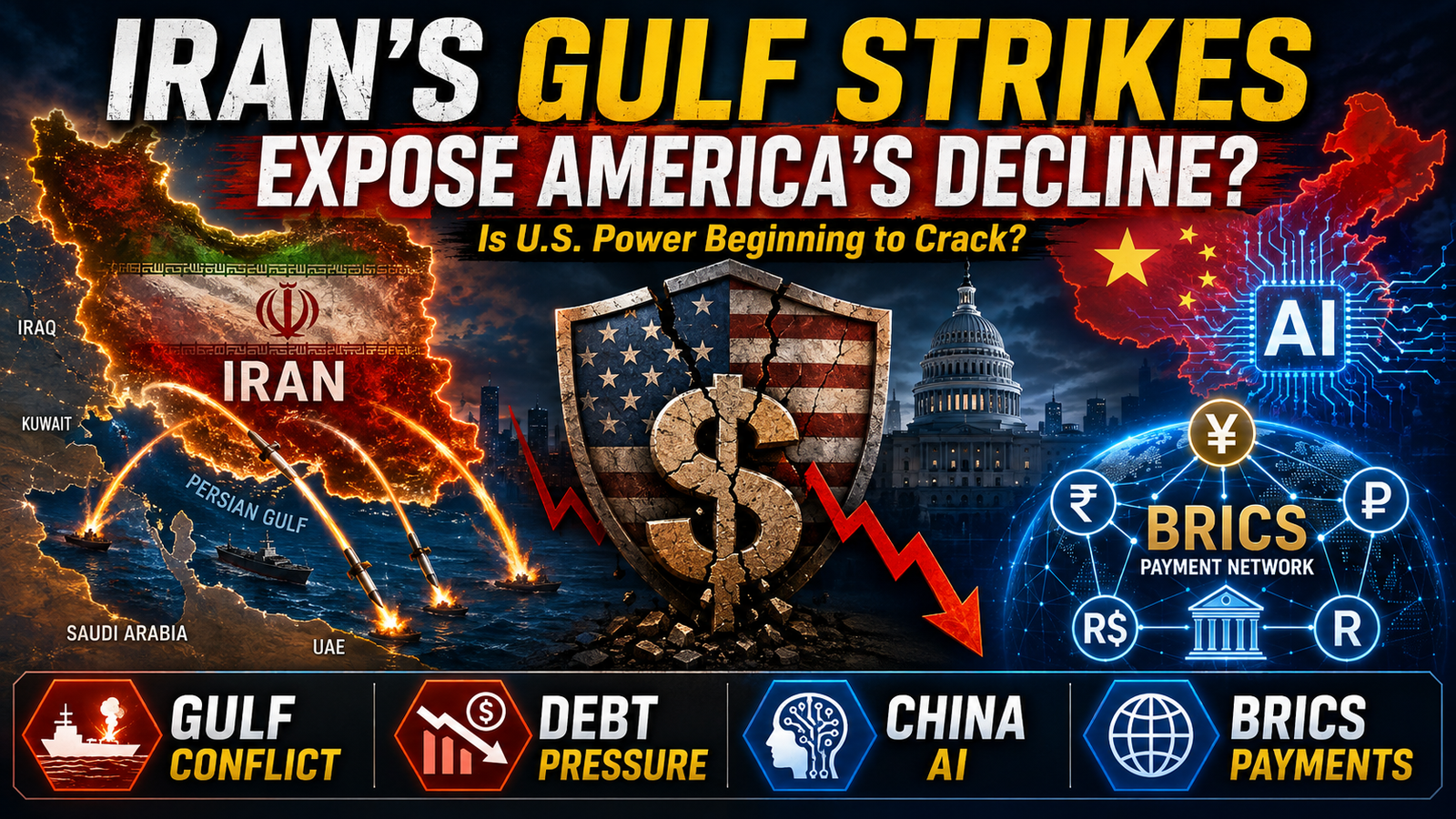
Iran’s Strikes Expose the Limits of US Power: Is American Dominance Beginning to Crack?

For decades, American global power rested on four major advantages: military dominance, technological leadership, the US dollar and the ability to attract the world’s brightest minds.
All four are now under pressure.
Iranian strikes have damaged American military facilities in Gulf countries. China is producing increasingly capable artificial-intelligence models. The dollar’s share of global reserves has fallen sharply since 2000, while BRICS countries are developing alternative payment systems. At home, rising debt and political hostility toward immigrants could weaken America further.
The United States has not collapsed. However, the decline of its once-unquestioned dominance is becoming difficult to ignore.
Iran Exposed the Vulnerability of US Gulf Bases
Iran did not destroy every American base in the Middle East, but the damage was more serious than initially acknowledged.
Satellite images examined by the Washington Post showed damage at multiple US military facilities in Bahrain, Kuwait and Qatar. Reported targets included communications systems, air-defence equipment, fuel infrastructure and buildings.
Stars and Stripes also reported extensive damage at some installations, including parts of the US Fifth Fleet headquarters in Bahrain.
This was a significant strategic achievement for Iran. It demonstrated that expensive, fixed American bases can be threatened by comparatively cheaper missiles and drones.
America remains militarily stronger than Iran, but the cost of defending every airfield, port, radar system and command centre is rising. A rival does not need to destroy the entire US military. It only needs to make America’s global deployments increasingly dangerous and expensive.
Aircraft-Carrier Conditions Reveal Military Overstretch
Reports from the USS Abraham Lincoln have raised concerns about the human cost of prolonged deployments.
According to Reuters, the carrier remained at sea for more than 200 consecutive days. Families raised concerns about morale, mental strain and living conditions.
Reports of suicide attempts among crew members are serious, although US officials dispute claims of a widespread mental-health crisis.
The broader warning is clear: aircraft carriers may appear powerful, but they depend on thousands of trained sailors, constant maintenance and enormous supply chains. Military power cannot be sustained indefinitely if personnel are exhausted and equipment is kept at sea for record periods.
Why America Is Relying on Diego Garcia
Diego Garcia is a remote military facility in the Indian Ocean used to support US and allied forces. Its location makes it safer from many of the short- and medium-range weapons threatening Gulf bases.
The US Navy describes Diego Garcia as a critical logistics centre supporting forces operating across several regions.
Using Diego Garcia does not prove that America’s entire Gulf network has collapsed. However, it shows why Washington needs greater distance from Iranian missiles.
That safety comes with a price. Distant operations require more fuel, longer flights, additional ships and more complicated supply chains. Bases close to Iran are vulnerable; bases farther away are slower and more expensive to use.
Iran has exposed this strategic dilemma.
The US Military Is Powerful, but No Longer Untouchable
America still spends more on defence than any other country.
The Stockholm International Peace Research Institute estimates that US military spending reached approximately $954 billion in 2025, compared with China’s estimated $336 billion.
But spending does not guarantee victory or immunity.
Iranian missiles can damage billion-dollar facilities. Low-cost drones can force expensive air-defence systems to fire valuable interceptors. China has developed advanced missiles capable of threatening US ships and bases in the Indo-Pacific.
The United States remains the world’s strongest military power by many measurements. It is no longer the only country capable of shaping the battlefield.
The US Dollar Is in Structural Decline
The long-term decline of the dollar’s reserve share is measurable.
Historical data show that the dollar represented:
- 71.1% of disclosed global reserves in 2000
- 65.4% in 2016
- Approximately 57% in early 2026
That is a decline of around 14 percentage points since 2000 and more than eight percentage points in a decade. A small quarterly increase does not reverse this trend. Federal Reserve historical data
IMF researchers have concluded that this decline reflects active diversification by central banks, not simply statistical or exchange-rate changes.
The dollar remains the largest reserve currency, but its dominance is clearly eroding.
Freezing Russian Assets Changed the Calculation
Western countries immobilized approximately $300 billion in Russian central-bank assets following the invasion of Ukraine.
For Western governments, this was an economic punishment for Russia’s actions. For other countries, it delivered a different message: foreign reserves held within Western systems can be frozen during a geopolitical conflict.
This does not mean countries will abandon the dollar immediately. It does give governments a reason to hold more gold, trade in local currencies and build payment systems outside Western control.
Unilateral tariffs add to this concern. When access to American markets and financial networks becomes unpredictable, countries naturally look for alternatives.
BRICS Does Not Need One Currency to Challenge the Dollar
A common BRICS currency has not yet been launched. Creating one would require difficult agreements on monetary policy, exchange rates and financial governance.
However, BRICS may not need a single currency.
Members are discussing links between their fast-payment platforms and central-bank digital currencies. RBI Governor Sanjay Malhotra confirmed that these proposals remain under discussion and that India will continue promoting local currencies in cross-border trade. Reuters
If India’s UPI, Brazil’s Pix and other national systems become connected, countries could conduct more trade without routing every transaction through the dollar.
Such financial infrastructure could gradually weaken dollar demand even without a formal BRICS currency.
China Is Challenging America in Technology
America’s technological advantage is also narrowing.
Moonshot AI’s Kimi K3 is an advanced open-weight, multimodal model designed for reasoning, coding and agent-based tasks. By releasing powerful models openly, Chinese companies can attract researchers and developers worldwide.
Kimi K3 does not prove that China leads every area of artificial intelligence. American companies remain highly competitive.
It does prove that advanced AI is no longer an exclusively American field. China is becoming a serious competitor in artificial intelligence, robotics, batteries, drones, manufacturing and telecommunications.
Technology leadership that once appeared permanent can no longer be taken for granted.
Immigration Could Become America’s Weakest Link
America built much of its scientific and technological strength by attracting talented people from around the world.
If immigrants and international students begin to see the United States as unsafe, hostile or unpredictable, more may choose Canada, Europe, Australia or Asian technology centres.
The US National Science Foundation has reported that America faces growing competition for international students, particularly in science and engineering.
Restricting skilled immigration while China and other countries expand their research capabilities could accelerate America’s technological decline.
A country that pushes away global talent eventually strengthens its competitors.
Exploding US Debt Could Accelerate the Decline
The US debt outlook is another major warning.
The Congressional Budget Office projects that debt held by the public could rise from 101% of GDP in 2026 to 120% by 2036. The annual deficit is projected to grow from $1.9 trillion to $3.1 trillion, while interest costs consume an increasing share of government spending.
America can carry more debt than most countries because it borrows in dollars. But that advantage depends on global confidence in the currency and US financial institutions.
If foreign demand for dollars and Treasury securities weakens, Washington may face higher borrowing costs, a weaker currency and greater pressure to reduce spending or increase taxes.
Debt alone may not cause a collapse. Debt combined with military overstretch, political instability, sanctions, tariffs and de-dollarization could create a much more dangerous crisis.
Is American Collapse Inevitable?
The United States still has a massive economy, leading companies, strong universities, natural resources, nuclear weapons and powerful alliances. An immediate Soviet-style collapse is therefore not certain.
But America’s relative decline is already visible.
Iran has exposed weaknesses in US military infrastructure. China is narrowing the technology gap. BRICS is building alternatives to dollar-based payments. Central banks are diversifying their reserves, while America’s debt continues rising.
These trends form a domino effect. Military setbacks weaken confidence. Reduced confidence accelerates financial diversification. De-dollarization makes debt more expensive. Higher interest costs leave less money for infrastructure, technology and social stability.
America is not powerless, but it is no longer unchallenged.
The real question is not whether US dominance is declining. The evidence shows that it is. The question is whether American leaders can reverse the trend—or whether today’s gradual decline will become tomorrow’s crisis of confidence.
Frequently Asked Questions
Did Iran destroy all US bases in the Gulf?
No. Iran damaged multiple American facilities, but the regional US military network remains operational.
Is the US dollar losing global dominance?
Yes, its share of global reserves has declined from approximately 71% in 2000 to around 57% in early 2026. However, it remains the largest reserve currency.
Has BRICS launched a common currency?
No. BRICS is currently focused on local-currency trade, fast-payment links and possible CBDC integration.
Is China ahead of America in AI?
China is increasingly competitive, but leadership varies by model, application and technology. Kimi K3 demonstrates the rapid improvement of Chinese open-weight AI.
Will the United States collapse soon?
Collapse is not guaranteed, but rising debt, military overstretch, technological competition and de-dollarization create a clear long-term risk.
Editorial Note: This article is based on publicly available information as of August 16, 2026. Military claims can change as new independent evidence emerges.