
















































FCRA Bill Goes to JPC: Why India Needs Strong Foreign Funding Rules Now

FCRA Bill Sent to Joint Committee: What Happened?
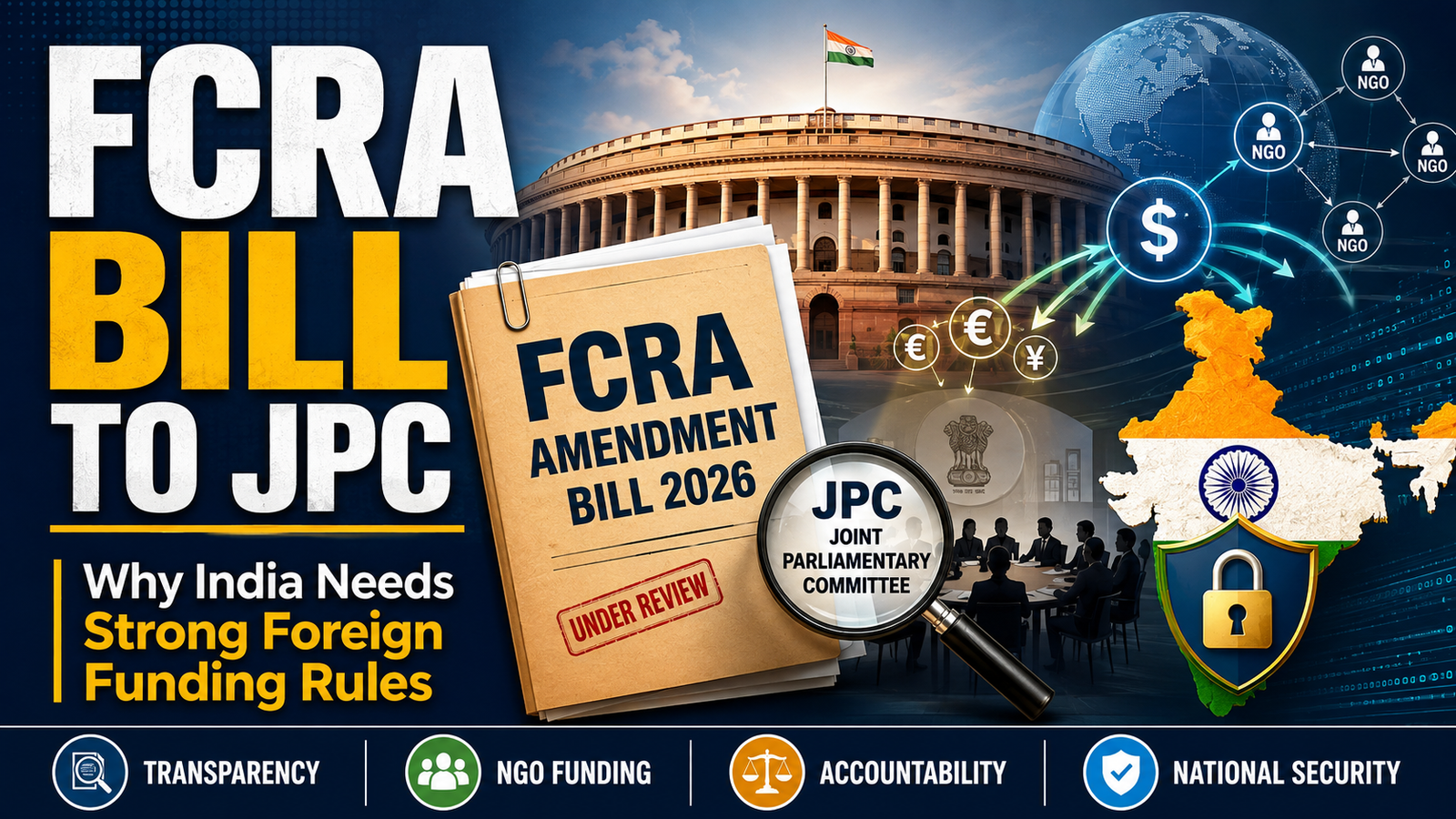
The Foreign Contribution (Regulation) Amendment Bill, 2026 has been referred to a Joint Committee of Parliament, often called a JPC, for detailed review.
According to Economic Times, the proposed committee will have 31 members, including 21 from Lok Sabha and 10 from Rajya Sabha, and is expected to submit its report by the last day of the first week of the Winter Session 2026.
This is an important development. Instead of rushing the Bill, Parliament has sent it for deeper scrutiny, debate and possible improvements.
That is how serious legislation should move.
But India should also be clear about one thing: a strong FCRA law is desperately needed.
What Is the FCRA Bill About?
FCRA stands for Foreign Contribution Regulation Act. It regulates how individuals, associations, companies and NGOs can receive and use foreign donations or grants in India.
PRS explains that the FCRA aims to regulate foreign contributions and prevent their diversion toward activities that may be detrimental to India’s national interest.
The 2026 Amendment Bill mainly focuses on what happens when an organisation’s FCRA certificate is cancelled, surrendered, not renewed or deemed ceased.
The Bill proposes a Designated Authority to supervise, manage and dispose of foreign contributions and assets created from foreign funds in such cases. It also says that in the case of assets that are places of worship, the authority must ensure that their religious character is maintained.
In simple words, the Bill tries to answer one key question: what happens to foreign-funded money and assets when an organisation loses its legal permission to receive foreign funds?
Why India Needs This Law Desperately
India is a sovereign country. Foreign donations for hospitals, schools, disaster relief, research, social welfare and charity are welcome when they are transparent and lawful.
But foreign money should not become a backdoor route to influence politics, social narratives, religious tensions, protests, legal activism or national security issues.
That is the real concern.
Foreign funding is not just charity. In the modern world, money can shape opinion, media narratives, activism, institutions and public pressure. If India does not track foreign money properly, outside forces can influence domestic issues without being accountable to Indian voters.
That is why FCRA is not anti-charity. It is pro-transparency.
PIB has also clarified that FCRA does not forbid legitimate international cooperation in areas like education, healthcare, poverty alleviation, disaster relief, cultural exchange, scientific research and environmental work. The government’s position is that the framework ensures foreign contributions are received, used and accounted for according to Indian law.
This distinction matters.
The law should not stop genuine service. It should stop misuse.
The Scale of Foreign Funding Is Huge
This is not a small issue.
According to PRS, the Ministry of Home Affairs said 13,520 organisations received ₹55,741 crore in foreign contributions between 2019 and 2022. PRS also noted that as of July 15, 2026, the FCRA portal showed 14,449 active certificates, 22,498 cancelled certificates and 15,212 deemed expired certificates.
When thousands of organisations and tens of thousands of crores are involved, India cannot depend only on trust.
There must be a clear legal system for tracking funds, preventing diversion and managing assets when legal permission ends.
Why Some People Are Opposing It
Some opposition parties, NGOs and religious groups have raised concerns over the Bill. Their main worry is that the Designated Authority may give the government too much control over assets created by foreign donations.
These concerns should not be ignored.
PRS has also pointed out key issues, including concerns about organisations losing assets when their FCRA certificates cease, and the lack of a clear appeal mechanism in cases where certificate renewal is denied.
This is exactly why sending the Bill to the JPC is useful.
The JPC should examine concerns around appeal rights, hearing procedures, religious institutions, genuine humanitarian work and misuse of power. A strong law should also be a fair law.
Why the Bill Should Still Pass
The answer to concerns is not to withdraw the Bill completely.
The answer is to improve it.
India needs a law that protects genuine NGOs while also stopping foreign-funded manipulation. It should allow hospitals, schools, charities and relief organisations to function legally. But it should also ensure that no organisation can misuse foreign money and then escape accountability when its registration is cancelled or expires.
A country of India’s size cannot afford loopholes in foreign funding.
The JPC should make the Bill sharper, more transparent and more legally balanced. After that, Parliament should pass it in the Winter Session.
Foreign Funding Must Not Become Foreign Influence
Many countries regulate foreign funding, lobbying and foreign-backed organisations. India has every right to do the same.
This is not about stopping Indians from receiving help. It is about ensuring that help does not become hidden control.
If money comes from outside India, the public has the right to know where it came from, how it was used and whether it followed Indian law.
Transparency protects national interest.
Transparency protects genuine NGOs.
Transparency protects citizens.
Transparency protects democracy.
Final Thoughts
The FCRA Amendment Bill going to the JPC is a positive step.
It gives Parliament time to review the Bill, hear concerns and improve safeguards. But India should not lose sight of the bigger goal.
Foreign funding must be transparent. Foreign-funded assets must be legally accountable. Genuine charity must be protected. Misuse must be stopped.
India should welcome humanitarian help, but it must never allow foreign money to secretly influence its society, politics or national security.
Let the JPC improve the Bill.
And let us hope a stronger, clearer and fairer FCRA Amendment Bill passes in the Winter Session 2026.
FAQs
What is the FCRA Amendment Bill 2026?
It is a proposed amendment to India’s foreign contribution law. It mainly creates a framework for handling foreign funds and assets when an organisation’s FCRA certificate is cancelled, surrendered or not renewed.
Why was the FCRA Bill sent to the JPC?
The Bill was sent to a Joint Committee of Parliament for detailed review, scrutiny and possible recommendations before further parliamentary action.
When will the JPC submit its report?
Reports say the JPC is expected to submit its report by the last day of the first week of the Winter Session 2026.
Does FCRA stop all foreign donations?
No. FCRA regulates foreign contributions. It does not ban lawful foreign charity, research grants, healthcare support or humanitarian aid.
Why does India need strong FCRA rules?
India needs strong FCRA rules to prevent misuse of foreign funds, protect national interest, increase transparency and ensure that foreign money is used only for lawful purposes.
Disclaimer: This article is for informational and editorial commentary only. It does not claim that all NGOs, charities, religious organisations or foreign donors misuse funds. The article supports lawful foreign funding, transparency, national security and fair legal safeguards.