







































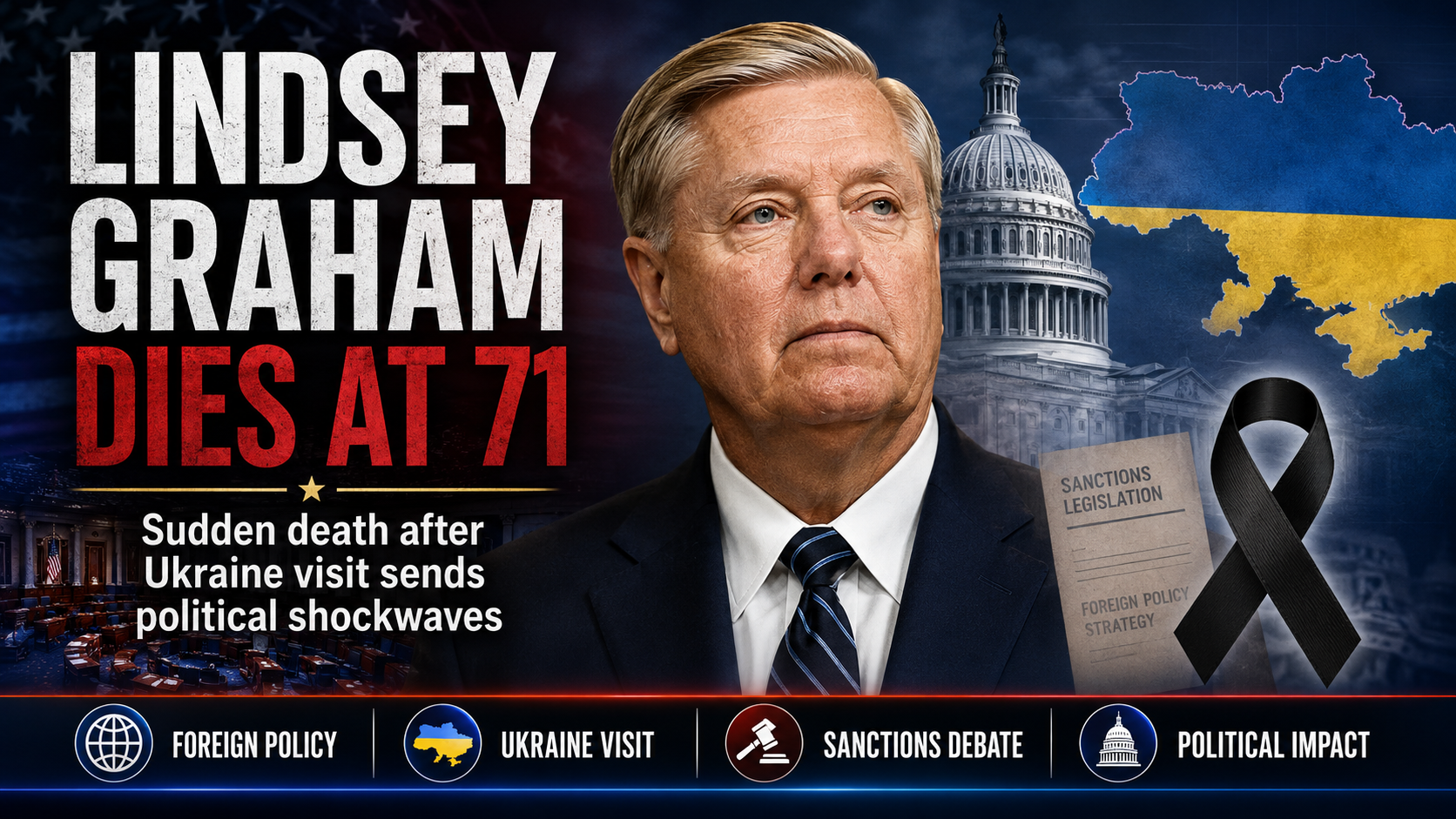
Lindsey Graham Dies at 71: Sudden Death After Ukraine Visit Raises Political Shockwaves

U.S. Senator Lindsey Graham, one of America’s most influential Republican foreign-policy voices and a close ally of President Donald Trump, has died at the age of 71. Reuters reported that Graham died from a heart-related condition, specifically an aortic dissection caused by arteriosclerotic cardiovascular disease.
The timing of his death has drawn attention because Graham had recently returned from Ukraine, where he met Ukrainian President Volodymyr Zelenskyy and pushed for stronger sanctions against Russia. Ukraine’s presidential office confirmed that Zelenskyy met Graham and discussed sanctions, diplomacy and support for Ukraine.
However, while the timing has sparked online speculation, there is currently no confirmed evidence of foul play. AP reported that the medical examiner said Graham likely died after an aorta rupture related to arterial hardening, with final confirmation expected after further medical tests.
Why Lindsey Graham Was So Important
Lindsey Graham was not an ordinary senator. He served in Congress for more than three decades and became one of the strongest voices in Washington on defence, Ukraine, Israel, Iran and Russia.
He was initially a critic of Donald Trump during the 2016 election, but later became one of Trump’s closest Senate allies. Reuters noted that Graham played an important role in shaping Trump’s judicial legacy and remained a major Republican figure on national security issues.
His sudden death creates a political vacuum at a sensitive moment, especially as Washington debates fresh Russia sanctions, Ukraine funding and tariff pressure on countries buying Russian energy.
The Ukraine Connection
Just before his death, Graham was actively involved in pushing a major Russia sanctions bill. Reuters reported that U.S. senators had reached an agreement with the Trump administration to advance new sanctions targeting Russia and countries buying Russian oil and gas. Graham was speaking from Kyiv after meeting Zelenskyy when he confirmed that the administration’s support made the bill more likely to move forward.
This made Graham a central figure in the renewed U.S. pressure campaign against Moscow.
His death shortly after the Ukraine visit is why many people online are calling the timing “suspicious.” But responsible reporting must separate timing from proof. At this stage, official reports point to a serious medical emergency, not a confirmed conspiracy.
The India Angle: 500% Tariff Threat
For India, Graham was a controversial figure because of his support for extreme secondary sanctions against countries buying Russian energy.
Reuters reported earlier that Trump had allowed a bipartisan sanctions bill targeting countries doing business with Russia to move forward, and Graham said the legislation could be put to a vote. The proposal was aimed at countries purchasing Russian energy exports.
The bill became especially controversial because it included the possibility of heavy tariffs — widely discussed as up to 500% — on countries buying Russian oil, gas, uranium and other exports. That placed countries like India, China and Brazil directly in the spotlight.
India has consistently defended its energy purchases by arguing that affordable crude oil is essential for its people, inflation control and economic stability.
Why His Death Matters for Global Politics
Graham’s death may affect three major policy areas.
First, it could slow momentum behind the Russia sanctions bill, depending on who takes over his Senate role and how strongly the Trump administration continues to support it.
Second, it may reshape Washington’s Ukraine debate. Graham was one of the strongest Republican supporters of Kyiv, and his absence could affect bipartisan coordination.
Third, countries like India will closely watch whether the tariff threat continues with the same intensity or softens after Graham’s death.
Was There Anything Suspicious?
The public question is understandable because the death happened shortly after a high-profile Ukraine visit and after Graham pushed a tough sanctions bill.
But based on available credible reports, officials have cited a medical cause. Reuters reported heart-related illness, while AP reported a likely ruptured aorta connected to arterial hardening.
Until law enforcement or medical authorities report otherwise, it would be irresponsible to claim assassination, poisoning or foul play.
The correct position is this: the timing is politically significant, but the confirmed public evidence currently points to a medical emergency.
Final Thoughts
Lindsey Graham’s sudden death at 71 is a major moment in U.S. politics. He was a powerful Republican senator, a close Trump ally, a strong supporter of Ukraine and one of the loudest voices behind aggressive sanctions on Russia and tariff pressure on countries like India.
His passing comes at a crucial time, just as Washington was preparing to move forward with a new Russia sanctions bill.
For now, official reports point to a medical cause, not confirmed foul play. But politically, his death will have major consequences for America’s Russia policy, Ukraine support and the global tariff debate.
FAQs
Did Lindsey Graham die at 71?
Yes. Multiple credible reports state that U.S. Senator Lindsey Graham died at the age of 71.
What was the reported cause of death?
Reports say officials believe he died from a heart-related condition, including a likely aortic rupture or aortic dissection connected to arterial disease.
Was Lindsey Graham in Ukraine before his death?
Yes. Ukrainian officials confirmed that Graham recently met President Volodymyr Zelenskyy to discuss sanctions, diplomacy and support for Ukraine.
Did Graham support tariffs on India?
Yes. Graham backed strong secondary sanctions and tariffs against countries buying Russian energy, a policy that could affect India, China and Brazil.
Is there evidence his death was suspicious?
There is no confirmed public evidence of foul play. The timing has raised questions online, but official reports currently point to a medical cause.
Disclaimer: This article is for informational and educational purposes only. It is based on official statements and credible media reports available at the time of writing. It does not claim foul play or criminal involvement unless confirmed by official authorities.