















































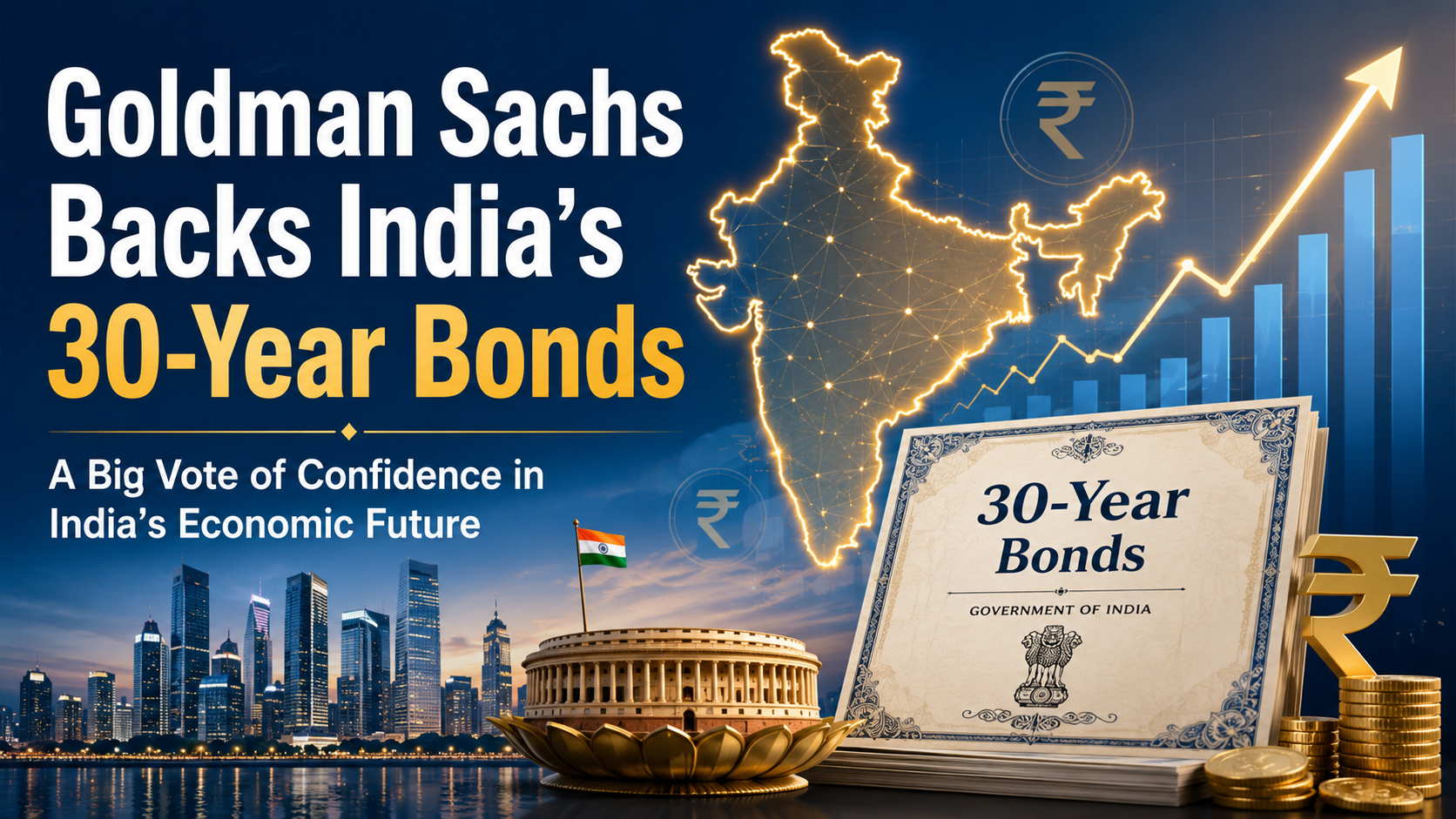
Goldman Sachs Backs India’s 30-Year Bonds: A Big Vote of Confidence in India’s Economic Future

Global investment bank Goldman Sachs has recommended investors go long on India’s 30-year government bond, a move that has attracted attention across financial markets.
According to The Economic Times, Goldman Sachs believes India’s 30-year bond yield has room to fall because of two major structural tailwinds: rising foreign demand and the growing shift of Indian household savings into long-term financial products such as pensions, insurance and retirement funds.
In simple words, Goldman is saying that India’s ultra-long bonds are becoming attractive because investors are gaining confidence in India’s long-term economic future.
Why 30-Year Bonds Matter
A 30-year government bond is not a short-term bet. It is a long-term confidence signal.
When investors buy a 30-year bond, they are trusting that the country will remain financially stable for decades. They are betting on inflation control, fiscal discipline, currency stability and long-term growth.
That is why Goldman’s positive view on India’s 30-year bond is important. It shows that global investors are no longer looking at India only as a fast-growing stock market. They are also seeing India as a serious long-term debt market.
The Big Reason: Foreign Investors Are Coming In
India’s bond market is seeing strong foreign inflows. Reuters reported that foreign investors have invested nearly $6.5 billion into Indian government securities since early June 2026, helping bring down the 10-year government bond yield by around 25 basis points to 6.73%.
This is a big change. For years, Indian bonds were mostly dominated by domestic banks, insurance companies and local institutions. Now, global investors are slowly increasing their exposure.
Reuters also noted that India’s Fully Accessible Route, or FAR, bonds are now part of three global bond indices, making them more attractive to foreign investors.
What Is the Fully Accessible Route?
The Fully Accessible Route is a category of Indian government bonds that foreign investors can buy without traditional investment limits.
Goldman Sachs highlighted the inclusion of the benchmark 30-year bond under FAR as one of the key reasons for rising demand. This opens the door for more global investors to participate in India’s long-term bond market.
This matters because when more investors want Indian bonds, demand rises. When bond prices rise, yields usually fall. Lower yields can reduce borrowing costs over time and support government financing.
India’s Household Savings Are Changing
Another major reason behind Goldman’s view is the financialisation of Indian household savings.
For decades, many Indians preferred bank deposits, gold and real estate. But slowly, more savings are moving into mutual funds, insurance products, pension funds, retirement schemes and long-term financial assets.
Goldman Sachs said this shift can increase structural demand for ultra-long government bonds because pension funds, Public Provident Funds and insurance companies naturally need long-duration assets.
This is a powerful domestic support base. Even if foreign investors become cautious, India still has strong local demand from banks, insurers and long-term savings institutions.
What Goldman Expects
Goldman Sachs reportedly recommended entering the 30-year bond around 7.34% and forecast the yield could ease toward 6.90%. The report also mentioned a stop-loss level of 7.65%, showing that this is still a market trade with risks.
As of July 15, 2026, Trading Economics showed India’s 30-year bond yield around 7.38%, down 0.14 percentage points over the past month.
This means the market is already watching India’s long-term debt closely.
Why This Shows Trust in India’s Economy
Goldman’s bond call reflects confidence in several parts of India’s economy.
First, India’s growth story remains strong compared with many major economies. Second, the Indian rupee has shown relative stability after policy measures to attract dollar flows. Reuters reported that rupee stability has become a positive factor for bond investors.
Third, India’s domestic savings base is deepening. Fourth, global index inclusion is increasing India’s visibility in international portfolios. Fifth, long-term investors are beginning to see Indian government bonds as a serious asset class.
This is not just about one bond. It is about India’s financial market maturity.
Bigger Message for Viksit Bharat
For India’s Viksit Bharat 2047 vision, a strong bond market is extremely important.
A developed economy needs more than stock market excitement. It needs deep debt markets, stable long-term financing, pension participation, insurance growth and global investor trust.
If India can attract long-term capital into government bonds, it can support infrastructure, clean energy, defence manufacturing, railways, highways, ports, digital infrastructure and urban development.
In that sense, the 30-year bond is not just a financial instrument. It is a signal of how global capital is beginning to look at India’s future.
Risks Investors Should Remember
This does not mean Indian bonds are risk-free.
The Economic Times reported that Goldman itself highlighted risks such as a global sell-off in long-end bonds, hawkish U.S. Federal Reserve comments, domestic inflation pressure or fiscal risks.
Oil prices are also important for India because India imports a large portion of its crude oil. If oil prices rise sharply due to geopolitical tensions, inflation and fiscal pressure can increase.
So the message is not “blindly buy bonds.” The message is that global confidence in India’s long-term economy is rising, but investors must still understand risks.
Final Thoughts
Goldman Sachs backing India’s 30-year government bonds is a major signal for global markets.
It shows that India is not only attracting attention for stocks, startups and GDP growth, but also for long-term financial stability. Foreign investors, global bond indices and India’s own growing savings ecosystem are together making Indian bonds more attractive.
For India, this is a positive development. It reflects growing trust in the country’s economic direction, policy stability and financial market depth.
The next big story of India’s rise may not only be in the stock market. It may also be in the bond market — where long-term investors are quietly betting on India’s future.
FAQs
Why is Goldman Sachs bullish on India’s 30-year bonds?
Goldman Sachs sees demand rising due to foreign investor access under the Fully Accessible Route and growing long-term savings through pensions, insurance and retirement products.
What does a 30-year bond show?
A 30-year bond reflects long-term investor confidence in a country’s economic stability, inflation management and fiscal strength.
Are foreign investors buying Indian bonds?
Yes. Reuters reported nearly $6.5 billion of foreign investment into Indian government securities since early June 2026.
Does this mean India’s economy is becoming stronger?
It shows growing global trust in India’s long-term financial market, but economic risks like inflation, oil prices and global interest rates still matter.
Is this investment advice?
No. This article is for educational purposes only and should not be treated as investment advice.
Disclaimer: This article is for informational and educational purposes only. It is not financial, investment or trading advice. Bond prices and yields can change due to inflation, interest rates, currency movement, global markets and government policy. Readers should consult a qualified financial advisor before making investment decisions.