















































Global Shipping Giant CMA CGM to Build LNG Container Ships in India: A Big Make in India Maritime Breakthrough

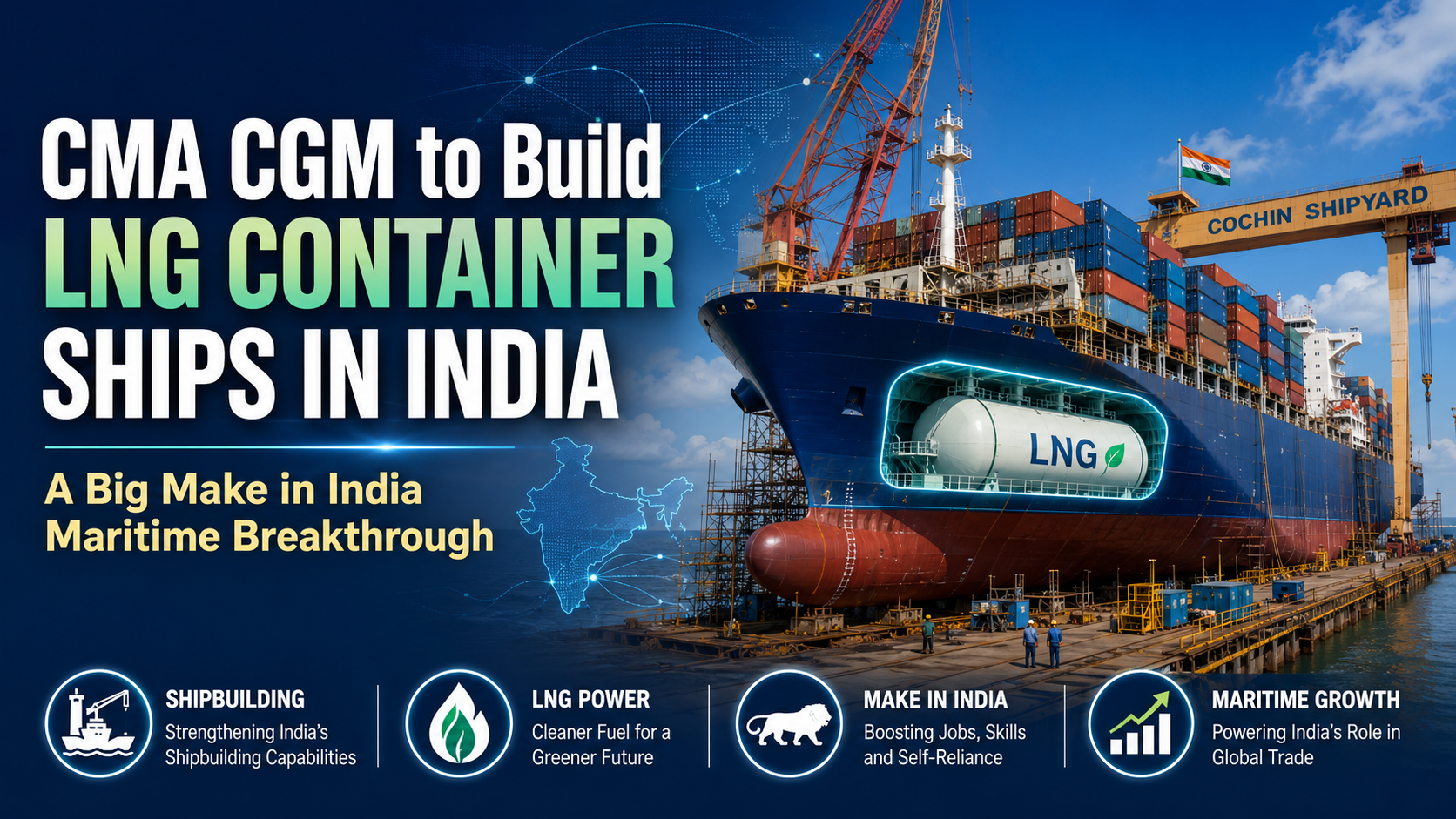
India’s maritime sector has received a major confidence boost after global shipping giant CMA CGM signed a letter of intent to build six LNG-powered container ships at Cochin Shipyard Limited in Kerala.
This is a big milestone because CMA CGM is one of the world’s largest container shipping companies, and according to Reuters, it is the company’s first-ever order for Indian-built vessels. The ships will be built by Cochin Shipyard, with technical support from South Korea’s HD Hyundai Heavy Industries.
For decades, global commercial shipbuilding has been dominated by countries like China, South Korea and Japan. Now, India is slowly entering that conversation.
What Exactly Has CMA CGM Ordered?
CMA CGM has signed an agreement for six new dual-fuel LNG-powered container ships, each with a capacity of 1,700 TEUs. TEU means “twenty-foot equivalent unit,” the standard measurement used in container shipping.
The company said these vessels will be built at Cochin Shipyard and will be registered under the Indian flag. CMA CGM also said the ships can run on LNG and are ready for future low-carbon fuels, supporting its goal of becoming net zero by 2050.
The vessels are expected to be delivered between 2029 and 2031, making this a long-term shipbuilding and maritime manufacturing project for India.
These are not the world’s biggest container ships, but they are extremely important because they mark the first major step by a global container carrier to trust Indian shipbuilding for modern commercial vessels.
Why This Deal Matters for India
This deal matters for three big reasons.
First, it proves that Indian shipyards can attract international commercial orders, not just defence or domestic projects.
Second, it brings global technical collaboration into India’s shipbuilding ecosystem. Cochin Shipyard will work with HD Hyundai, one of the world’s strongest shipbuilding technology players.
Third, it supports India’s dream of becoming a global maritime hub under Maritime India Vision 2030 and Maritime Amrit Kaal Vision 2047. CMA CGM itself said Cochin Shipyard is helping demonstrate India’s maritime development vision.
In simple words, this is not just a ship order. It is a signal that India’s shipbuilding industry is becoming globally visible.
A Boost for Make in India and Atmanirbhar Bharat
For India, shipbuilding is a strategic industry. Ships are not just commercial assets; they support exports, energy security, defence logistics, coastal trade, ports and global supply chains.
CMA CGM said it is the first major international container shipping company to enter an agreement for LNG vessels built in India. The company also said the project aligns with Make in India and Atmanirbhar Bharat.
This is important because India spends heavily on global shipping services. If India can build more vessels domestically, it can create jobs, reduce import dependence, strengthen ports and capture a bigger share of the global maritime economy.
Jobs, Seafarers and Maritime Skills
This deal is not only about ships. It is also about people.
CMA CGM said it will reflag four vessels under the Indian registry in 2025, recruit 1,000 Indian seafarers by the end of the year and hire another 500 Indian seafarers in 2026.
That means India can benefit not only from ship construction, but also from ship operations, maritime training, logistics, technical services and global crewing.
India already has a strong pool of seafarers and engineers. If shipbuilding grows, the country can create thousands of skilled jobs in welding, marine design, engine systems, electronics, logistics, port operations and ship repair.
Why Global Shipping Companies Are Looking at India
The world is trying to diversify supply chains. China and South Korea still dominate commercial shipbuilding, but geopolitical tensions, rising costs and supply-chain risks are pushing companies to look for alternatives.
Reuters reported that CMA CGM’s chairman Rodolphe Saadé said the goal is to rely on other shipbuilding countries and that India has proven it can be one.
India has several advantages: a long coastline, strong engineering talent, growing ports, strategic location in the Indian Ocean and rising government focus on maritime infrastructure.
Japan’s Mitsui O.S.K. Lines, one of the world’s largest ship owners by fleet size, is also looking at shipbuilding opportunities in India and investments in terminals and logistics.
This shows that global shipping interest in India is no longer just theory. It is becoming real business.
Government Push: India Wants to Become a Top Shipbuilding Nation
India is also backing the sector with policy support.
A 2026 maritime presentation from India’s maritime administration highlights a major shipbuilding support structure, including the Shipbuilding Financial Assistance Scheme, Maritime Development Fund, legal reforms and the Shipbuilding Development Scheme, with a total allocation shown as ₹69,725 crore.
The same presentation says India is targeting 5–10% of global market share and wants to become one of the top five shipbuilding nations.
Recently, the Shipping Ministry also gave in-principle approvals for a greenfield shipbuilding cluster in Porbandar and a ship repair facility at Vadinar in Gujarat under the Shipbuilding Development Scheme.
This policy push matters because shipbuilding needs long-term capital, technology, skilled workers and large industrial clusters.
Clean Shipping: Why LNG Vessels Matter
The CMA CGM vessels will be powered by LNG and designed for future low-carbon fuels. LNG is not a perfect zero-emission fuel, but it is considered a transition fuel that can help reduce some emissions compared with conventional heavy fuel oil.
For India, this gives shipyards exposure to cleaner vessel technology, alternative-fuel systems and future-ready maritime design.
As global shipping moves toward decarbonization, India must not only build ships — it must build the next generation of cleaner, smarter and more efficient vessels.
Final Thoughts
CMA CGM’s decision to build LNG-powered container ships in India is a major breakthrough for the country’s maritime ambitions.
It shows that global shipping companies are beginning to trust India’s industrial and technological capability. It also supports Make in India, creates jobs, strengthens Cochin Shipyard and gives India a stronger role in global supply chains.
India is not yet replacing China, South Korea or Japan in shipbuilding. But the direction is clear: India is entering the global shipbuilding race.
If India continues to invest in shipyards, maritime finance, skilled workers, green vessels and port infrastructure, this could become one of the biggest industrial growth stories of the next decade.
FAQs
Which global shipping company will build vessels in India?
France-based CMA CGM has signed a letter of intent to build six LNG-powered container ships at Cochin Shipyard in India.
How many ships will be built?
Six dual-fuel LNG-powered container ships are planned.
What is the capacity of each ship?
Each vessel will have a capacity of around 1,700 TEUs.
When will the ships be delivered?
The vessels are expected to be delivered between 2029 and 2031.
Why is this important for India?
It marks the first major order by a global container shipping company for Indian-built vessels and supports India’s goal of becoming a global shipbuilding hub.
Disclaimer: This article is for informational and educational purposes only. It is based on publicly available company statements, government documents and credible media reports. It should not be treated as investment, shipping, legal or financial advice.