




































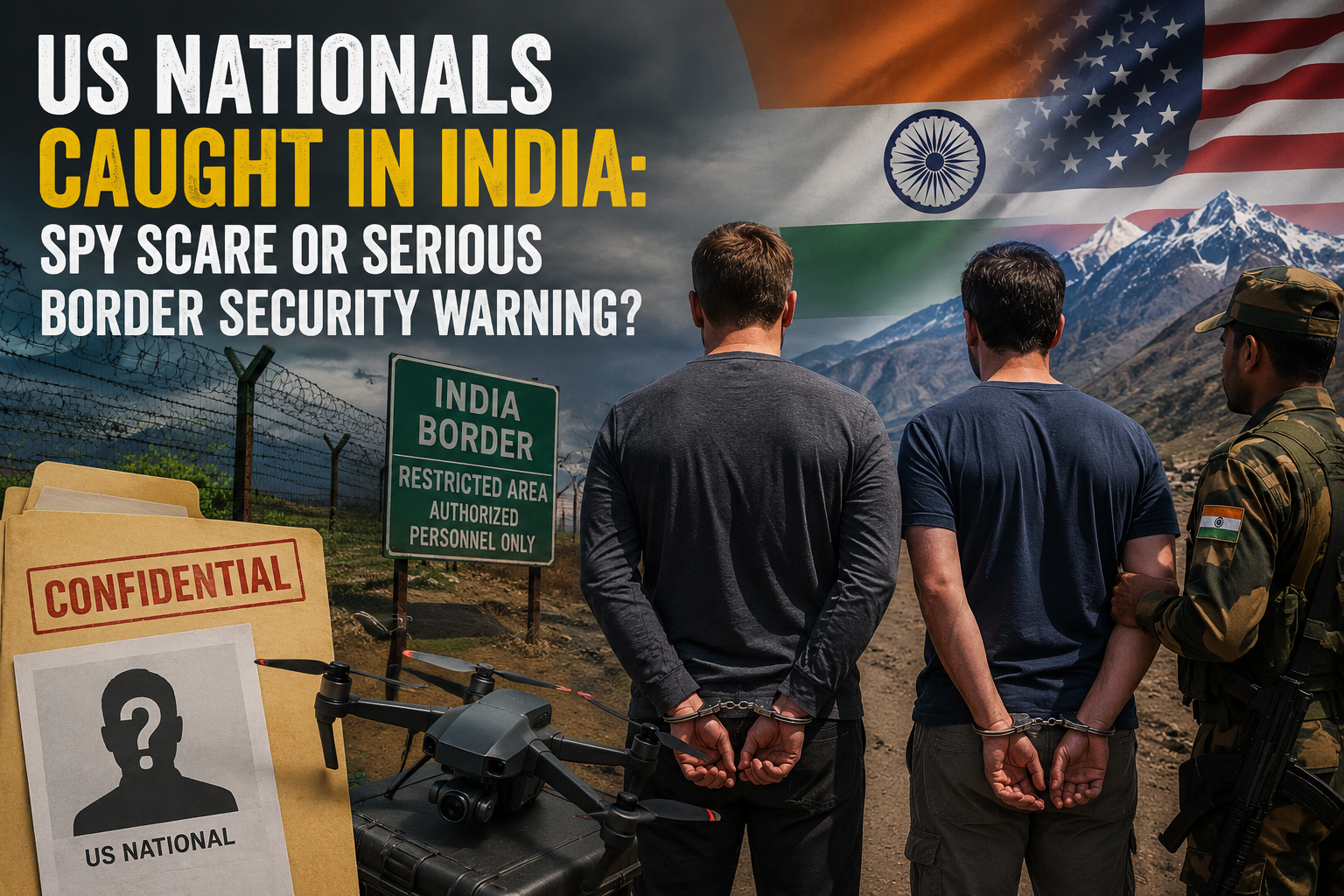
US Nationals Caught in India: Spy Scare or Serious Border Security Warning?

India’s security agencies are facing a sensitive question: why are foreign nationals with military or conflict-zone backgrounds being found near India’s vulnerable borders?
The latest case involves Jordan Brown, an American national who reportedly claimed to be a former U.S. Navy and Special Forces serviceman. According to Times of India, he was apprehended near the India-Nepal border in Uttar Pradesh while allegedly trying to cross into Nepal through an unauthorized route. Officials said he was not carrying a passport, visa or identity document, and gave contradictory statements about his identity, travel history and purpose of visit.
This comes months after another American, Matthew Aaron VanDyke, was arrested by India’s National Investigation Agency along with six Ukrainian nationals in a case involving alleged illegal travel to Myanmar and training of armed groups in drone warfare.
Together, these cases have created a national security debate: are these isolated individuals, private adventurers, mercenaries — or part of something bigger?
Who Is Jordan Brown?
Jordan Brown reportedly told Indian authorities that he was from California, had travelled to nearly 70 countries, studied at the University of California and served in the U.S. Navy and Special Forces before leaving military service around two years ago.
He was allegedly intercepted near Border Pillar No. 516 in the Sonauli area, away from the official immigration route. Security personnel reportedly stopped him while he was moving toward Nepal through an unauthorized foot trail.
At this stage, Indian authorities have not publicly proven that Brown was a spy. But the lack of documents, sensitive border location and contradictory answers naturally raise serious questions.
For India, this is not a small issue. The India-Nepal border is open and people-to-people friendly, but it can also be misused by smugglers, fake-document networks, illegal foreign entrants and hostile intelligence actors.
Matthew VanDyke: The More Serious Case
The Matthew VanDyke case is much bigger.
NDTV reported that VanDyke and six Ukrainian nationals were sent to judicial custody and charged under India’s anti-terror law, the Unlawful Activities (Prevention) Act. According to the FIR, they allegedly travelled to restricted areas in Mizoram, crossed into Myanmar illegally, contacted ethnic armed organisations and groups banned in India, and allegedly gave weapons training and drone-operation support.
The case became even more serious because authorities reportedly alleged that drones were routed from Europe to Myanmar via India for use by armed groups.
Al Jazeera also reported that India arrested six Ukrainians and one American for allegedly entering India’s northeast without permits and crossing into Myanmar to train armed groups in drone warfare.
Was India Being Used as a Transit Route?
This is the biggest concern.
ThePrint reported that VanDyke had allegedly used India as a route to Myanmar in 2025 as well, and that this was his second such visit. According to security establishment sources cited by ThePrint, the group was allegedly training Kuki-Chin Army representatives in drone warfare and operations in Myanmar.
The same report also said investigators found photos and videos showing training activity, and drones were allegedly delivered from Europe to Mizoram before being taken across the border.
However, one important detail must be mentioned: ThePrint reported that, so far, sources said no videos or photos had been found showing them training ethnic groups fighting against India.
That means the case is serious, but responsible reporting should avoid jumping ahead of the investigation.
Is the U.S. Trying to Destabilize India?
There is no confirmed public evidence that the U.S. government officially sent Jordan Brown or Matthew VanDyke to destabilize India.
That distinction matters.
India and the United States have a complex relationship. They cooperate in defence, technology, semiconductors, maritime security and the Indo-Pacific. A White House statement in 2025 said both countries were deepening defence ties and planning a new ten-year framework for the U.S.-India Major Defense Partnership. It also mentioned expanded defence sales, co-production and intelligence-sharing cooperation.
At the same time, India and the U.S. also have tensions over trade, tariffs, Russia, energy, agriculture, data, technology controls and strategic autonomy. Reuters recently reported that India held out for better terms in U.S. trade talks, refusing to rush into a deal that could compromise sensitive sectors like agriculture.
So the reality is this: India and America are partners, but not always on the same page.
The arrests do not prove an official U.S. destabilization plan. But they do show that India must be alert to foreign individuals, private military networks, NGO-linked conflict actors, intelligence freelancers and mercenary-style groups using Indian territory as a transit or operating zone.
Why Northeast India Is Sensitive
Northeast India is strategically important because it connects India to Myanmar, Bangladesh, Bhutan, China and Southeast Asia. States like Manipur, Mizoram and Nagaland have complex ethnic, border and insurgency histories.
Al Jazeera noted that foreigners require special permits before entering certain northeastern states bordering Myanmar, especially after Myanmar’s 2021 military coup.
This is why alleged drone training and cross-border movement by foreign nationals is a serious security issue. Drone warfare has changed modern conflict. Small armed groups can now use drones for surveillance, targeting and attacks. If such technology reaches unstable border regions, India’s internal security risks can increase.
Why India Must Take This Seriously
These cases should push India to strengthen four areas.
First, India needs tighter monitoring of foreign nationals entering sensitive border states.
Second, drone imports, drone parts and dual-use technology must be tracked more carefully.
Third, intelligence coordination between immigration, state police, central agencies and border forces must improve.
Fourth, India must ensure that friendly countries do not ignore private citizens or organizations operating in conflict zones using Indian territory.
This is not anti-Americanism. This is basic national security.
The Bigger Message
India is rising as a global power. As India becomes more important in defence, semiconductors, AI, critical minerals, maritime security and global trade, more foreign actors will watch India closely.
Some will come as investors. Some as diplomats. Some as researchers. Some as journalists. But some may come with unclear intentions.
The Jordan Brown and Matthew VanDyke cases should be treated as a wake-up call. India must stay open to the world, but not careless with its borders.
Final Thoughts
The arrests of Jordan Brown and Matthew VanDyke have triggered important questions about foreign movement near India’s sensitive borders.
There is no confirmed public evidence that Washington officially ordered a destabilization operation against India. But there is enough evidence to say India faces a real challenge from foreign nationals, private conflict networks and cross-border grey-zone activity.
India’s rise will attract attention, partnership and pressure. The country must work with allies where interests match, but protect its sovereignty where risks emerge.
The message is simple: India can be a partner to the world, but India’s borders cannot become a playground for foreign operatives.
FAQs
Was Jordan Brown officially proven to be a spy?
No. Public reports say he was detained near the India-Nepal border without valid documents, but authorities have not publicly proven espionage.
Who is Matthew VanDyke?
Matthew Aaron VanDyke is an American national arrested by India’s NIA along with six Ukrainian nationals in a case involving alleged illegal travel to Myanmar and drone warfare training.
Is the U.S. government trying to destabilize India?
There is no confirmed public evidence proving an official U.S. plan to destabilize India. However, the cases raise serious concerns about foreign nationals and private conflict networks using Indian territory.
Why is Northeast India sensitive?
Northeast India borders Myanmar and has a history of ethnic tensions, insurgent networks and cross-border movement, making it a sensitive security region.
What should India do next?
India should strengthen border monitoring, track drone-related technology, improve immigration checks and increase intelligence coordination in sensitive regions.
Disclaimer: This article is for informational and educational purposes only. It is based on publicly available reports and allegations currently under investigation or court process. It does not claim guilt, espionage or official foreign-state involvement unless confirmed by competent authorities.