

















































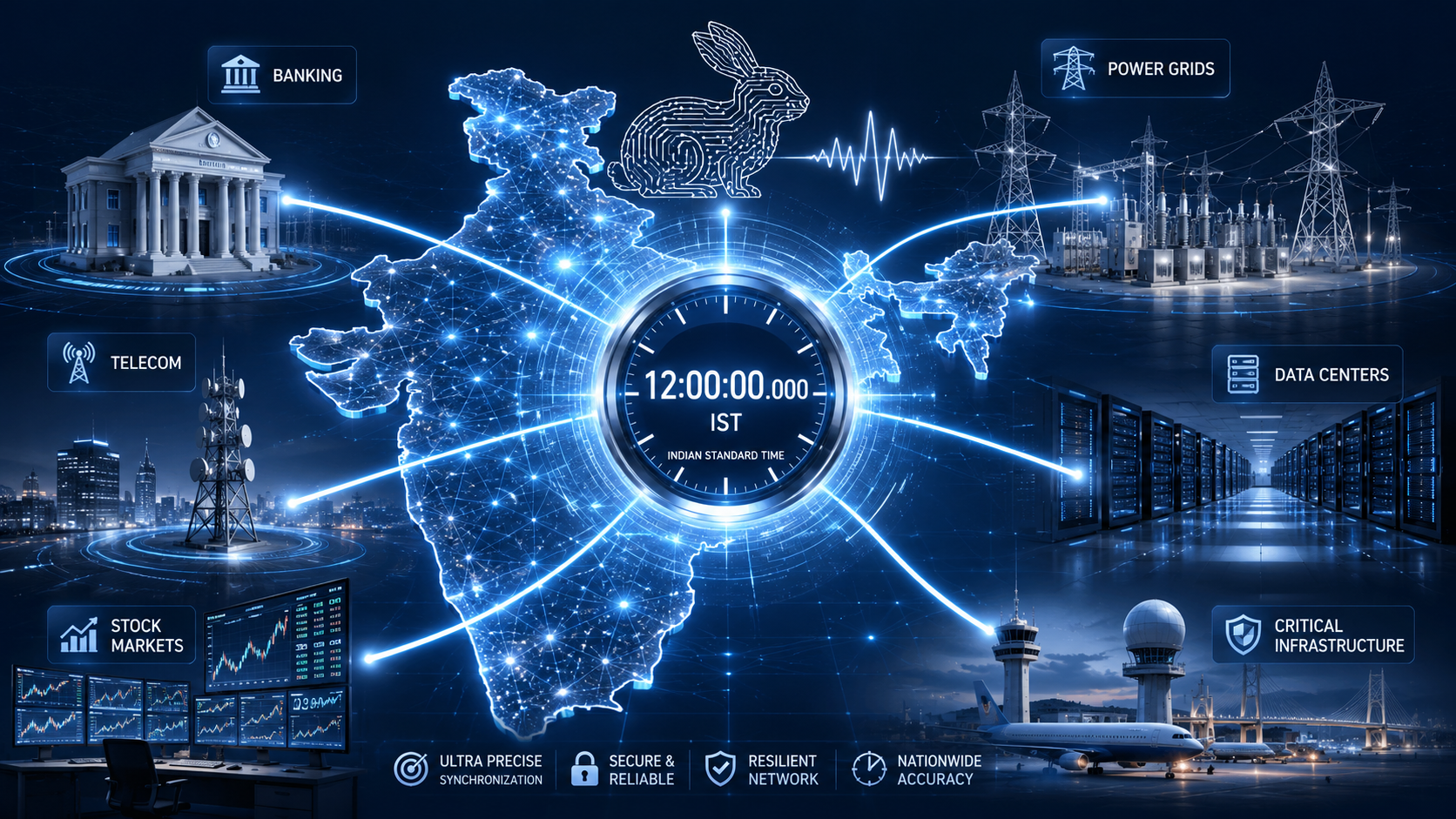
India’s White Rabbit Technology: Why Precision Time Is the New Digital Power

India’s New Digital Infrastructure Breakthrough
India has taken a major step toward technological self-reliance with the launch of a White Rabbit Technology-based Indian Standard Time dissemination network in Bengaluru.
Union Minister Pralhad Joshi commissioned the demonstration network at the Regional Reference Standard Laboratory, Bengaluru, under the government’s “One Nation, One Time” initiative. The system was developed jointly by the Department of Consumer Affairs, CSIR-National Physical Laboratory and ISRO to securely distribute Indian Standard Time using White Rabbit precision timing technology.
At first, this may sound like a small technical update. But in reality, precise time is the hidden backbone of the modern digital economy.
Banking, stock exchanges, mobile networks, power grids, transportation, satellites, defence systems and digital governance all depend on exact time synchronization.
What Is White Rabbit Technology?
White Rabbit is an advanced time-synchronization technology originally developed at CERN for particle-accelerator systems that require extremely accurate timing. CERN says White Rabbit can provide sub-nanosecond accuracy and picosecond-level precision for large distributed systems connected through networks.
In simple words, White Rabbit makes different machines, servers and devices agree on the exact same time with extreme precision.
It combines Ethernet networking with precision time protocols so that data and time signals can move together through optical-fibre networks. CERN Open Science describes White Rabbit as an Ethernet-based network technology that helps users precisely time-tag measured data and trigger data-taking in large installations.
For India, this means Indian Standard Time can be distributed securely across critical sectors without relying only on foreign time sources.
Why Time Synchronization Matters
Most people think time is just what appears on a phone screen. But for critical infrastructure, time is a security layer.
In stock markets, exact timestamps decide the order of trades. In digital banking, timestamps help verify transactions. In telecom, synchronized timing improves network stability. In power grids, precise time helps monitor frequency, faults and grid behaviour. In cyber forensics, trusted timestamps help investigate attacks.
PIB says India’s White Rabbit network is designed for critical sectors such as banking and financial markets, telecommunications, power systems, transportation, digital governance and strategic infrastructure.
This is why White Rabbit is not just a lab technology. It is a national infrastructure technology.
Reducing Dependence on GPS
One of the biggest advantages of India’s project is reduced dependence on foreign timing sources such as GPS.
PIB said the initiative is aimed at establishing sovereignty of Indian Standard Time and reducing reliance on external time references, which can protect critical sectors from risks such as cyberattacks and data manipulation.
This is important because GPS is controlled by the United States. It is useful and widely used, but overdependence on any foreign satellite-based timing source can become a strategic vulnerability.
India already has its own satellite navigation system, NavIC, and earlier C-DOT and CSIR-NPL signed an agreement to develop a NavIC-based IST-traceable Primary Reference Time Clock for the telecom sector. That project aimed to provide Indian Standard Time traceability within ±20 nanoseconds to telecom and internet service providers, reduce GPS dependence, support cyber-secure networks and reduce call drops.
White Rabbit takes this vision further by building a secure, high-precision time distribution backbone.
A Big Step for Stock Markets and Digital Banking
India’s financial markets operate at high speed. In modern trading, milliseconds and microseconds matter. If time records are inaccurate, disputes can arise over which trade came first, whether systems were manipulated, or whether a transaction was properly recorded.
That is why the involvement of SEBI and the National Stock Exchange is important.
PIB reported that India successfully completed verification of secure Indian Standard Time dissemination between RRSL Bengaluru and NSE Chennai using White Rabbit Technology, in collaboration with CSIR-NPL, ISRO, SEBI, NSE, BSNL and other stakeholders.
This could help create more reliable timestamps for financial systems, trading infrastructure and digital payments.
Why Telecom and 5G Need It
Telecom networks also need accurate timing. As India moves deeper into 5G, 6G, IoT and smart infrastructure, time synchronization becomes even more important.
Every tower, switching system and data node must coordinate smoothly. Better synchronization can support faster networks, fewer errors, improved reliability and more secure data exchange.
This is why India’s earlier NavIC-based timing project specifically mentioned telecom service providers, internet service providers, cyber-secure networks, transaction forensics and reduced call drops.
In the future, White Rabbit-style timing can become even more important for autonomous systems, smart factories, drone corridors, defence networks and AI-powered infrastructure.
Power Grids, Defence and National Security
India’s power grid is one of the world’s largest. Managing it safely requires real-time data from multiple locations. If timing is inaccurate, grid monitoring and fault analysis can become weaker.
PIB specifically listed power systems among the sectors that can benefit from White Rabbit-based secure time synchronization.
The defence significance is also clear. Modern defence depends on satellites, radars, secure communications, missile tracking, command systems and encrypted networks. All of these require trusted time.
A sovereign time network strengthens India’s ability to operate critical systems even during cyber conflict, satellite disruption or geopolitical pressure.
Why This Is a Make in India Moment
White Rabbit technology itself began internationally, but India’s achievement is in building an indigenous, secure and resilient national time dissemination framework around Indian Standard Time.
PIB said the project reflects India’s technological self-reliance and will reduce dependence on foreign timing sources while supporting critical digital infrastructure.
This is the real Make in India message: India is not only building roads, trains, rockets and semiconductors. It is now building the invisible digital foundations needed for a modern economy.
Final Thoughts
India’s White Rabbit Technology network may not look as dramatic as a rocket launch or a bullet train, but its importance is massive.
It gives India a secure way to distribute Indian Standard Time across critical infrastructure. It supports banking, stock markets, telecom, power grids, cyber security, transport and digital governance. It also reduces dependence on foreign timing sources like GPS.
In the digital age, the country that controls trusted time controls the reliability of its networks.
White Rabbit technology is another sign that India is building the deep infrastructure needed for Viksit Bharat — not only visible infrastructure, but the invisible systems that keep a modern nation running.
FAQs
What is White Rabbit Technology?
White Rabbit is a precision time-synchronization technology that can synchronize devices across a network with extremely high accuracy.
Why did India launch a White Rabbit network?
India launched it to securely distribute Indian Standard Time across critical sectors such as banking, telecom, power grids, transportation and digital governance.
Who developed India’s White Rabbit time network?
It was developed jointly by the Department of Consumer Affairs, CSIR-NPL and ISRO, with involvement from stakeholders such as SEBI, NSE and BSNL.
Does this reduce India’s dependence on GPS?
Yes. The project is designed to reduce dependence on foreign timing sources such as GPS and strengthen India’s digital sovereignty.
Why is precise time important?
Precise time is essential for financial transactions, stock trades, telecom networks, power-grid stability, cyber forensics, defence systems and digital governance.
Disclaimer: This article is for informational and educational purposes only. It is based on official government releases and credible technical sources. It should not be treated as technical, investment, cyber-security or policy advice.