



























US-Saudi Nuclear Deal: Could It Trigger a Nuclear Race in West Asia?

A Nuclear Deal With Big Geopolitical Consequences
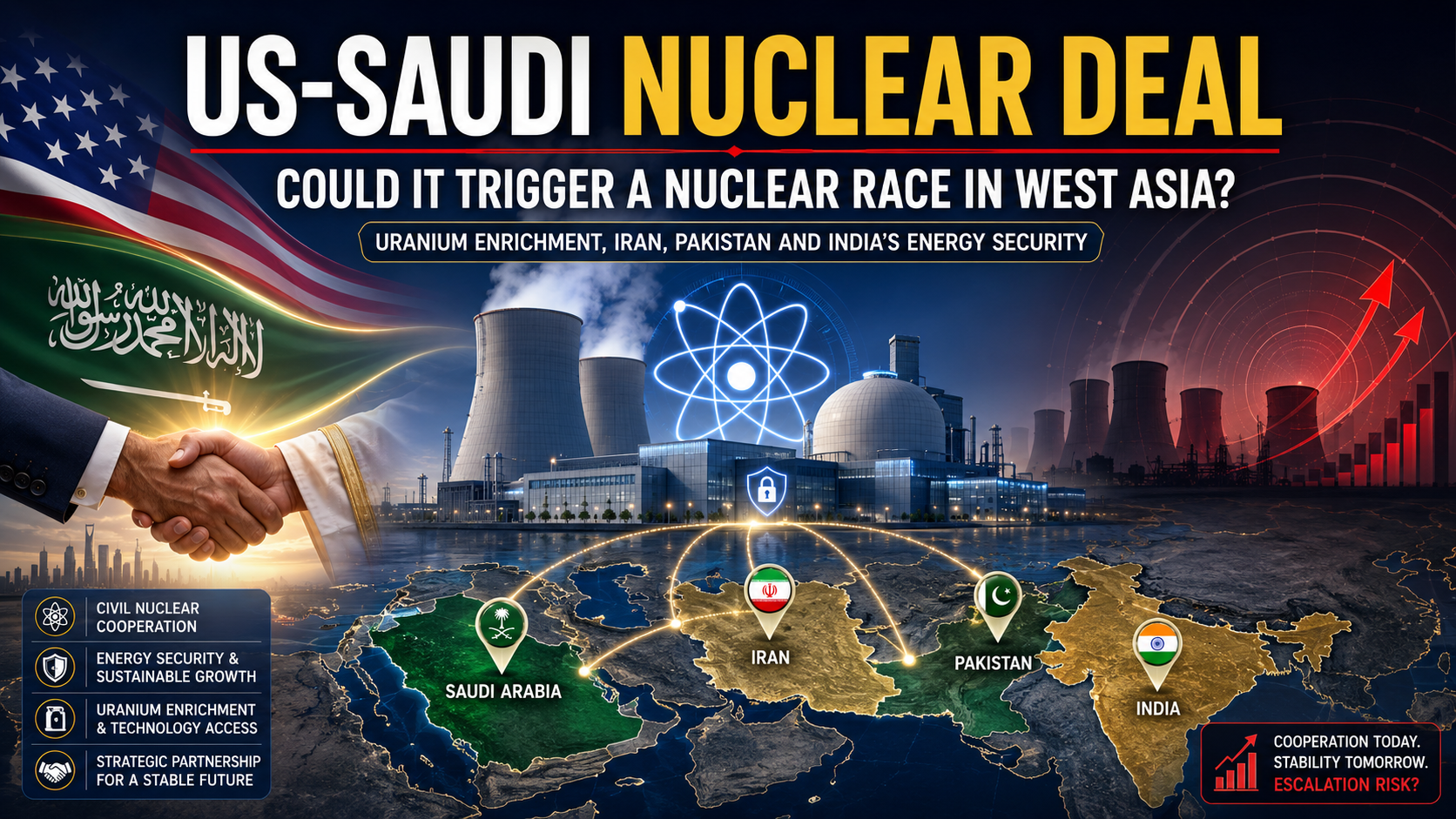
The proposed United States-Saudi Arabia civil nuclear deal has become one of the most sensitive developments in West Asia.
On paper, the agreement is about peaceful nuclear energy. Saudi Arabia wants nuclear power to diversify its energy mix, reduce domestic oil consumption and support its Vision 2030 economic transformation. AP reported that Washington sees cooperation with Riyadh as a way to support American nuclear companies while countering Russian and Chinese influence in the Gulf.
But the concern is not nuclear power itself. The real concern is whether Saudi Arabia will be allowed to develop sensitive nuclear fuel-cycle capabilities such as uranium enrichment and spent-fuel reprocessing.
Those technologies can be used for peaceful energy, but they can also create pathways toward nuclear weapons if strict safeguards are missing.
Why the Deal Is Controversial
Reuters reported in February 2026 that the Trump administration had informed Congress of its intent to pursue a civil nuclear agreement with Saudi Arabia that omits key non-proliferation safeguards usually demanded in such agreements. The report said the proposed pact could open the way for Saudi Arabia to have enrichment-related capabilities.
Reuters also reported in May 2026 that a proposed US pact with Saudi Arabia lacked the strictest guardrails urged by lawmakers. These guardrails include a Saudi commitment not to enrich uranium or reprocess spent nuclear fuel.
This is why arms-control experts are worried. A normal civil nuclear program does not automatically mean a bomb program. But if a country gains enrichment capability in a tense region, other regional powers may start asking: why should we stay behind?
The Iran Factor
The biggest reason this issue is dangerous is Iran.
Saudi Arabia and Iran have long been regional rivals. Saudi Crown Prince Mohammed bin Salman has previously said that if Iran develops a nuclear weapon, Saudi Arabia would seek one too. The Guardian reported his statement in 2023 that if Iran gets a nuclear weapon, “we will have to get one.”
That statement is the heart of the issue.
If Iran is seen as moving closer to nuclear weapon capability, Saudi Arabia may demand its own nuclear option. If Saudi Arabia gains enrichment rights, Iran may use that as justification for maintaining or expanding its own program. Then other countries in the region may also rethink their positions.
This is how a nuclear race begins — not with one announcement, but with a chain reaction of insecurity.
Civil Nuclear Energy or Nuclear Bomb Race?
It is important to be fair: Saudi Arabia says it wants nuclear energy for peaceful development. Nuclear power can support electricity generation, desalination and industrial growth. World Nuclear Association notes that Saudi Arabia’s nuclear plans include large reactors, small modular reactors and fuel-cycle ambitions linked to Vision 2030.
The problem is that West Asia is not a normal region. It has wars, proxy conflicts, missile attacks, oil chokepoints, Israel-Iran tensions, US military bases and fragile security alliances.
In such an environment, even a peaceful nuclear program can become a strategic signal.
If the deal follows the strict “gold standard” model — no enrichment, no reprocessing and strong IAEA inspections — the risk will be much lower. But if enrichment is allowed without the strongest safeguards, the deal could weaken global non-proliferation norms.
Why Enrichment Is the Red Line
Uranium enrichment is the most sensitive part of this debate.
Low-enriched uranium can fuel nuclear reactors. But higher enrichment levels can move a country closer to weapons capability. That does not mean every enrichment program becomes a bomb program, but it does shorten the technical distance.
This is why the United States pushed the UAE into a “gold standard” nuclear agreement in 2009, where the UAE agreed not to pursue enrichment or reprocessing. Arms Control Association notes that many lawmakers want Saudi Arabia to accept similar restrictions.
If Saudi Arabia gets a softer deal, critics will ask: why was one rule applied to the UAE and another to Saudi Arabia?
Could Pakistan Become a Factor?
Another sensitive angle is Pakistan.
Pakistan is already a nuclear-armed state and has close security ties with Saudi Arabia. Reuters reported that Pakistan signed a mutual defence agreement with Saudi Arabia last year and that thousands of Pakistani soldiers have been deployed in the kingdom.
This does not mean Pakistan will transfer nuclear weapons to Saudi Arabia. There is no confirmed public evidence of that.
But in a crisis, the perception of a Saudi-Pakistan security link matters. If Saudi Arabia feels threatened by Iran, Pakistan’s role in Gulf security could become more important. For India, this is a development worth watching carefully.
What This Means for India
India is not directly part of the US-Saudi nuclear deal, but India will feel the impact if West Asia becomes unstable.
First, India’s energy security is deeply connected to the Gulf. The Embassy of India in Riyadh says India-Saudi trade reached $41.88 billion in FY 2024-25, with India importing crude oil, LPG, fertilizers, chemicals and plastics from Saudi Arabia.
Second, Saudi Arabia remains an important oil supplier for India. Economic Times reported that Saudi Arabia supplied an average of about 700,000 barrels per day between July 2025 and April 2026, accounting for around 14.5% of India’s crude imports during that period.
Third, millions of Indians live and work in Saudi Arabia. Prime Minister Modi has previously said nearly 2.6 million Indians have made Saudi Arabia their second home.
So if a nuclear race increases tension in West Asia, India could face higher oil prices, pressure on remittances, shipping risks, inflation concerns and diplomatic complications.
India’s Diplomatic Challenge
India has strong ties with both the United States and Saudi Arabia. India also maintains relations with Iran, Israel and Gulf countries. This balancing act is not easy.
If West Asia becomes more nuclearized, India will need a careful strategy.
India should support peaceful nuclear energy under strict international safeguards. It should oppose nuclear proliferation in West Asia. It should protect its energy supply chains. It should avoid taking sides in every regional rivalry. And it should continue building strategic petroleum reserves, renewable energy, nuclear power and green hydrogen at home.
For India, the biggest lesson is simple: dependence on unstable regions creates vulnerability.
Could This Affect India’s Own Nuclear Policy?
India already has its own nuclear doctrine and strategic deterrent. The US-Saudi deal will not directly change India’s nuclear policy.
But it can change the regional environment around India.
If Saudi Arabia moves closer to nuclear capability, Iran may react. If Iran reacts, Israel may react. If Pakistan becomes more deeply involved in Gulf security, India will monitor that closely. If oil prices rise, India’s economy feels the shock.
So the effect on India is indirect but serious.
Final Thoughts
The US-Saudi nuclear deal could become a major turning point in West Asia.
If it remains a strictly peaceful civil nuclear agreement with strong IAEA safeguards, it can support Saudi Arabia’s energy transition without destabilizing the region. But if it allows enrichment or reprocessing without the strongest controls, it could create a dangerous precedent.
Saudi Arabia does not currently have nuclear weapons. But the political message is clear: Riyadh does not want Iran to dominate the nuclear balance in West Asia.
That is why this deal matters far beyond Saudi Arabia.
For India, the best strategy is to stay alert, protect energy security, maintain balanced diplomacy and push for strict non-proliferation standards.
West Asia’s nuclear future will not only affect Riyadh, Tehran, Washington and Tel Aviv. It will also affect New Delhi.
FAQs
What is the US-Saudi nuclear deal?
It is a proposed civil nuclear cooperation agreement that would allow the United States and Saudi Arabia to cooperate on nuclear energy.
Why is the deal controversial?
The controversy is over whether Saudi Arabia may be allowed to develop uranium enrichment or reprocessing capabilities without the strictest safeguards.
Does Saudi Arabia have nuclear weapons?
No. Saudi Arabia does not currently have nuclear weapons.
Could this trigger a nuclear race in West Asia?
It could increase the risk if enrichment is allowed and Iran-Saudi rivalry intensifies. Strong safeguards would reduce that risk.
How will this affect India?
India could be affected through oil prices, Gulf stability, Indian workers in Saudi Arabia, trade, shipping routes and Pakistan’s security role in the Gulf.
Disclaimer: This article is for informational and educational purposes only. It does not claim that Saudi Arabia is building nuclear weapons. It discusses publicly reported concerns about civil nuclear cooperation, uranium enrichment, regional security and non-proliferation risks.