

















































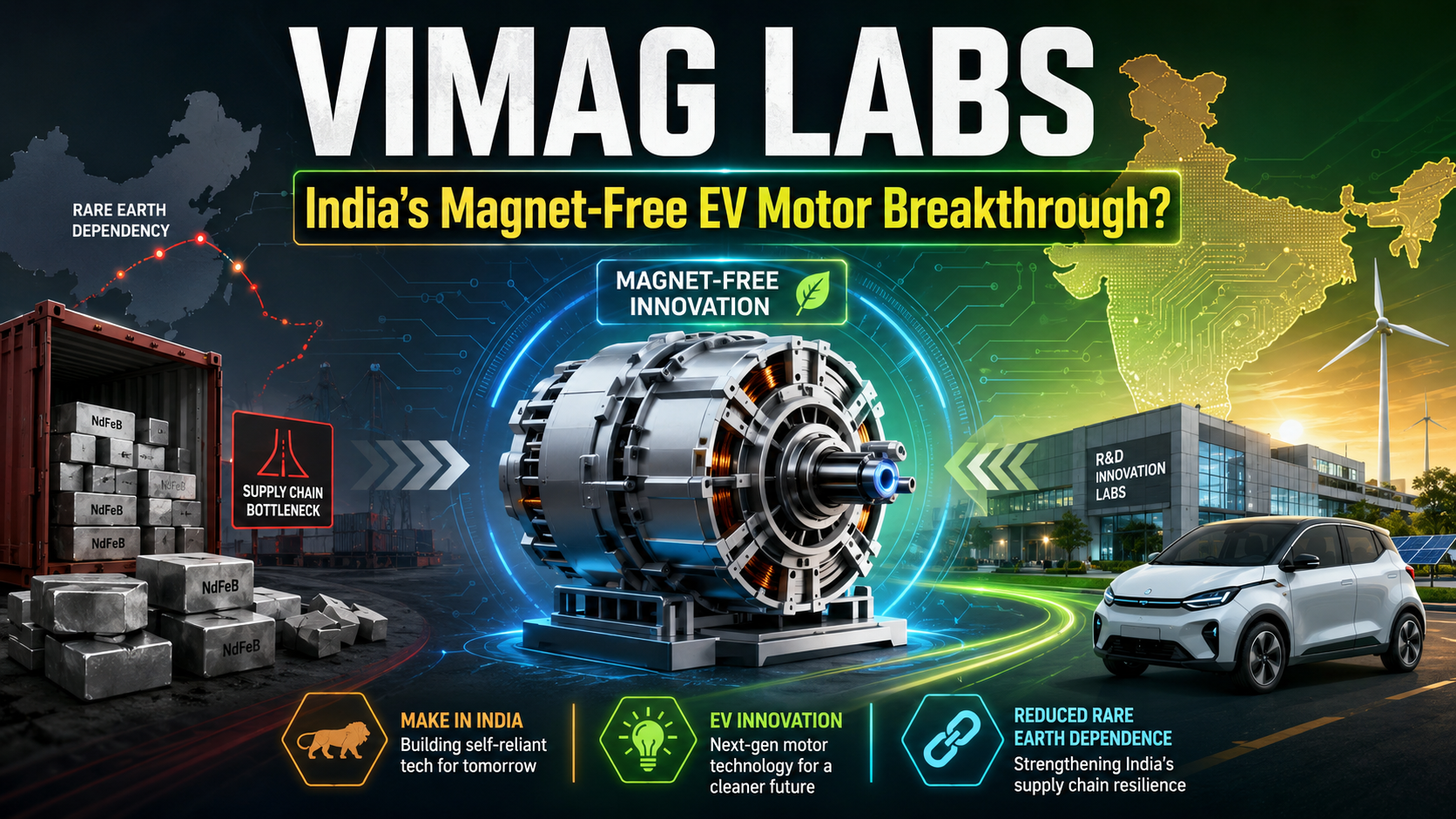
Vimag Labs: The Indian Startup Trying to Break China’s Rare Earth Magnet Grip on EVs

India’s electric vehicle story is no longer only about batteries, charging stations and subsidies. A new battlefield has opened inside the EV motor itself — and Bengaluru-based startup Vimag Labs is trying to solve one of the biggest supply-chain problems in the industry: dependence on China’s rare earth magnets.
Vimag Labs has developed a magnet-free Virtual Magnet Synchronous Motor platform, designed to deliver performance similar to permanent magnet motors without using rare earth magnets. The startup recently secured its fifth Indian patent for its proprietary motor technology, marking an important moment for India’s deep-tech and EV manufacturing ecosystem.
This matters because rare earth magnets are used in many high-performance EV motors. They help deliver strong torque, compact size and energy efficiency. But the supply chain is highly concentrated — especially in China.
Why Rare Earth Magnets Are a Strategic Problem
Rare earth elements are used in electric vehicles, wind turbines, drones, defence systems, robotics, electronics and even data center infrastructure. The issue is not that rare earth minerals are found only in China. The real issue is processing and magnet manufacturing.
The International Energy Agency says China accounted for 91% of global refined output of magnet rare earths in 2024 and 94% of sintered permanent magnet production.
That level of control creates a major risk for countries like India. If exports are restricted, delayed or made expensive, EV makers can face production problems. Reuters reported that India has been racing to reduce reliance on Chinese rare earth magnets after export curbs created pressure on automakers and component makers.
In simple words, without secure motor technology, India’s EV dream can become vulnerable to foreign supply-chain pressure.
What Is Vimag Labs Building?
Vimag Labs is trying to remove the rare earth magnet problem from the motor itself.
The company’s Virtual Magnet Synchronous Motor, or VMSM, uses power electronics, software control algorithms and rotating transformer excitation to create and control the magnetic field electronically. Instead of using physical permanent magnets in the rotor, the system creates a “software-defined magnet.”
India Today reported that Vimag’s technology replaces rare earth magnets with copper coils and steel, then uses software and electronics to generate magnetic fields inside the motor. The motor firmware can dynamically adjust this field in real time, which could help performance and efficiency.
This is important because most magnet-free motors struggle with size, weight, torque or efficiency. Vimag’s big claim is that software and electronics can help close that performance gap.
Why This Is a Make in India Moment
Vimag Labs was founded in 2025 by Manish Seth and Piyush Desai. The company says its goal is to create indigenous electric motor intellectual property that can reduce India’s dependence on imported critical materials while delivering globally competitive performance.
The startup has already raised $5 million in a Series A round led by Accel, with participation from Chakra Growth Fund and Thinkuvate. The money is being used to commercialise its Virtual Magnet motor platform, expand engineering and manufacturing capabilities, and support go-to-market plans across automotive, defence and industrial sectors.
This is exactly the kind of innovation India needs. Instead of waiting for foreign companies to solve supply-chain problems, Indian engineers are trying to redesign the core technology.
Beyond Cars: Defence, Industry and Robotics
The most exciting part of Vimag Labs’ technology is that it is not limited to cars.
According to Startup Pedia, the company is working on pilot programmes with two-wheeler and passenger vehicle manufacturers and is also developing higher-power variants for light commercial vehicles, heavy commercial vehicles and industrial applications in the 200 kW to 600 kW range.
The same report says Vimag sees opportunities in robotics, defence systems, HVAC and advanced cooling applications. That makes the technology strategically important because high-efficiency motors are everywhere — from factories and drones to military platforms and AI data centers.
If India can build reliable magnet-free motor systems at scale, it can reduce dependence not only in EVs but also in several future industries.
Why This Matters for India’s EV Future
India wants to become a global EV manufacturing hub. But to achieve that, the country cannot depend only on imported motors, imported magnets and imported critical materials.
A strong EV ecosystem needs local battery manufacturing, local power electronics, local motor technology, local software, and domestic manufacturing capacity.
Vimag Labs fits into this bigger picture. Its technology could help Indian EV makers reduce exposure to rare earth price shocks and geopolitical uncertainty.
Reuters reported that alternate EV motor technologies are being tested in India as companies try to reduce dependence on Chinese rare earth magnets. But the challenge is clear: magnet-free motors must still match the compact size, low weight and strong performance of magnet-based motors.
That means Vimag’s success will depend on real-world testing, OEM adoption, cost competitiveness and manufacturing scale.
India Is Innovating Faster Than Before
Vimag Labs is a strong example of how India’s startup ecosystem is moving beyond apps and consumer platforms into serious hardware innovation.
For years, India was seen mostly as a software services powerhouse. Now, Indian startups are entering semiconductors, defence tech, space tech, EV powertrains, AI infrastructure and advanced manufacturing.
This shift is important for Viksit Bharat 2047. A developed India cannot depend only on imported core technologies. It must own intellectual property in strategic sectors.
Vimag Labs’ fifth patent does not mean India has solved the entire rare earth challenge. But it does show that Indian startups are attacking global hard-tech problems with speed, ambition and original engineering.
Final Thoughts
Vimag Labs may be a young startup, but its idea is powerful: if rare earth magnets are a geopolitical weakness, redesign the motor so it does not need them.
That is the kind of thinking India needs in the EV and AI era.
China still dominates rare earth processing and magnet manufacturing. Building an alternative supply chain will take time. But India does not have to wait passively. It can mine, refine, recycle and — most importantly — innovate around the bottleneck.
Vimag Labs shows that Make in India is not only about assembling products. It is about creating new technology from the ground up.
If the company can successfully commercialise its magnet-free motor platform, it could become a major milestone for India’s EV independence, defence technology and clean mobility future.
FAQs
What is Vimag Labs?
Vimag Labs is a Bengaluru-based deep-tech startup developing magnet-free electric motor technology for EVs, industrial systems, defence and other applications.
What problem is Vimag Labs trying to solve?
The startup is trying to reduce dependence on rare earth permanent magnets, a supply chain dominated by China.
What is a Virtual Magnet Synchronous Motor?
It is Vimag Labs’ magnet-free motor platform that uses power electronics, software and control algorithms to electronically create and regulate magnetic fields.
Why are rare earth magnets important in EVs?
Rare earth magnets help EV motors deliver high torque, compact size and efficiency, but their supply chain is highly concentrated.
Can Vimag Labs replace Chinese rare earth magnets completely?
Not immediately. The technology still needs large-scale commercial validation, OEM adoption and manufacturing scale. But it is an important step toward reducing dependence.
Disclaimer: This article is for informational and educational purposes only. It is based on publicly available reports and company-related updates. It should not be treated as investment, financial, technical or business advice. Readers should verify details from official company and regulatory sources before making any business or investment decisions.