














































Gujarat’s Kalpasar Project: Can Dutch Water Expertise Turn the Gulf of Khambhat Into India’s Mega Reservoir?

Gujarat’s long-awaited Kalpasar Project is again in the spotlight after India and the Netherlands agreed to deepen technical cooperation on the mega water project. During Prime Minister Narendra Modi’s visit to the Netherlands in May 2026, India’s Ministry of Jal Shakti and the Dutch Ministry of Infrastructure and Water Management signed a Letter of Intent for technical cooperation on the Kalpasar Project.
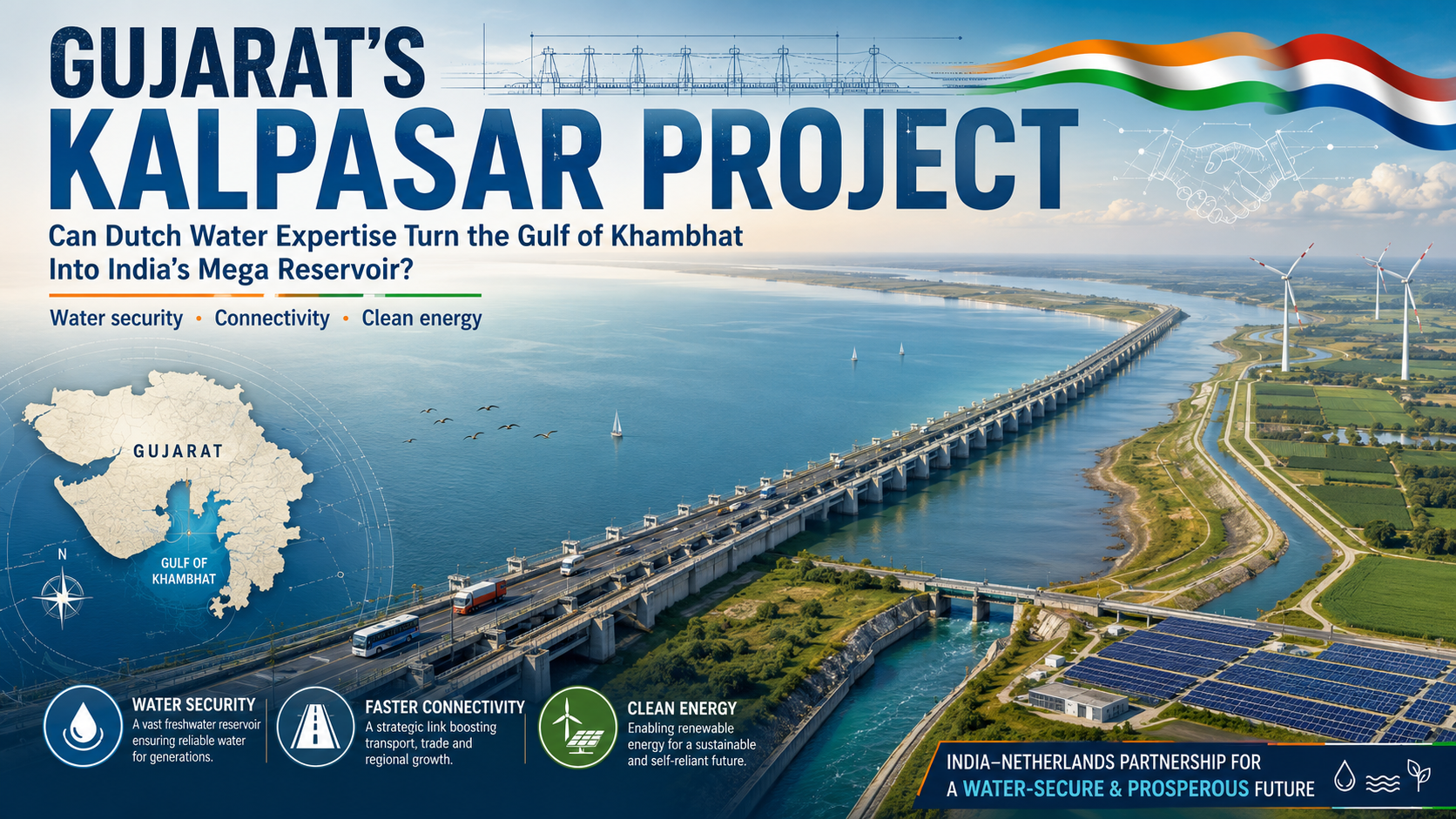
The symbolism was powerful. PM Modi visited the Netherlands’ iconic Afsluitdijk, a 32-km dam and causeway that has protected the country from the North Sea while enabling freshwater storage. The Prime Minister’s Office said the visit highlighted parallels between Afsluitdijk and Gujarat’s Kalpasar vision, which aims to create a freshwater reservoir across the Gulf of Khambhat while integrating tidal power, irrigation and transport infrastructure.
What Is the Kalpasar Project?
Kalpasar, often described as one of India’s most ambitious water infrastructure ideas, proposes building a large dam system across the Gulf of Khambhat to create a massive freshwater reservoir.
The basic idea is simple but bold: instead of allowing huge volumes of river water to flow into the Arabian Sea, Gujarat wants to store part of that water and use it for drinking, irrigation and industrial needs.
The Times of India reported that the Gujarat government told the state assembly that the project’s Detailed Project Report was in the finalisation stage as of December 31, 2025. The report said the project could store around 10 billion cubic metres of freshwater and include a road link over the dam to reduce travel distance between Saurashtra and South Gujarat.
Why Netherlands Matters
The Netherlands is one of the world’s most experienced countries in water management. Much of the country sits at or below sea level, and Dutch engineering has become globally respected for flood control, storm barriers, dykes, water pumping, land reclamation and climate-resilient infrastructure.
Rijkswaterstaat says the Afsluitdijk is a 32-km dyke completed in 1932 that separates the Wadden Sea from the IJsselmeer and has protected the Netherlands from the sea for around 90 years.
For Gujarat, Dutch experience can help in areas like hydraulic modelling, sediment management, salinity control, flood safety, environmental planning, navigation systems and long-term maintenance.
This is important because Kalpasar is not a normal dam. It is a sea-based mega project in a complex tidal zone.
Solving Gujarat’s Water Security Challenge
Water is the biggest reason Kalpasar matters.
Gujarat has strong industrial growth, fast urbanisation and water-stressed regions, especially Saurashtra and parts of north and central Gujarat. The Times of India reported that Gujarat’s per capita annual water availability is around 920 cubic metres, far below the 1,700 cubic metres adequacy benchmark. It also reported that nearly 30,000 MCM of water flows into the sea annually without being stored.
If implemented successfully, Kalpasar could store monsoon river flows from systems linked to the Gulf of Khambhat and supply water for agriculture, drinking needs and industry.
For farmers, this could mean more reliable irrigation. For cities, it could mean improved long-term drinking water planning. For industries, it could reduce uncertainty around water availability.
A Mega Connectivity Boost
Kalpasar is also a connectivity project.
A dam-top road or transport corridor could directly connect Saurashtra and South Gujarat, reducing long travel routes around the Gulf of Khambhat. Recent reports say the evolving plan has considered a multi-lane highway over the dam, with some versions describing a 10-lane or 16-lane corridor depending on the alignment and DPR stage.
This could reduce travel time, cut logistics costs, improve port connectivity and support industrial corridors.
For businesses, shorter routes mean cheaper transport. For people, it means faster movement between Bhavnagar, Bharuch, Dahej, Surat and the wider Saurashtra region.
Clean Energy Potential
Kalpasar also has clean-energy potential because the Gulf of Khambhat has strong tidal movement. The PMO said the project aims to integrate tidal power generation along with irrigation and transport infrastructure.
If technically and environmentally feasible, tidal energy could add a reliable renewable power source. Unlike solar, tidal flows are more predictable. This could support Gujarat’s clean-energy ambitions and reduce fossil fuel dependence.
However, tidal power must be studied carefully. The Gulf’s sediment, marine ecology, fishing livelihoods and navigation routes need strong safeguards before any large-scale construction begins.
Why Kalpasar Could Be a Game Changer
Kalpasar could solve multiple problems at once.
It can improve water security by storing freshwater that otherwise flows into the sea. It can support agriculture by expanding irrigation reliability. It can boost industrial development by ensuring long-term water availability. It can improve connectivity between Saurashtra and South Gujarat. It can create clean-energy opportunities through tidal power. It can also strengthen Gujarat’s climate resilience against future water stress.
This is why Kalpasar is not just an engineering project. It is a development strategy.
The Challenges Are Real
Kalpasar is ambitious, but it is also extremely complex.
The project needs environmental clearances, detailed engineering, financial planning, social impact assessment, marine ecology protection, fisheries safeguards and long-term sediment management.
The Times of India reported that 51 studies had been completed and three more were still in progress, expected to be completed by June 2028.
That means Kalpasar should not be treated as an overnight project. It must be built carefully, transparently and scientifically.
Final Thoughts
Gujarat’s Kalpasar Project could become one of India’s most transformative infrastructure projects if executed properly. With Dutch technical cooperation, India now has access to some of the world’s best water-management experience.
The project has the potential to improve water security, strengthen connectivity, support clean energy and prepare Gujarat for future climate challenges.
But the real success of Kalpasar will depend on one thing: smart execution. If India combines Dutch expertise with Indian scale, environmental safeguards and strong engineering discipline, Kalpasar could become Gujarat’s next big development milestone.
FAQs
What is the Kalpasar Project?
Kalpasar is Gujarat’s proposed mega project to build a dam system across the Gulf of Khambhat and create a large freshwater reservoir for drinking water, irrigation and industry.
How is the Netherlands involved?
India and the Netherlands signed a Letter of Intent for technical cooperation on the Kalpasar Project, using Dutch expertise in water management and hydraulic engineering.
How will Kalpasar improve connectivity?
The project may include a major road or transport corridor over the dam, reducing travel distance between Saurashtra and South Gujarat.
Can Kalpasar generate clean energy?
The project has been linked with tidal power potential, but actual clean-energy generation will depend on technical and environmental feasibility.
Is Kalpasar already under construction?
No. The project is still in the DPR, study and approval stage. Construction would begin only after final approvals.
Disclaimer: This article is for informational and educational purposes only. It is based on official statements and credible media reports available at the time of writing. Kalpasar is still subject to technical, financial, environmental and government approvals. This should not be treated as investment, policy or engineering advice.