












































India-Canada-Australia Tech Triangle: Can Critical Minerals and Semiconductors Power the AI Race?

The global AI race is not only about software, chatbots and cloud platforms. Behind every AI model are semiconductors, data centers, rare minerals, clean energy and secure supply chains.
That is why the new India-Canada-Australia technology triangle matters.
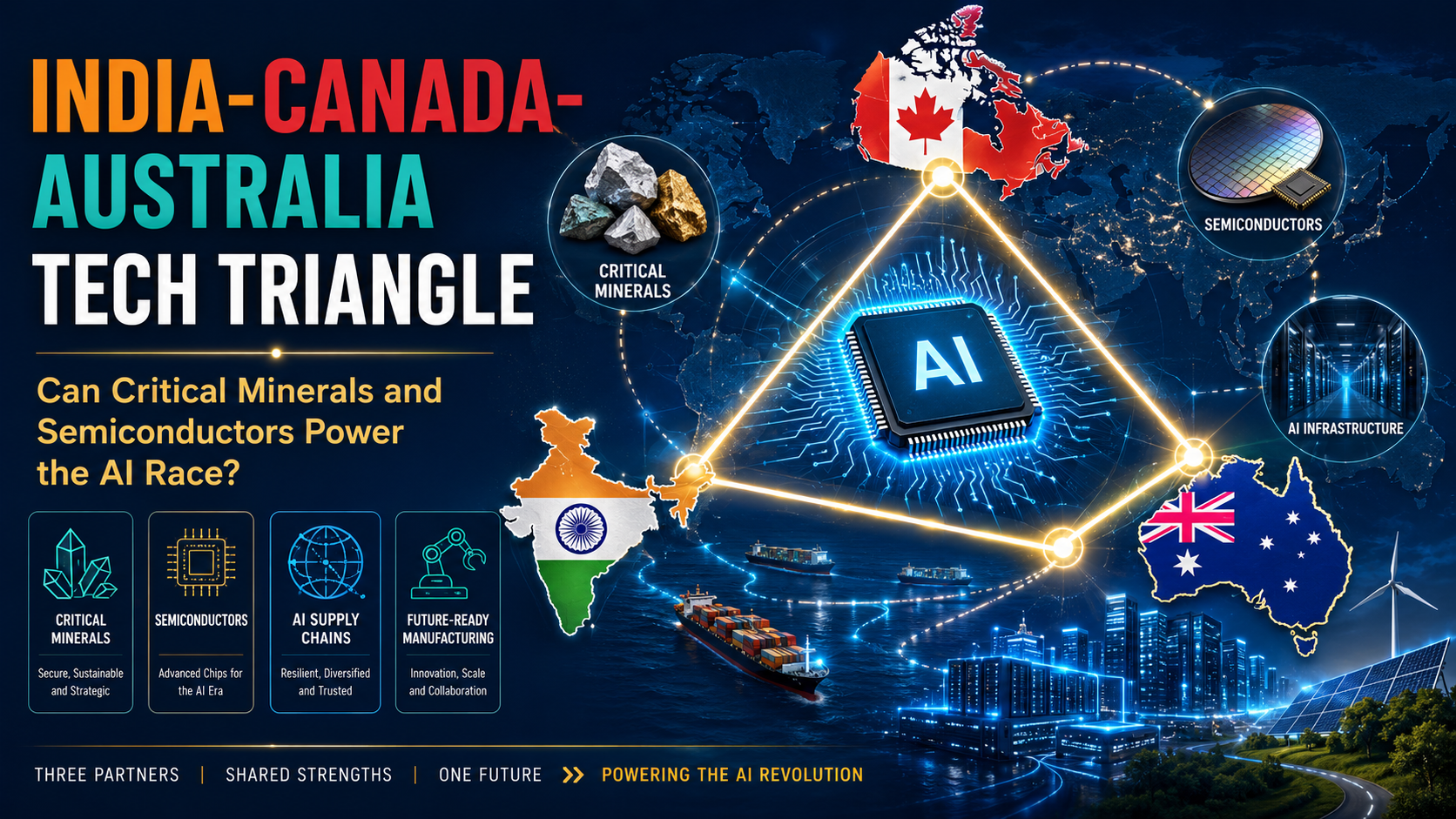
On July 10, 2026, Australia, Canada and India signed a Memorandum of Understanding under the Australia-Canada-India Technology and Innovation Partnership, also known as ACITI. The official Australian government overview says the MoU supports cooperation in artificial intelligence, emerging technologies and the digital economy. It also covers semiconductors, data centres, cloud, digital public infrastructure, IoT, robotics, high-performance computing and cybersecurity.
This is not just another diplomatic announcement. It is a strategic move to build trusted technology supply chains for the AI era.
Why These Three Countries Fit Together
Each country brings a different strength.
India brings scale, engineering talent, digital public infrastructure, semiconductor ambitions and one of the world’s fastest-growing technology markets.
Australia brings critical minerals, energy resources and a strong Indo-Pacific strategic position. Geoscience Australia says Australia remained the world’s top lithium producer in 2023, with 49% of global production, and was also a top-five producer of cobalt, manganese ore, rare earths, rutile, tantalum and zircon.
Canada brings critical minerals, AI research strength, advanced manufacturing capability and access to North American markets. Canada’s Critical Minerals Strategy says the country is investing in minerals needed for clean energy, advanced technology, manufacturing and defence value chains.
Together, these three countries can create a powerful democratic supply-chain network.
Why Critical Minerals Matter for AI
AI may look digital, but it depends on physical materials.
Semiconductors need ultra-specialized materials. Data centers need electricity, batteries, cooling systems and power electronics. Electric vehicles, drones, robotics, satellites and defence systems all need critical minerals.
This is where the world faces a serious risk. The International Energy Agency has warned that refining of key energy minerals has become even more concentrated, with China leading supply growth in cobalt, graphite and rare earths.
That means countries cannot rely on one supply chain forever. If critical minerals are blocked, delayed or controlled by a small number of countries, the AI economy can slow down.
The India-Canada-Australia triangle is important because it creates an alternative path: trusted mining, responsible processing, technology collaboration and semiconductor manufacturing.
India’s Semiconductor Mission Needs Reliable Inputs
India is already trying to become a global semiconductor hub. The India Semiconductor Mission says it aims to build a strong semiconductor and display ecosystem and position India as a global hub for electronics manufacturing and design.
The government has backed this with a ₹76,000 crore semiconductor mission. A PIB factsheet says total approved projects under the mission reached 10, with cumulative investments of around ₹1.60 lakh crore across six Indian states.
But semiconductor manufacturing cannot grow in isolation. India needs a secure flow of materials, equipment, gases, chemicals, talent and advanced packaging technology.
That is where Canada and Australia become valuable partners.
Canada’s Role: Strategic Metals and AI Strength
Canada has a major opportunity to become a trusted supplier of strategic metals for the AI and semiconductor economy.
Reuters recently reported that Canada agreed to a potential investment of up to C$400 million in Teck Resources to expand strategic metals production in British Columbia, including germanium, antimony and gallium — materials important for semiconductors, defence and radar systems.
This is exactly the kind of supply-chain move India should watch closely.
India needs semiconductor-grade materials. Canada needs reliable demand and trusted partners. A stronger India-Canada technology corridor can support both sides.
Australia’s Role: Minerals, Energy and Indo-Pacific Security
Australia is already one of the world’s most important mineral powers. Its lithium, rare earths, cobalt and clean-energy potential make it a natural partner for India’s AI and semiconductor expansion.
During PM Modi’s recent Australia visit, Reuters reported that India and Australia agreed to deepen cooperation in renewable energy, critical minerals, green hydrogen and low-carbon aluminium.
This is important because AI data centers will need massive electricity. Semiconductors will need stable energy and materials. A future India-Australia clean-tech corridor can support both.
Why This Helps India
For India, the tech triangle can help in five major ways.
First, it can reduce dependence on risky or over-concentrated supply chains.
Second, it can support India’s semiconductor mission by securing critical materials.
Third, it can help Indian data centers access cleaner and more reliable technology partnerships.
Fourth, it can create joint research opportunities in AI, cybersecurity, robotics and high-performance computing.
Fifth, it can strengthen India’s position as a trusted manufacturing and technology partner in the Indo-Pacific.
This is not about cutting off trade with any one country. It is about diversification, resilience and national security.
The Bigger Geopolitical Message
The official Canada-Australia-India joint statement said the partnership will focus on critical and emerging technologies, green energy innovation, resilient supply chains, critical minerals and mass adoption of artificial intelligence.
That tells us something important: the future global order will not be shaped only by military power. It will be shaped by who controls chips, minerals, clean energy, AI infrastructure and trusted digital systems.
India, Canada and Australia are all democracies with strong technology ambitions. If they work seriously, they can build a supply-chain bridge across the Indo-Pacific and North America.
Final Thoughts
The India-Canada-Australia tech triangle could become one of the most important partnerships of the AI era.
Australia can supply critical minerals. Canada can strengthen strategic metals and AI-linked innovation. India can provide scale, talent, semiconductor manufacturing and a massive digital market.
The world is entering a new industrial race where chips, minerals and data centers are as important as oil once was.
If India wants to lead the AI race, it must secure the supply chains behind AI. The ACITI partnership is a strong step in that direction.
FAQs
What is the India-Canada-Australia tech triangle?
It refers to the ACITI partnership between India, Canada and Australia to cooperate on AI, emerging technologies, semiconductors, data centers, critical minerals and resilient supply chains.
Why are critical minerals important for AI?
Critical minerals are used in semiconductors, batteries, power systems, data centers, robotics, defence systems and clean-energy infrastructure.
How can this partnership help India?
It can help India secure mineral supply chains, support semiconductor manufacturing, strengthen AI infrastructure and reduce dependence on concentrated global supply sources.
What role does Australia play?
Australia brings major critical mineral resources, including lithium, rare earths, cobalt and other strategic materials.
What role does Canada play?
Canada brings critical minerals, strategic metals, AI research strength, advanced manufacturing and North American market access.
Disclaimer: This article is for informational and educational purposes only. It is based on official statements and credible reports available at the time of writing. It should not be considered financial, investment, diplomatic or policy advice.