

















































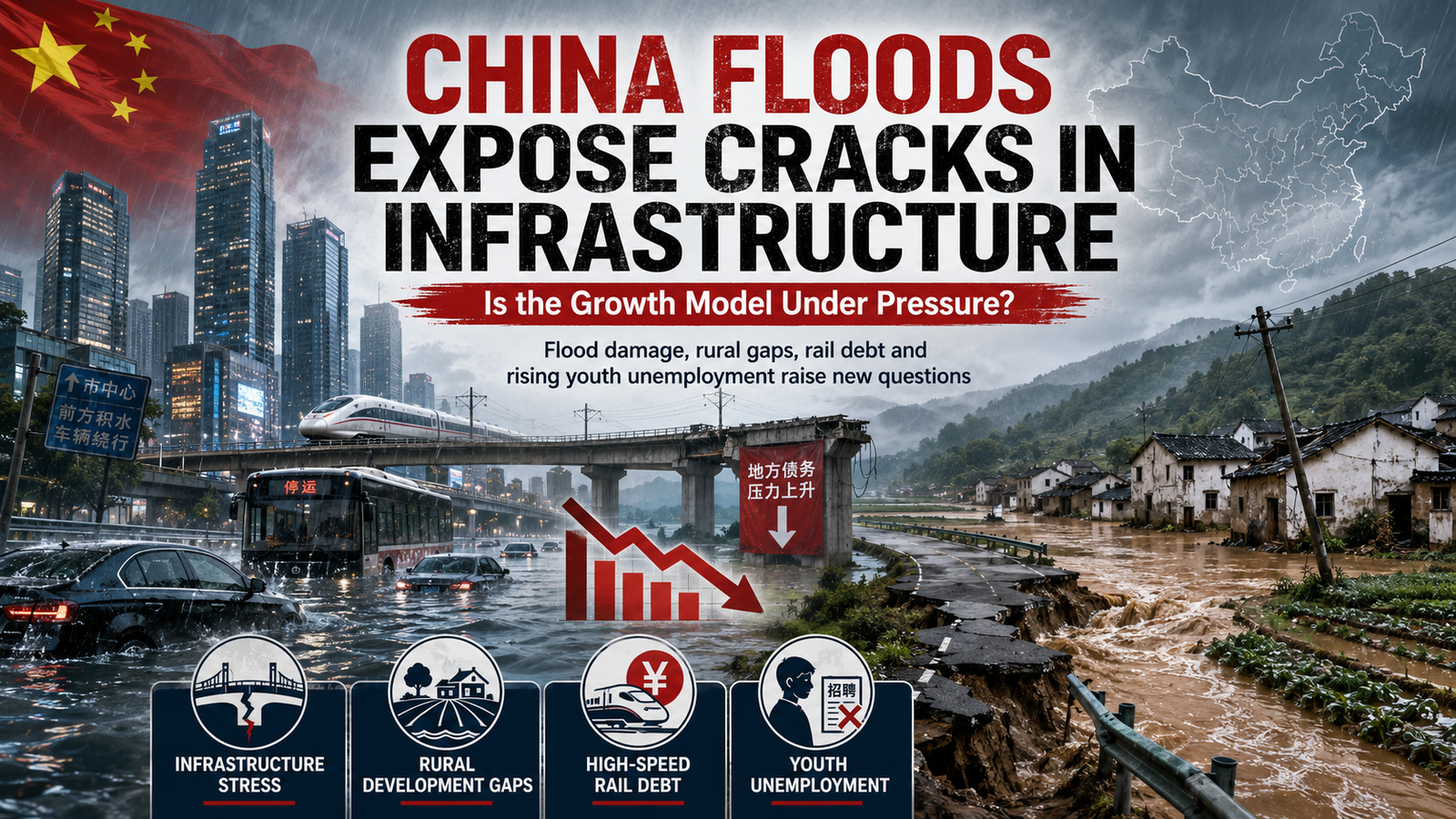
China Floods Expose Cracks in Infrastructure: Is the Growth Model Under Pressure?

China’s recent floods have once again exposed the gap between the country’s global image of bullet trains, mega-cities and futuristic infrastructure — and the reality faced by many smaller cities, towns and rural communities.
Tropical Storm Maysak brought days of heavy rain to southern China, triggering severe flooding in Guangxi. AP reported that the floods killed 39 people, left nine missing, damaged infrastructure, trapped residents, and forced around 130,000 people to evacuate. Hengzhou was among the worst-hit areas, where a reservoir dam partially collapsed and floodwaters trapped people in homes, schools and villages.
This was not just a weather disaster. It was a stress test for China’s infrastructure — and many places failed that test.
From Cities to Villages, the Damage Was Widespread
China often shows the world its Tier-1 cities like Shanghai, Beijing, Shenzhen and Guangzhou. But the recent floods mainly exposed the vulnerability of regional cities, county-level areas and villages.
In Guangxi, floodwaters submerged homes and forced large-scale rescues. AP reported that more than 10,000 trapped students and teachers were rescued, while thousands of emergency workers and boats were deployed.
Reuters also reported that scientists warned China could face more extreme storms in 2026, with climate change and El Niño increasing the risk of intense rainfall and stronger typhoons.
The message is clear: China’s infrastructure may look world-class in selected urban zones, but many lower-tier cities and rural regions still remain vulnerable to floods, drainage failures, dam stress, landslides and emergency-response gaps.
Rural China Still Faces a Development Gap
China has made huge economic progress, but rural China is still far behind urban China.
Official National Bureau of Statistics data showed that in 2025, the median per capita disposable income of urban residents was 51,115 yuan, while rural residents had a median income of only 20,711 yuan.
That income gap matters during disasters. Wealthier cities can upgrade drainage, relocate people, build stronger housing and recover faster. Poorer villages and smaller towns often suffer longer because homes, roads, bridges, clinics and local emergency systems are weaker.
This is why flooding in China is not only an environmental issue. It is also a development issue.
The “Sponge City” Dream Is Still Uneven
China has promoted its “sponge city” model for years. The idea is to make cities absorb and manage rainwater through wetlands, permeable roads, green roofs and better drainage.
The concept is smart. But implementation remains uneven. Some cities have improved, while others still face severe flooding when extreme rainfall exceeds design capacity. The latest floods show that climate-resilient infrastructure cannot be limited to showcase districts. It must reach smaller cities, old neighborhoods and rural belts too.
If a city has bullet trains but poor drainage, the development model is incomplete.
High-Speed Rail: Symbol of Power or Debt Pressure?
China’s high-speed rail network is one of the largest in the world and remains a major national achievement. It has reduced travel time, connected cities and boosted mobility.
But financially, the system also reflects China’s debt-heavy growth model.
Reports have highlighted that China State Railway Group has carried massive liabilities, with estimates around 6.2 trillion yuan by the end of 2024. Some profitable eastern routes help support the network, but many remote and less-used routes remain financially weak.
A 2025 academic study on China’s high-speed rail corridors found that benefits were not equally distributed. Urban districts and stronger county-level cities gained more, while weaker counties saw smaller benefits, and some areas faced population outflows.
This raises an important question: did China build too much infrastructure before enough real demand existed in many regions?
Employment Pressure Is Rising
China’s economic stress is also visible in the job market.
Reuters reported that China’s youth unemployment rate for people aged 16 to 24, excluding college students, was 15.6% in May 2026, even though it had fallen to an 11-month low. Unemployment among 25-to-29-year-olds was 7.2%.
The Financial Times also reported that China dropped a specific urban employment target in its latest five-year plan for the first time in decades, reflecting pressure from weak demand, the property slowdown and slower job creation.
This is important because floods do not hit an economy in isolation. They hit people who are already dealing with job insecurity, weak local income, falling property wealth and uneven development.
China’s Real Challenge: Not Infrastructure, but Balanced Development
China does not lack infrastructure. It has highways, ports, airports, bullet trains, industrial parks and mega-cities.
The real problem is balance.
Tier-1 cities may look advanced, but many Tier-2, Tier-3 and rural areas still need better drainage, safer housing, stronger dams, improved disaster warning systems, rural healthcare, reliable local employment and more resilient public services.
The recent floods show that a country cannot measure development only by skyscrapers and high-speed trains. True development is tested when disaster comes — and when ordinary people in smaller cities and villages are protected.
Final Thoughts
China’s recent floods are more than a natural disaster. They are a warning sign about uneven development, vulnerable rural regions, debt-heavy infrastructure and employment pressure.
China has built one of the world’s most impressive infrastructure networks, but the floods reveal that not every part of the country has benefited equally.
The real question now is whether China can move from headline infrastructure to human-centered development — where smaller cities, villages and ordinary workers are protected as much as mega-cities and flagship projects.
FAQs
What caused the recent floods in China?
The floods were caused by days of heavy rainfall linked to Tropical Storm Maysak, with more typhoon activity expected during China’s flood season.
Which areas were badly affected?
Guangxi, including Hengzhou, was among the worst-hit areas. Other regions also faced storms, landslides and severe weather.
Is China’s infrastructure weak?
China has world-class infrastructure in many places, but the floods show that infrastructure quality is uneven, especially in smaller cities, county-level areas and rural regions.
Is China’s high-speed rail profitable?
Some major eastern lines are profitable, but many routes in less-developed regions remain financially weak and depend on subsidies or cross-support from stronger lines.
Is unemployment high in China?
Youth unemployment remains a concern. In May 2026, China’s 16–24 unemployment rate, excluding students, was reported at 15.6%.
Disclaimer: This article is for informational and educational purposes only. It is based on publicly available news reports, official data and economic analysis available at the time of writing. It should not be treated as financial, political or investment advice.