












































China’s Submarine Missile Test: Nuclear Warning for India and the USA?

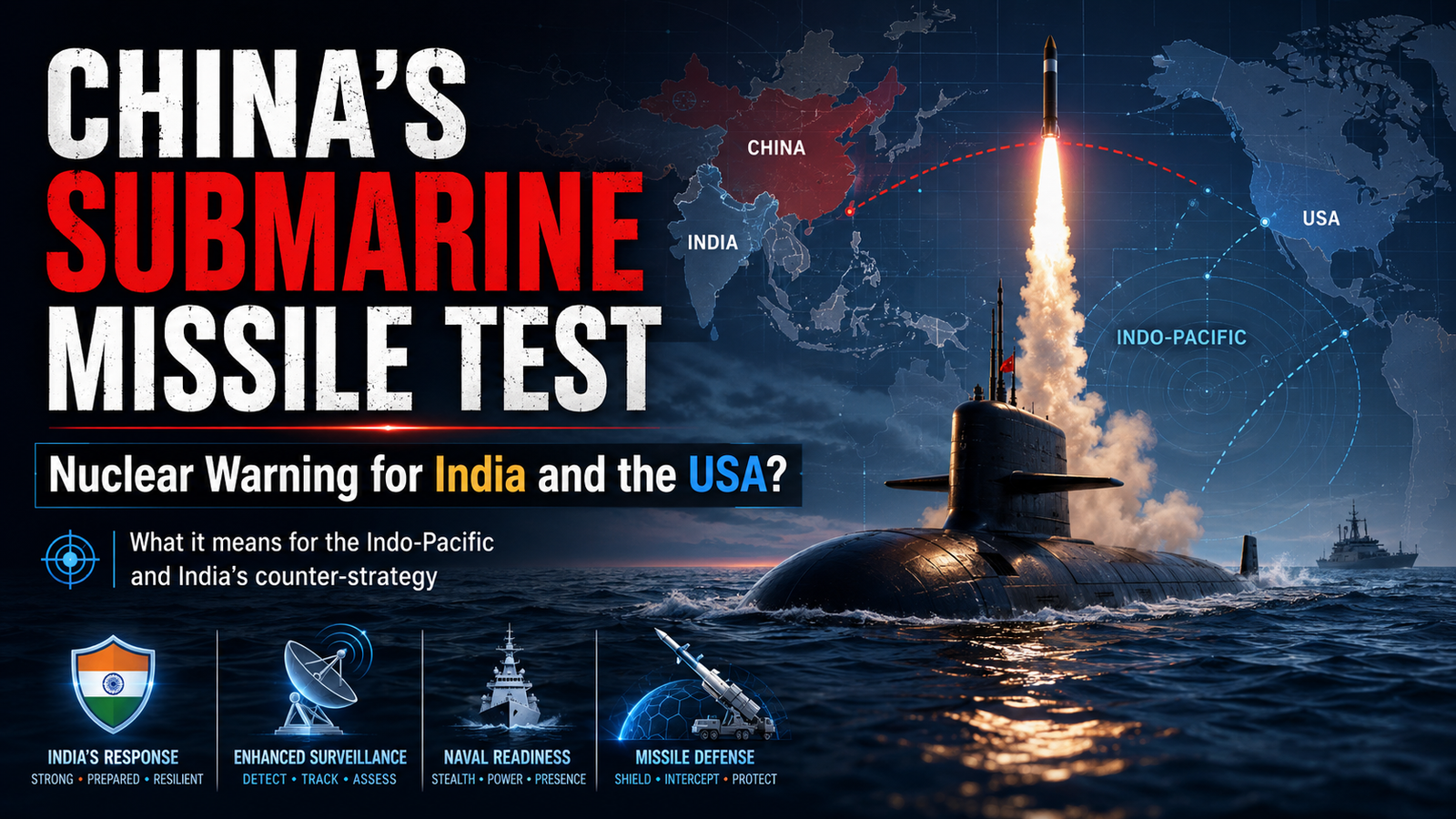
China’s recent submarine-launched ballistic missile test has become one of the biggest strategic developments in the Indo-Pacific. On July 6, 2026, China tested a submarine-launched ballistic missile from the South China Sea toward the Pacific. According to CSIS, the missile carried a simulated training warhead, flew roughly 7,300 km, and landed in the South Pacific Nuclear Free Zone.
This was not a normal missile test. CSIS said it was the first time China had launched a submarine-launched ballistic missile into international open waters and publicly demonstrated in the Indo-Pacific that it has a strategic nuclear strike capability from a nuclear-powered submarine.
In simple words, China is showing that its nuclear deterrent is no longer only land-based. It is now moving deeper under the sea.
Why Submarine-Launched Missiles Are So Dangerous
Submarine-launched ballistic missiles, or SLBMs, are among the most powerful weapons in the world because they can be fired from underwater platforms that are difficult to detect.
Reuters reported that analysts believe the missile was fired from one of China’s Type-094 nuclear-powered ballistic missile submarines, also known as SSBNs. These submarines are designed to carry nuclear-capable ballistic missiles and give China a stronger second-strike capability.
Second-strike capability means that even if a country is attacked first, it can still retaliate from hidden submarines. This makes nuclear deterrence more survivable — and more dangerous.
Threat to the USA
The biggest message from this test was clearly aimed at the United States. AP reported that experts saw China’s launch as a message to Washington, showing that the PLA is becoming a powerful military with stronger strategic nuclear capability.
Reuters noted that China’s newer JL-3 submarine-launched missile is believed to have a range of around 10,000 km, and analysts said China may be trying to demonstrate that even if it cannot easily position itself to hit the U.S. mainland, it could still threaten places such as Guam and Hawaii.
That matters because Guam is a major U.S. military hub in the Pacific. Any Chinese ability to threaten U.S. bases from the sea changes the military balance in the Indo-Pacific.
Threat to India
For India, the concern is different but equally serious.
China’s growing undersea nuclear capability adds pressure in the Indian Ocean, where Chinese naval activity has already increased over the past decade. If Chinese submarines can move more freely from the South China Sea into the wider Indo-Pacific, India must prepare for a future where nuclear-capable Chinese submarines may operate closer to the Indian Ocean region.
This does not mean war is imminent. But it does mean India needs stronger surveillance, anti-submarine warfare, missile tracking, and its own credible sea-based deterrent.
The biggest danger is not only the missile itself. The real danger is uncertainty. If nuclear-capable submarines operate secretly in tense waters, the risk of miscalculation increases.
How India Is Countering China
India is not sitting silent. New Delhi is building a layered response.
First, India is strengthening its own nuclear triad. In August 2024, India commissioned INS Arighaat, its second Arihant-class nuclear-powered ballistic missile submarine. The Defence Ministry said Arighaat would strengthen India’s nuclear triad, enhance deterrence, and improve strategic balance in the region.
Second, India is improving anti-submarine warfare. The Indian Navy’s P-8I aircraft has become one of its most important submarine-hunting platforms. The New Indian Express reported that India sent a P-8I to the U.S.-hosted RIMPAC 2026 exercise and that the aircraft is used for maritime surveillance, anti-submarine warfare and coordinated operations with partner navies.
Third, India is expanding its helicopter and undersea detection network. The Economic Times reported that India is strengthening anti-submarine warfare capabilities through platforms such as the MH-60R Seahawk, P-8I aircraft, sonobuoys, dipping sonars and torpedoes.
Fourth, India is working more closely with Quad partners — the United States, Japan and Australia — through naval exercises, maritime domain awareness, and Indo-Pacific coordination.
Why This Is Bigger Than One Missile Test
China says the test was routine. But the timing, location and missile type make it much bigger than a routine drill.
CSIS noted that China did not follow standard international ballistic missile notification procedures and that short-notice open-ocean missile tests increase the risk of miscalculation.
That is why countries across the Indo-Pacific are worried. The region is already tense because of Taiwan, the South China Sea, U.S.-China rivalry, and China’s growing naval presence.
A nuclear-capable submarine missile test adds another layer of danger.
Final Thoughts
China’s submarine-launched missile test is a clear signal: Beijing wants the world to recognize its growing undersea nuclear power.
For the United States, it is a warning that China’s missile reach and second-strike capability are expanding. For India, it is a reminder that the Indian Ocean and Indo-Pacific are becoming more contested than ever.
India’s answer is clear: build its own sea-based nuclear deterrent, strengthen anti-submarine warfare, improve maritime surveillance, and deepen partnerships with trusted Indo-Pacific democracies.
The new military balance will not be decided only by aircraft carriers or fighter jets. It will also be decided silently — deep under the ocean.
FAQs
What missile did China test from a submarine?
Reports say China tested a submarine-launched ballistic missile, possibly from the JL-2 or JL-3 family. The exact missile type has not been officially confirmed.
Was the missile nuclear-armed?
The test reportedly carried a simulated training warhead, but the missile class is nuclear-capable.
Why is this a threat to the USA?
It strengthens China’s ability to threaten U.S. military assets in the Pacific, especially Guam and Hawaii, while improving China’s sea-based nuclear deterrent.
How is India countering China’s submarine threat?
India is strengthening its nuclear submarine fleet, deploying P-8I submarine-hunting aircraft, inducting MH-60R helicopters, improving sonar capability, and working with Quad partners.
Disclaimer: This article is for informational and educational purposes only. It is based on official statements and credible media reports available at the time of writing. It should not be treated as military, diplomatic, political or investment advice.