














































India’s Monsoon Session 2026: Five Big Bills, FCRA Debate and the Battle Over Foreign Influence

Parliament’s Monsoon Session Begins With High Stakes
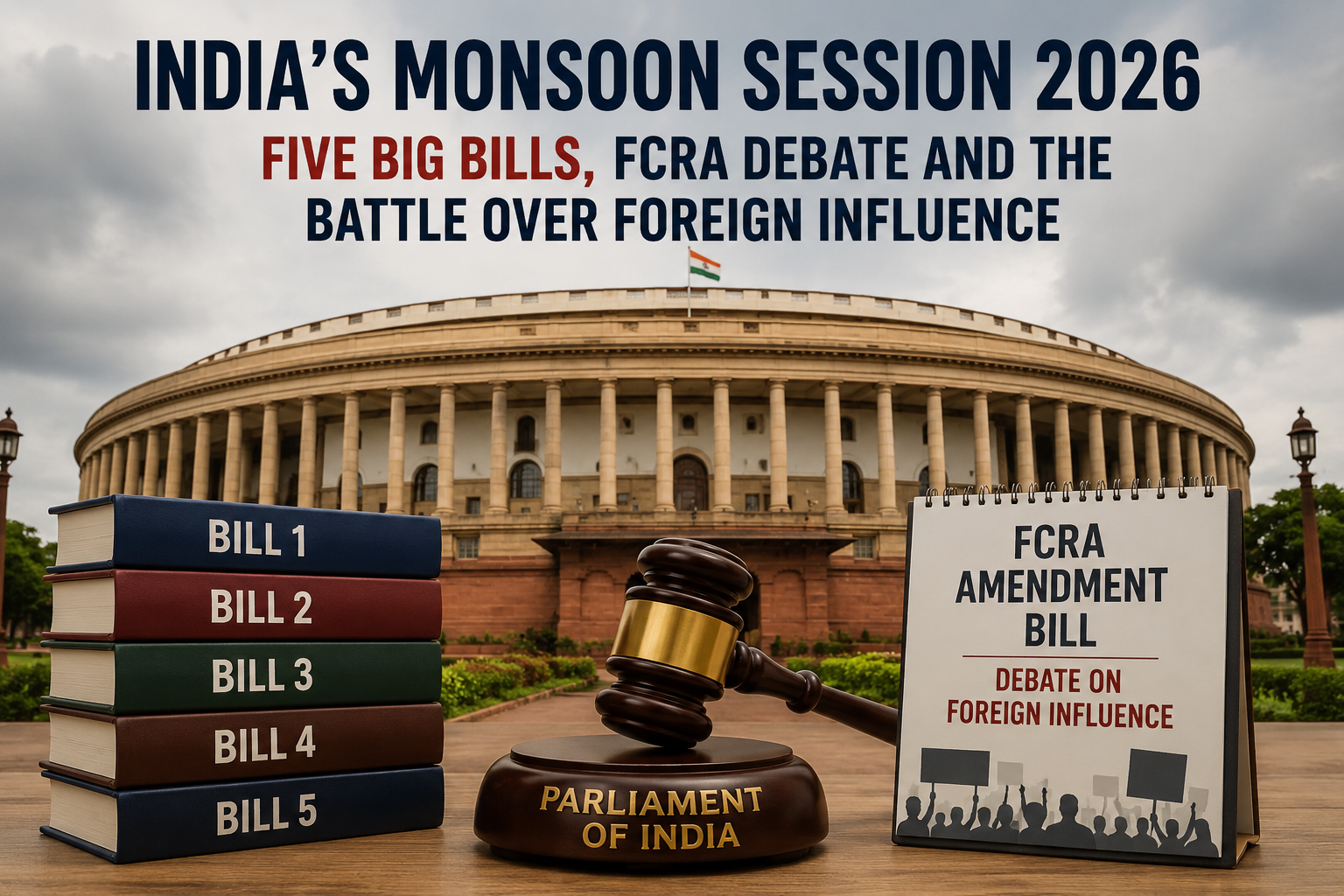
India’s Monsoon Session of Parliament 2026 has begun at a politically sensitive time. According to PRS Legislative Research, the session is scheduled from July 20 to August 13, 2026, with 19 sittings. Five new Bills are listed for introduction, consideration and passing, while two pending Bills are also listed for consideration and passing.
Among all the legislation, the Foreign Contribution (Regulation) Amendment Bill, 2026 has become one of the most important and controversial. It deals with foreign funding, NGOs, assets created from foreign donations and the management of organisations whose FCRA certificates are cancelled, surrendered or not renewed.
This is not just a normal parliamentary session. It is a test of whether India can pass important governance reforms despite political noise, street protests and pressure campaigns.
The Five New Bills Listed for the Monsoon Session
PRS says five Bills have been listed for introduction, consideration and passing during the session.
The first is the Income-tax (Amendment) Bill, 2026. It replaces an earlier ordinance and exempts foreign institutional investors and the Bank for International Settlements from income tax on earnings from investment, sale and transfer of government securities. The goal is to deepen India’s sovereign debt market and attract stable global capital.
The second is the Micro, Small and Medium Enterprises Development (Amendment) Bill, 2026. This Bill seeks to strengthen the mechanism for delayed payments and improve enforcement of arbitral awards. It also aims to give states more power in deciding the composition of Micro and Small Enterprises Facilitation Councils.
The third is the Registration of Births and Deaths (Amendment) Bill, 2026. It aims to make delayed registration of births and deaths more stringent. This matters because birth and death records are now linked to identity, welfare delivery, governance and demographic planning.
The fourth is the Supreme Court (Number of Judges) Amendment Bill, 2026. It replaces an ordinance and seeks to increase the number of Supreme Court judges, excluding the Chief Justice of India, from 33 to 37. This is aimed at improving judicial capacity and helping reduce pendency.
The fifth is the Prevention of Insults to National Honour (Amendment) Bill, 2026. This Bill seeks to amend the 1971 law related to national honour.
The Two Pending Bills: Why FCRA Stands Out
Apart from the five new Bills, two pending Bills are listed for consideration and passing: the Foreign Contribution (Regulation) Amendment Bill, 2026 and the Viksit Bharat Shiksha Adhishthan Bill, 2025.
The education Bill aims to replace the University Grants Commission, AICTE and the National Council for Teacher Education with a single higher education regulatory commission.
But the FCRA Bill is the one drawing the most attention because it touches foreign money, national interest, public order and national security. The Indian Express reported that the FCRA Amendment Bill seeks to amend the 2010 law that governs acceptance and use of foreign contribution and foreign hospitality to ensure such inflows do not adversely affect national interest, public order or national security.
Why the FCRA Bill Is Crucial
Foreign funding is not automatically bad. Many organisations do good work in health, education, disaster relief and social welfare.
But foreign money entering a country must be transparent.
The FCRA framework exists because money can influence activism, institutions, public campaigns, social movements, religious activities, legal networks and political narratives. If foreign funds are misused, they can create internal pressure points inside a democracy.
PRS notes that FCRA regulates acceptance and use of foreign contributions by individuals, associations and companies, and aims to prevent diversion of such funds toward activities detrimental to national interest.
The scale is also large. PRS cites Ministry of Home Affairs data showing that 13,520 organisations received ₹55,741 crore in foreign contribution between 2019 and 2022. It also notes that, as of July 15, 2026, the FCRA portal showed 14,449 active FCRA certificates, 22,498 cancelled, and 15,212 deemed expired.
That is why the FCRA Bill matters. This is not about stopping genuine charity. It is about ensuring that foreign funds do not become tools of hidden influence.
What the FCRA Amendment Bill Proposes
The Bill creates a framework for supervision, management and disposal of foreign contribution and assets of an organisation that no longer has an FCRA certificate. An organisation may cease to have a certificate if it is cancelled, surrendered, not renewed, or renewal is denied.
The Bill also creates a Designated Authority to manage such foreign-funded assets. If the assets include a place of worship, the Authority must ensure that its religious character is maintained.
It also reduces the maximum penalty for FCRA violations from imprisonment of five years to one year, while adding clearer responsibility for key functionaries such as directors, trustees, partners and office bearers.
In simple language, the Bill asks: if an organisation received foreign money and built assets through that money, what happens when its FCRA approval ends?
That is a serious governance question.
Why Sudden Protests Matter During Parliament
The Monsoon Session has already seen political tension. The Economic Times reported that Delhi remained tense after a large protest march to Parliament turned confrontational, while protesters continued a sit-in near Kerala House and security remained tight in Central Delhi.
The Times of India reported that Congress warned the session could be a “washout” if the government did not allow discussion on the NEET-UG 2026 paper leak and police action against student protesters.
The concerns of students and citizens must be heard in a democracy. Peaceful protest is a democratic right.
But Parliament also has a duty to function.
When protests, walkouts and disruptions consume an entire session, important Bills on taxation, judiciary, MSMEs, governance, higher education and foreign funding may get delayed. Whether the timing is accidental, political or strategic, the result can be the same: legislative paralysis.
Is Foreign Interference Increasing?
Foreign influence is a real global issue. Countries across the world, including the United States, Australia, Canada and European nations, regulate foreign funding, lobbying, foreign agents and political influence because outside money can shape domestic debate.
India has the same right.
That is why the FCRA Bill is crucial. It does not say every foreign-funded organisation is bad. It says foreign contributions must remain transparent, accountable and aligned with Indian law.
A rising India will attract investment, partnership and admiration. But it will also attract pressure, narrative warfare and influence operations. Strong laws are needed so that genuine social work continues, while hidden foreign manipulation is exposed.
Why This Session Matters for Viksit Bharat
These Bills are not disconnected. Together, they reflect India’s broader governance agenda.
The Income-tax Bill can support India’s bond market and financial depth. The MSME Bill can help small businesses get payments faster. The Births and Deaths Bill can improve demographic data. The Supreme Court Judges Bill can expand judicial capacity. The National Honour Bill touches national identity. The education reform Bill aims to reshape higher education regulation. The FCRA Bill strengthens foreign-funding accountability.
This is why Parliament must function.
India cannot become a developed country by 2047 if every major reform gets trapped in political disruption.
Final Thoughts
The Monsoon Session 2026 is important because it brings together economy, judiciary, governance, education, national identity and foreign funding oversight.
Among all the Bills, the FCRA Amendment Bill stands out because it deals with a sensitive but necessary question: should foreign money be allowed to shape Indian institutions without strong accountability?
The answer should be clear. India must welcome genuine charity, research, education and humanitarian work. But India must also protect itself from foreign-funded influence that harms national interest, public order or national security.
Democracy means protest. But democracy also means Parliament must debate, vote and legislate.
A confident India should allow criticism, protect peaceful protest and still pass laws that defend sovereignty.
FAQs
When is the Monsoon Session 2026?
The Monsoon Session of Parliament is scheduled from July 20 to August 13, 2026, with 19 sittings.
What are the five new Bills listed?
The five new Bills are the Income-tax Amendment Bill, MSME Development Amendment Bill, Registration of Births and Deaths Amendment Bill, Supreme Court Number of Judges Amendment Bill and Prevention of Insults to National Honour Amendment Bill.
Is the FCRA Bill one of the five new Bills?
No. The FCRA Amendment Bill, 2026 is a pending Bill listed for consideration and passing.
Why is the FCRA Bill important?
It deals with foreign contributions, assets created from foreign funds and the management of organisations whose FCRA certificates are cancelled, surrendered or not renewed.
Does FCRA target all NGOs?
No. The law regulates foreign funding. Genuine NGOs can continue their work, but foreign funds must follow Indian law and transparency requirements.
Disclaimer: This article is for informational and editorial commentary purposes only. It does not claim that all protests, NGOs or foreign-funded organisations are anti-national. It supports lawful transparency, peaceful democratic debate and India’s sovereign right to regulate foreign contributions.