









































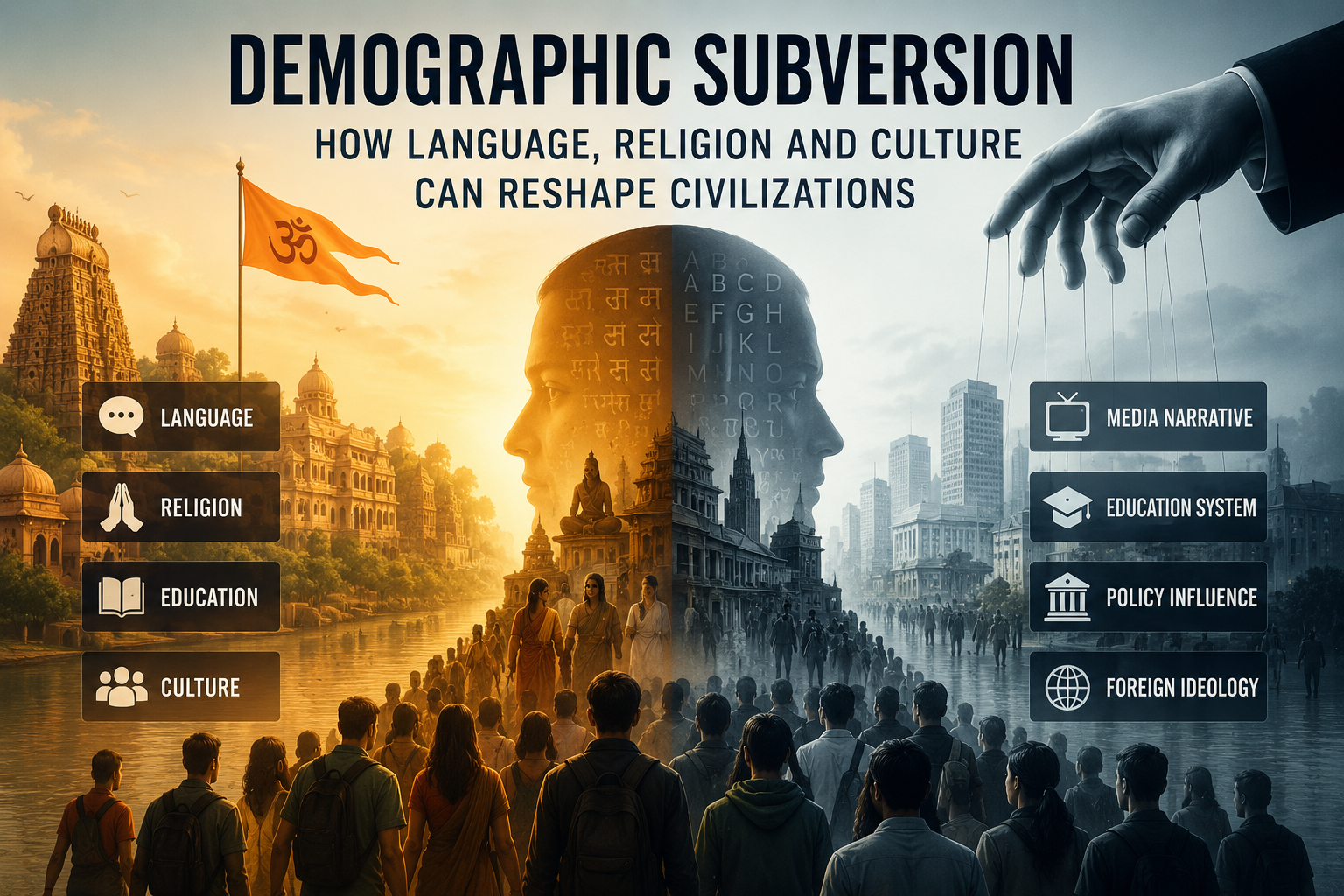
Demographic Subversion: How Language, Religion and Culture Can Reshape Civilizations

What Is Demographic Subversion?
A country does not always lose itself through war. Sometimes, it loses itself slowly — through language, education, religion, culture, funding networks and identity politics.
This is often called demographic or cultural subversion: a long-term process where a society’s original identity is weakened, replaced or made dependent on outside systems of power.
History gives many examples. Latin America, Africa and parts of Asia show how colonial powers did not only control land. They also shaped minds, languages, beliefs and institutions.
For India, this is not just history. It is a warning.
The Latin America Example: Land Was Colonized, Then Identity Was Changed
South America and much of Latin America were colonized mainly by Spain and Portugal. Over time, indigenous civilizations lost political control, and European languages such as Spanish and Portuguese became dominant.
Religion also changed dramatically. Pew Research Center notes that Latin America was more than 90% Catholic for much of the 20th century, while indigenous and Afro-Caribbean religious traditions became a much smaller share of public religious identity. Today, most Latin Americans still identify with Christianity, though the region is becoming more religiously diverse.
Language loss is one of the biggest signs of cultural displacement. UNESCO says Latin America is home to hundreds of Indigenous peoples and more than 420 Indigenous languages, many of which face extinction. Globally, more than 40% of Indigenous languages are endangered.
This matters because language is not just communication. Language carries memory, stories, festivals, spirituality, local knowledge and worldview. When a language dies, an entire way of seeing life can die with it.
Why Many Former Colonies Remained Weak
Many former colonies became politically independent but remained economically dependent. Latin America still struggles with deep inequality. The World Bank has repeatedly described the region as facing persistent poverty, inequality and exclusion, especially among Indigenous communities.
The same pattern can be seen in parts of Africa. Africa is rich in minerals, oil, forests, land and young people, but many countries still struggle because colonial systems were designed for extraction, not local empowerment.
The problem was not only religion. It was the full colonial structure: extract resources, weaken native institutions, create foreign-language elites, divide communities and make local economies dependent on outside markets.
Africa: Resource-Rich, But Culturally Disrupted
Africa’s case is especially important. Pew Research Center notes that in 1900, most people in sub-Saharan Africa practiced traditional African religions, while Christians and Muslims together were less than a quarter of the population. Over the next century, Christianity and Islam became dominant, while traditional religions became a much smaller visible share.
Recent research on colonial rule in Africa also argues that European colonization contributed to major religious change, especially where direct colonial rule disrupted traditional social structures.
But again, the lesson is not to attack any religion. The lesson is that when outside political power, foreign language education and religious change happen together, indigenous identity can weaken across generations.
Africa also shows the danger of resource extraction without cultural and institutional strength. The African Development Bank has warned against natural resource-backed loans that can trap countries into using future mineral or oil revenues to repay debt.
A civilization that loses control over its resources, language and institutions can become dependent even after independence.
Is Something Similar Happening in India?
India is not Latin America. India is not Africa. India is a strong civilization with living traditions, temples, festivals, languages, families, local communities and deep spiritual memory.
But India does face pressure.
One major concern is language. English has become the language of aspiration for many urban families. It is useful for jobs, technology and global communication, but when English becomes a status symbol and mother tongues become “backward,” cultural damage begins.
India’s own National Education Policy 2020 recognizes this danger. The policy promotes mother tongue, local language or regional language as the medium of instruction at least till Grade 5, and preferably till Grade 8 and beyond.
This is a major civilizational correction. Children learn better when they think in the language of home. They also stay connected to family, tradition and culture.
English Should Be a Tool, Not an Identity
India should not reject English. English is useful for science, business, diplomacy and technology.
But English must remain a tool, not a replacement for identity.
The danger begins when a young Indian can speak fluent English but cannot read Hindi, Tamil, Bengali, Marathi, Gujarati, Kannada, Telugu, Malayalam, Punjabi, Odia, Assamese, Sanskrit or their own mother tongue.
The danger begins when children know Western pop culture but do not know their own local saints, philosophers, poets, temples, rivers, festivals, food traditions and family histories.
That is how cultural subversion works — not by banning your culture, but by making you feel ashamed of it.
Foreign Funding and NGO Influence
Another sensitive issue is foreign funding.
Not every NGO is bad. Many NGOs do good work in health, education, disaster relief and social welfare. But foreign-funded organisations must be transparent because outside money can influence policy, religion, activism and public opinion.
India regulates this through the Foreign Contribution Regulation Act, or FCRA. The Ministry of Home Affairs says FCRA regulates foreign contributions to ensure that associations function in a manner consistent with India’s sovereignty and democratic values, and that foreign funds are not used for activities harmful to national interest.
In 2026, reports said India tightened FCRA rules further, including clearer restrictions around religious categories and proselytisation-related activity.
This does not mean every foreign-funded group is anti-India. But it does mean India has the right to ask: who is funding whom, for what purpose, and with what long-term impact?
The West Is Also Searching for Spirituality
Interestingly, many people in the West are also moving toward spirituality, meditation, yoga, mindfulness and sober living.
Pew Research Center found that about half of religiously unaffiliated Americans still describe themselves as spiritual or say spirituality is very important in their lives.
At the same time, America continues to face serious addiction problems. CDC data showed that nearly 69,973 people died from drug overdoses in the U.S. in 2025, although overdose deaths declined from the previous year.
This shows a global truth: materialism alone cannot satisfy human beings. People need meaning, community, discipline and inner peace.
India already has these answers through dharma, yoga, meditation, family values, festivals, nature worship, self-control and community life.
Why Indian Roots Matter Today
India’s civilizational strength is not only in GDP, missiles, highways or startups. It is also in the mind of the Indian child.
A confident India needs children who can speak global languages but think with Indian self-respect. It needs schools that teach science along with civilizational memory. It needs youth who understand technology but do not become rootless.
Cultural confidence does not mean hating others. It means refusing to hate yourself.
India can learn from the world without becoming a copy of the world. It can use English without losing Indian languages. It can welcome modernity without destroying tradition. It can respect all religions while protecting its own civilizational continuity.
Final Thoughts
Demographic and cultural subversion works slowly. First language changes. Then education changes. Then festivals become “old-fashioned.” Then native beliefs are mocked. Then foreign ideas become elite identity. Finally, a society forgets who it was.
Latin America and Africa show how deeply colonial systems can reshape religion, language, resources and power.
India must not repeat that mistake.
The answer is not isolation. The answer is cultural confidence.
India should learn English, trade with the world, use global technology and cooperate internationally. But India must also protect its languages, temples, festivals, families, local traditions and spiritual worldview.
A civilization survives when its people remember who they are.
FAQs
What is demographic subversion?
Demographic subversion is a process where a society’s identity, language, religion or cultural confidence is weakened over time through outside pressure, policy change, migration, education or funding networks.
How did colonialism affect Latin America?
Spanish and Portuguese colonization transformed Latin America’s languages, religion, institutions and power structures, while many Indigenous languages and traditions were marginalized.
Did colonialism affect African religions?
Yes. Traditional African religions declined sharply in public identity over the 20th century as Christianity and Islam became dominant in many regions.
Is English bad for India?
No. English is useful, but it should be a tool. India must not allow English to replace mother tongues, Indian languages and civilizational identity.
What should India do to protect its culture?
India should strengthen mother-tongue education, promote Indian languages, support traditional knowledge, regulate foreign funding transparently and teach youth to value their roots without hating others.
Disclaimer: This article is for informational and cultural commentary purposes only. It does not promote hatred against any religion, nationality or community. It supports cultural preservation, transparency in foreign funding, mother-tongue education and peaceful civilizational confidence.