

















































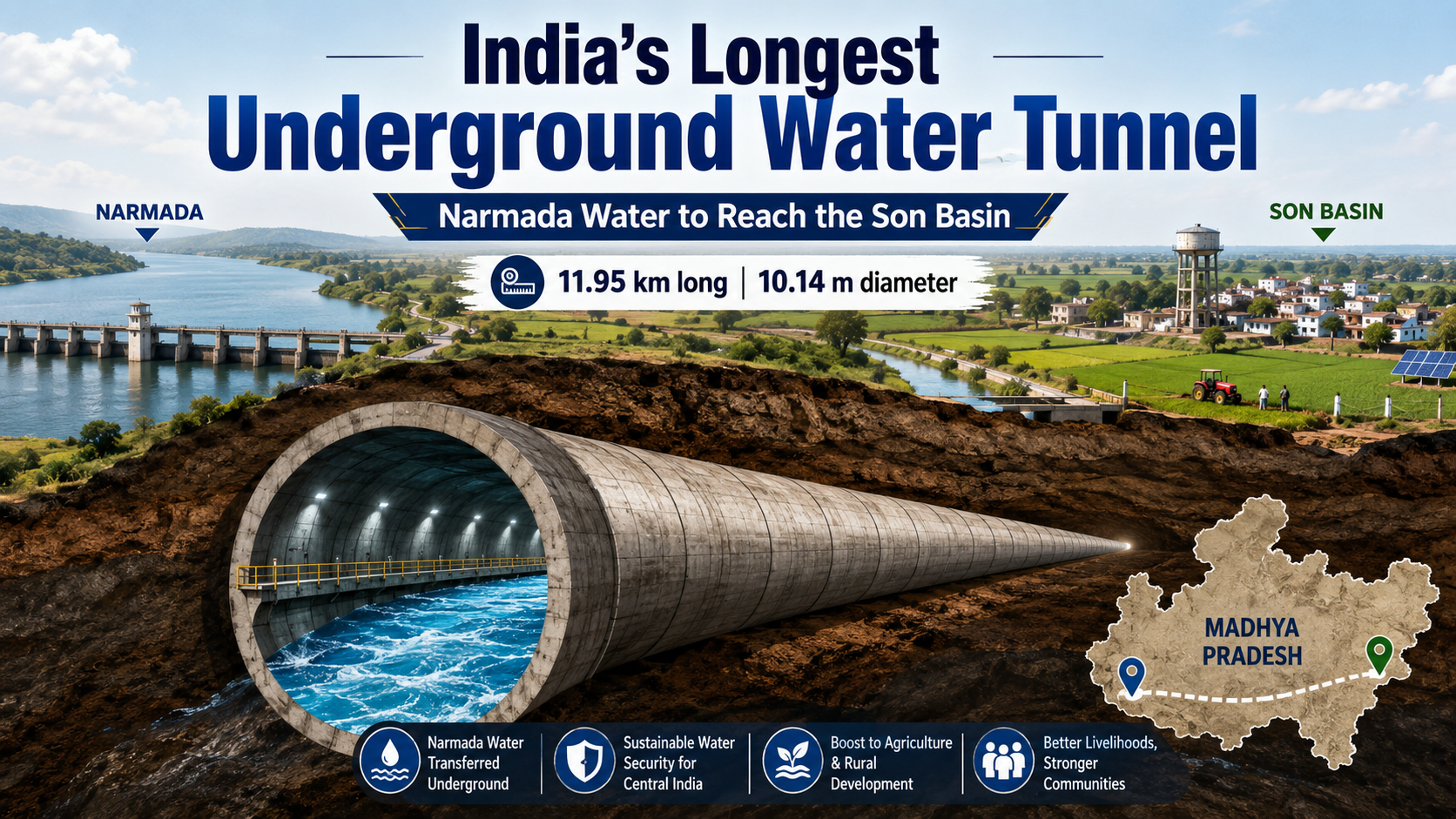
India’s Longest Underground Water Tunnel: How Narmada Water Will Reach the Son Basin

A Historic Engineering Breakthrough in Madhya Pradesh
India has achieved a major water-infrastructure milestone with the breakthrough of the Sleemanabad Tunnel in Madhya Pradesh’s Katni district. The 11.95-km underground water conveyance tunnel will carry Narmada water beneath the Vindhya hills toward the Son basin, making it India’s longest underground water tunnel for irrigation. Times of India reported that the final breakthrough came on July 14, 2026, after nearly 18 years of work.
This is not just a tunnel. It is a symbol of India’s growing engineering capability, water-management ambition and commitment to taking water to drought-prone regions.
What Is the Sleemanabad Tunnel?
The Sleemanabad Tunnel is the backbone of the Bargi Diversion Project, developed by the Narmada Valley Development Authority. It is designed to take water from the Rani Avanti Bai Sagar, also known as Bargi Dam, near Jabalpur, and move it under the Vindhya ridge toward dry regions of eastern Madhya Pradesh.
The tunnel is about 11.95 km long and has a diameter of 10.14 metres. Its biggest strength is that it will move water through gravity flow, meaning water can travel without the use of pumps.
That makes the project important not only for irrigation, but also for long-term energy efficiency.
Linking the Narmada and Son Basins
For centuries, the Narmada and Son have flowed in opposite directions. The Narmada flows west toward the Arabian Sea, while the Son is part of the Ganga river system.
Now, through this underground tunnel, Narmada water will enter the Son basin. NDTV described the project as a passage through the Vindhyas that connects Narmada water to the Son basin by gravity flow.
This does not mean the rivers themselves are being merged completely. It means water from the Narmada system will be transferred into the Son basin region for irrigation and water security.
Why This Project Is So Significant
The biggest impact will be on farmers.
The project is expected to irrigate around 2.45 lakh hectares of agricultural land across six districts: Jabalpur, Katni, Satna, Maihar, Rewa and Panna. Nearly 1,450 villages are expected to benefit.
For drought-prone parts of the Vindhya region, this could be transformational. Reliable irrigation can improve crop productivity, reduce dependence on uncertain rainfall, support rural income and strengthen food security.
Moneycontrol reported that the project is also expected to support drinking and industrial water supply for Jabalpur and Katni.
In simple words, this project is about water for farms, villages, cities and future development.
The Technology Behind the Tunnel
The Sleemanabad Tunnel is a major tunnelling achievement because engineers had to cut through difficult geology under the Vindhya range.
Times of India reported that workers faced hard marble, limestone and dolomite formations, underground cavities, heavy groundwater inflows, unstable rock and even carbon dioxide emissions. These conditions repeatedly damaged tunnel boring machines and delayed work.
A Robbins Tunnel Boring Machine was deployed in 2011, but it managed to excavate only about 1.4 km in four years because of the tough geology. Later, a second German-made TBM was launched from the opposite end in 2016. Engineers used advanced methods such as TAM grouting, high-capacity dewatering and simultaneous excavation from both ends to complete the breakthrough.
This shows an important point: the technology involved global machines, but the execution, adaptation and problem-solving were driven by Indian engineers, workers and water-management institutions.
Passing Under Roads, Railways and Villages
Another major achievement is that the tunnel passes 20 to 40 metres below the surface and runs beneath highways, railway tracks, utilities and populated areas without damaging structures above.
This is a big reason underground tunnelling was chosen. An open canal would have required massive land cutting across the terrain. NDTV reported that open excavation would have required removing more than 40 million cubic metres of earth and dealing with difficult groundwater conditions.
By going underground, engineers protected surface infrastructure while creating a hidden water highway beneath the hills.
A Project Built Through Patience
The project was not easy.
Construction faced delays, machine damage, groundwater flooding, geological surprises and cost escalation. Moneycontrol reported that the cost rose from an original estimate of around ₹799 crore to nearly ₹1,600 crore by completion.
But difficult infrastructure projects often define a country’s engineering confidence. The tunnel’s completion shows that India can build complex underground water systems even in challenging terrain.
Why It Matters for India’s Future
India’s future growth will depend not only on highways, airports and digital infrastructure, but also on water infrastructure.
Climate change is making rainfall more unpredictable. Some regions face floods while others face drought. Projects like the Bargi Diversion and Sleemanabad Tunnel show how India is trying to move water more intelligently from available river systems to water-stressed areas.
This is especially important for agriculture because millions of farmers still depend heavily on monsoon rainfall.
If executed responsibly, with environmental safeguards and efficient water use, such projects can help India improve irrigation, drinking water security and rural resilience.
Final Thoughts
The Sleemanabad Tunnel is one of India’s most impressive water-engineering achievements.
After nearly 18 years of effort, Indian engineers have opened a 11.95-km underground passage beneath the Vindhyas to carry Narmada water toward the Son basin. It will support irrigation across six districts, benefit nearly 1,450 villages and strengthen water security in drought-prone Madhya Pradesh.
This is not only a tunnel. It is a reminder that India’s development is now moving underground, across mountains and through complex geology.
The message is clear: India is building the infrastructure needed for a water-secure future.
FAQs
What is India’s longest underground water tunnel?
India’s longest underground water conveyance tunnel is the 11.95-km Sleemanabad Tunnel in Madhya Pradesh.
Which rivers or basins does it connect?
The tunnel carries Narmada water toward the Son basin under the Bargi Diversion Project.
Where is the tunnel located?
It is located in Katni district of Madhya Pradesh and passes beneath the Vindhya hills.
How will the tunnel benefit farmers?
It is expected to irrigate around 2.45 lakh hectares across Jabalpur, Katni, Satna, Maihar, Rewa and Panna districts.
What technology was used?
The project used Tunnel Boring Machines, TAM grouting, high-capacity dewatering and gravity-flow water conveyance technology.
Disclaimer: This article is for informational and educational purposes only. It is based on publicly available reports. Large water-transfer projects require careful environmental, social and hydrological assessment, and this article does not provide engineering, investment or policy advice.