































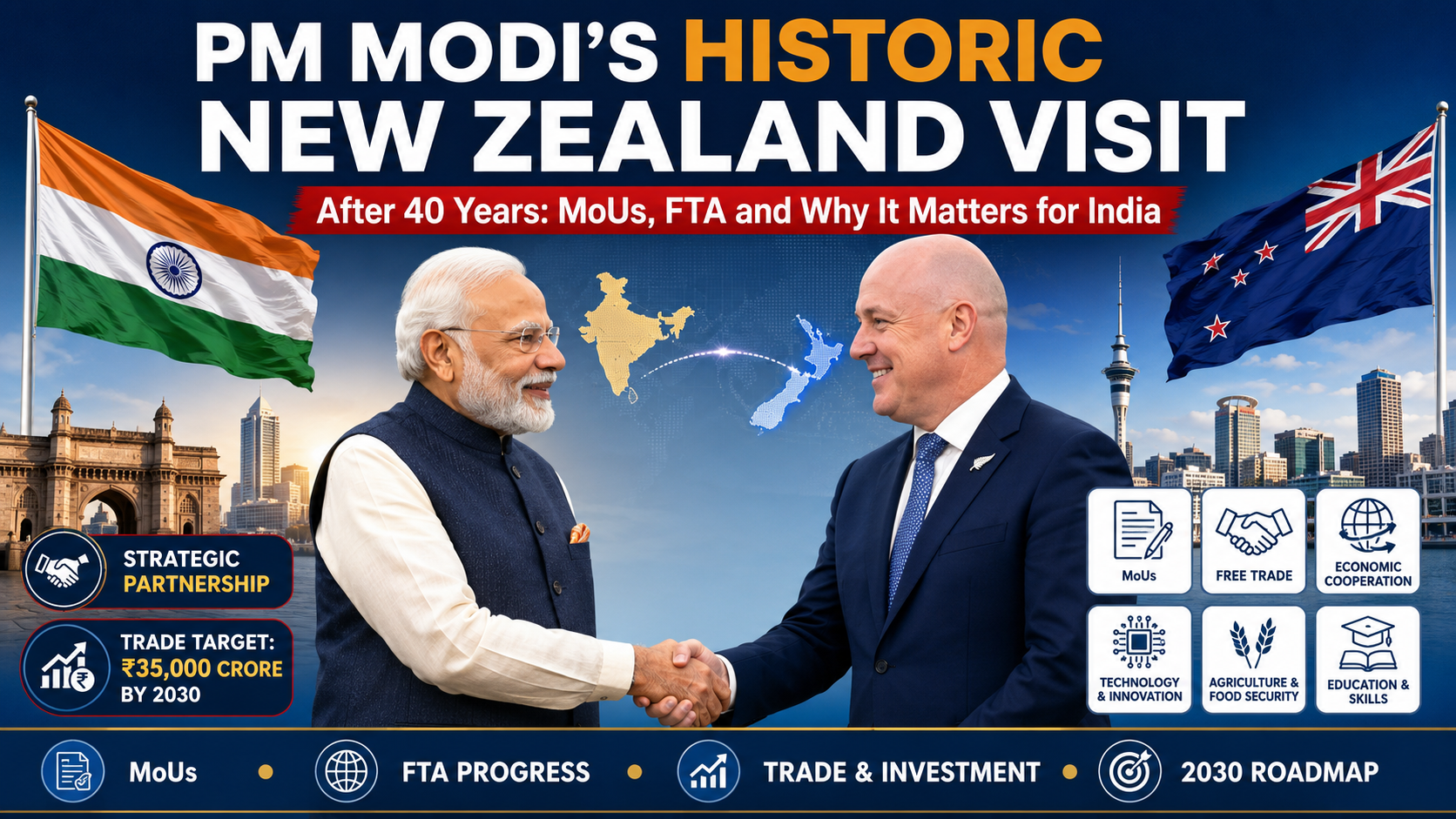
PM Modi’s Historic New Zealand Visit After 40 Years: MoUs, FTA and Why It Matters for India

Prime Minister Narendra Modi’s official visit to New Zealand on July 10–11, 2026 has become a major diplomatic milestone. According to the official India-New Zealand Joint Statement, this was the first visit by an Indian Prime Minister to New Zealand in 40 years, making it a historic moment in bilateral relations.
During the visit, PM Modi met New Zealand Prime Minister Christopher Luxon in Auckland, received a traditional Māori welcome, addressed business leaders and interacted with the Indian community. The two leaders agreed to elevate India-New Zealand relations to a Strategic Partnership, giving the relationship a stronger political, economic and security foundation.
Strategic Partnership and Roadmap to 2030
The biggest outcome of the visit was the launch of the India-New Zealand Strategic Partnership: Roadmap to 2030. This roadmap will guide cooperation over the next four years in trade, defence, maritime security, tourism, culture, sports, agri-tech, education and people-to-people ties.
This is important because India and New Zealand are both democratic Indo-Pacific nations. As global politics becomes more uncertain, India needs trusted partners in the Pacific region, and New Zealand needs stronger access to one of the world’s fastest-growing major economies.
Free Trade Agreement: Big Boost for India-New Zealand Trade
A major highlight of the visit was the India-New Zealand Free Trade Agreement, or FTA. Both leaders welcomed the conclusion and signature of a balanced and mutually beneficial FTA and agreed to work for its early entry into force.
The two countries also set a target to double bilateral trade in goods and services to NZ$7 billion, or around ₹35,000 crore, by 2030.
For India, this can open new opportunities in exports, services, agriculture, food processing, education, tourism and investment. Indian businesses can benefit from better market access, while New Zealand can support India’s growth in agriculture, innovation, clean energy, skills and technology.
Major MoUs and Agreements Signed
India and New Zealand exchanged several important MoUs and arrangements during the visit.
The first major area was maritime cooperation. The agreement between India’s Ministry of Defence and the New Zealand Defence Force will support dialogue, coordination, information exchange and joint activities in the Indo-Pacific.
The second major agreement was on hydrography and nautical cartography, which includes joint production of navigational charts, sharing hydrographic data, training and capacity building.
A third important arrangement was mutual logistics support between the Indian Navy and the New Zealand Defence Force. This can help both sides support each other during approved maritime activities and operations.
India and New Zealand also agreed to establish a Joint Working Group on Counter-Terrorism, strengthening cooperation against terrorism, organised crime, cyber-enabled crime, drug trafficking, people smuggling and related security threats.
Other major MoUs covered disaster management, animal husbandry and dairying, tourism, sports, culture, maritime heritage, food technology and ocean research.
Agriculture, Dairy and Kiwifruit Cooperation
One of the most practical outcomes for India is cooperation in agriculture and primary industries. New Zealand is known globally for dairy productivity, food safety, horticulture, post-harvest systems and value-chain development.
The two sides launched a Kiwifruit Action Plan and announced two Centres of Excellence for kiwifruit in Nagaland and Uttarakhand. This can help Indian farmers improve productivity, quality and export potential.
The MoU on animal husbandry and dairying can also support India through better technology, best practices and knowledge exchange. If implemented properly, this can help Indian farmers, dairy cooperatives and food-processing businesses.
Why This Visit Helps India
PM Modi’s New Zealand visit helps India in five major ways.
First, it strengthens India’s presence in the Indo-Pacific, where maritime security and supply-chain stability are becoming increasingly important.
Second, it creates trade opportunities through the FTA and the ₹35,000 crore trade target.
Third, it supports Indian farmers through agri-tech, dairy cooperation and kiwifruit productivity projects.
Fourth, it improves defence and maritime cooperation with a stable Pacific partner.
Fifth, it strengthens people-to-people ties, education, tourism and sports cooperation between the two countries.
Indo-Pacific and Maritime Security
India and New Zealand also agreed to establish a Maritime Security Dialogue. New Zealand nominated maritime security as its priority pillar under India’s Indo-Pacific Oceans Initiative, with focus areas including illegal, unreported and unregulated fishing.
This matters because the Indo-Pacific is now the centre of global trade and strategic competition. Stronger India-New Zealand maritime cooperation can help protect sea lanes, support regional stability and strengthen the rules-based international order.
Final Thoughts
PM Modi’s New Zealand visit after 40 years is not just symbolic. It has delivered concrete outcomes in trade, defence, maritime security, agriculture, tourism, disaster management, culture, education and research.
The Strategic Partnership and Roadmap to 2030 show that India and New Zealand are ready to move from limited engagement to structured long-term cooperation.
For India, this visit supports the larger vision of Viksit Bharat 2047 by expanding trade, strengthening Indo-Pacific partnerships, improving agricultural productivity and opening new doors for businesses, students and farmers.
In simple words, India-New Zealand relations have entered a new era.
FAQs
Why is PM Modi’s New Zealand visit historic?
It is historic because it was the first visit by an Indian Prime Minister to New Zealand in 40 years.
What was the biggest outcome of the visit?
The biggest outcome was the elevation of India-New Zealand ties to a Strategic Partnership and the launch of the Roadmap to 2030.
What is the India-New Zealand FTA?
The Free Trade Agreement is a trade pact aimed at reducing barriers, improving market access and increasing economic cooperation between both countries.
What is the new trade target?
India and New Zealand aim to double bilateral trade to NZ$7 billion, or around ₹35,000 crore, by 2030.
Which MoUs were signed?
MoUs and arrangements were signed in maritime cooperation, hydrography, mutual logistics support, counter-terrorism, disaster management, dairy, tourism, sports, culture, maritime heritage, food technology and ocean research.
Disclaimer: This article is for informational and educational purposes only. It is based on official statements and credible media reports available at the time of writing. It should not be treated as diplomatic, financial, investment or policy advice.