

















































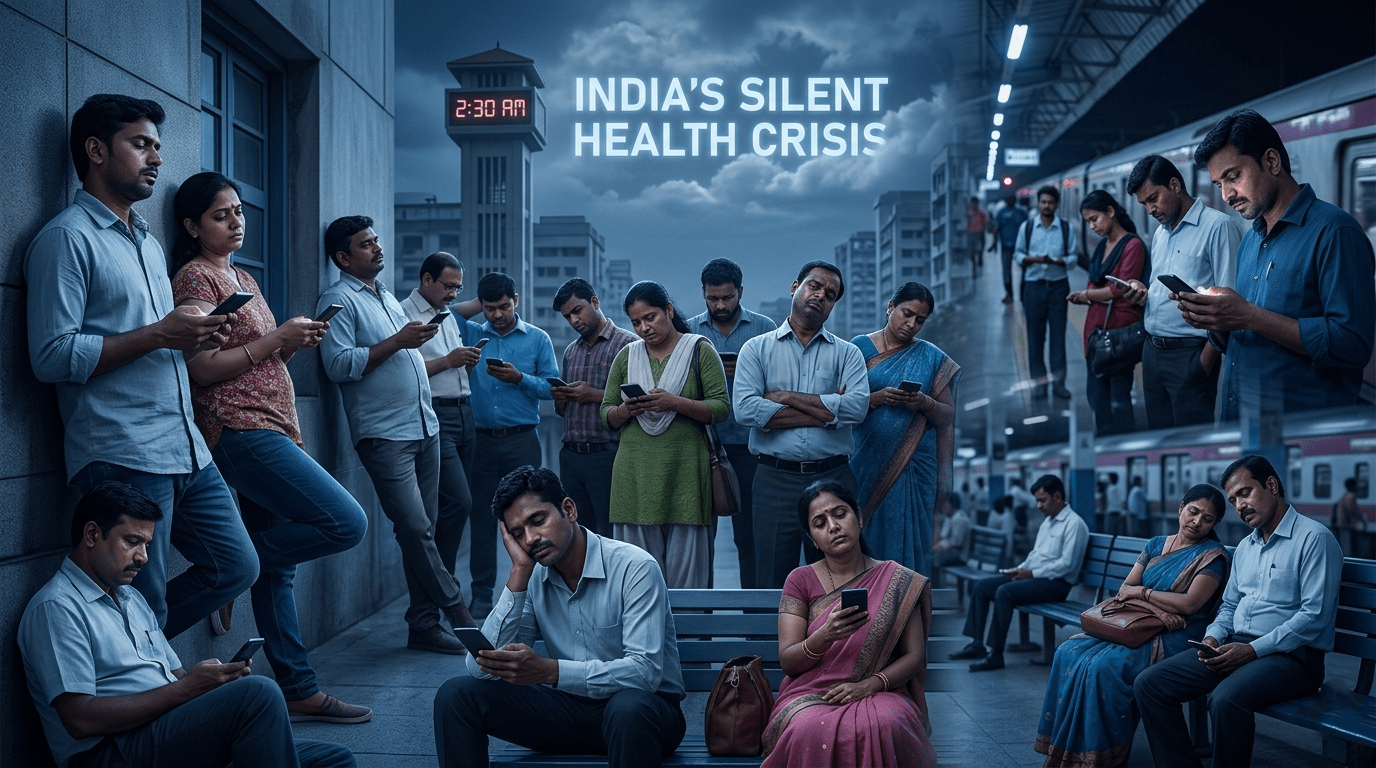
Why India Cannot Sleep: The Silent Health Crisis Robbing 1.4 Billion People of Their Best Years

Six out of ten Indian adults are sleeping less than six hours a night — and the number is rising every year. This is not just tiredness. It is a public health emergency hiding in plain sight, one that is quietly increasing your risk of a heart attack, diabetes, depression, and even early death. Here is what the science says, why India is uniquely affected, and what you can do starting tonight.
| Here is a number worth sitting with: every night, the average Indian sleeps 2.5 hours less than their great-grandparents did a century ago. And according to a 2026 survey, nearly 6 in 10 Indian adults now get under six hours of sleep — the fourth consecutive year that number has risen. The World Sleep Society’s annual report places India among the world’s most sleep-deprived large nations. We do not talk about it. We should. |
🧠 What Sleep Actually Does — And Why Losing It Is Catastrophic
Most people think of sleep as the absence of activity — your body switched off, resting. The science tells a completely different story. Sleep is not passive. It is one of the most biologically active states your body enters. Every night, across roughly 90-minute cycles, your brain does things that waking life physically cannot accomplish.
During deep sleep, your glymphatic system — the brain’s waste-clearance network — flushes out toxic proteins including beta-amyloid, the same protein that accumulates in Alzheimer’s disease. During REM sleep, your brain consolidates memory, processes emotional experiences, and literally rewires neural connections formed during the day. Your immune system releases cytokines — proteins that fight infection and inflammation — almost exclusively during sleep. And your body releases 80% of its daily human growth hormone during deep sleep, regardless of your age.
Cut sleep short, and all of that stops happening. Not gradually. Immediately.
| A landmark 2025 umbrella review of 29 systematic studies found that sleeping less than 7 hours consistently is a significant independent risk factor for: hypertension, stroke, coronary heart disease, type 2 diabetes, obesity, and all-cause mortality. The relationship is dose-dependent — the less you sleep, the higher each risk climbs. And the risks compound each other. A sleep-deprived person has impaired insulin sensitivity, elevated cortisol, and a hyperactive inflammatory response — simultaneously. |
🇮🇳 Why India Is Uniquely Affected
India’s sleep crisis is not simply a matter of bad habits. It is the product of structural forces specific to Indian society that are extremely difficult to change through willpower alone.
The most significant is noise and crowding. A J-PAL study on urban sleep in Chennai found that low-income workers in Indian cities face environmental sleep conditions — heat, mosquitoes, noise from traffic and neighbours, overcrowding in small homes — that fundamentally prevent restorative sleep. Increasing sleep duration by 30 minutes in this environment made almost no difference to productivity because the sleep quality itself was too poor to be restorative.
Then there is the always-on work culture. A cross-sectional study of 1,000 Indian corporate professionals across IT, finance, and marketing found that extended work hours, high stress, and prolonged screen exposure had created what researchers called a “silent epidemic” of sleep deprivation in the Indian corporate sector. The findings are particularly alarming because this group — India’s educated, productive, economically active core — is precisely the population whose cognitive output drives the economy.
Add to this India’s love of late nights — the cultural norm of families staying up past midnight, the explosion of streaming content, and social media scrolling that now dominates the post-10 PM window — and you have a perfect storm. Indian sleep researchers note that the country’s average bedtime has shifted nearly 90 minutes later over two generations, while wake-up times have not shifted to match.
🔍 The Specific Damage: What Is Actually Happening to Your Body Tonight
The abstract risk of ‘cardiovascular disease’ is easy to dismiss. These specifics are harder to ignore.
After just one night of under six hours of sleep, your insulin sensitivity drops by up to 25% — your body handles sugar more like a pre-diabetic than a healthy person. Your levels of ghrelin (the hunger hormone) rise and leptin (the satiety hormone) falls, making you roughly 24% more likely to overeat the following day. Your prefrontal cortex — the part of your brain responsible for judgement, impulse control, and complex decision-making — is measurably impaired, performing at a level equivalent to mild intoxication.
Across weeks and months of this pattern, the damage accumulates in ways that feel increasingly normal but are not. Short sleepers have a 48% higher risk of heart disease than 7-hour sleepers. Research from Indian healthcare settings found that 30.7% of healthcare professionals — the people caring for India’s sick — were themselves sleep-deprived, with measurable impacts on their professional functioning. And a worrying body of research links chronic sleep deprivation to faster cognitive decline and elevated Alzheimer’s risk, precisely because of that glymphatic system failure described earlier.
| The productivity paradox: India’s culture of working late and sleeping little is often framed as ambition or dedication. The science frames it differently. Research consistently shows that beyond 17 hours of wakefulness, cognitive performance degrades to the level of someone with a blood alcohol content of 0.05%. The person who sleeps 5 hours and works 19 is not more productive than the person who sleeps 8 and works 16. They are less productive, more error-prone, and accumulating biological debt that will eventually be collected. |
✅ Five Things That Actually Work: A Science-Backed Sleep Fix
The good news is that sleep quality is highly responsive to the right interventions. These five are supported by the strongest evidence:
1. Keep Your Wake Time Sacred
Consistency of wake time — not bedtime — is the most powerful regulator of your sleep-wake cycle. Pick a time and wake up at it every single day, including weekends. Your body’s circadian clock anchors to morning light. Within two weeks of consistent wake times, sleep quality improves measurably even without changing bedtime.
2. Make Your Bedroom 2–3 Degrees Cooler
Core body temperature must drop by approximately 1–1.5°C for sleep onset to occur. In India’s increasingly hot summers, a cooler bedroom is not a luxury — it is a biological requirement. If AC is not available, a cold-water foot bath before bed or a damp towel over the feet triggers the same peripheral cooling mechanism.
3. Kill the Screen One Hour Before Bed
Blue light from phone and laptop screens suppresses melatonin production by up to 50%, delaying sleep onset by 60–90 minutes. This is not a suggestion — it is documented biology. Use Night Mode from 9 PM, or better, simply place the phone in a different room at 10 PM. The compulsive checking habit is the actual problem, not the light.
4. Treat Caffeine as a Sleep Saboteur After 2 PM
Caffeine’s half-life in the body is 5–6 hours. A 4 PM coffee is still 50% active in your bloodstream at 10 PM, blocking the adenosine receptors that build sleep pressure. Move your last caffeine intake to before 2 PM and most people notice improved sleep depth within a week.
5. Use the 20-Minute Rule for Middle-of-the-Night Waking
If you wake and cannot return to sleep within 20 minutes, get out of bed. Do something quiet and non-stimulating in low light until you feel sleepy, then return. This sounds counterintuitive, but it breaks the anxiety loop that forms when you associate lying in bed with wakefulness — the most common driver of insomnia in India’s working population.
❓ Frequently Asked Questions
How much sleep do adults actually need?
The science consensus, across dozens of systematic reviews, is 7–9 hours for adults, with most people optimised at 7.5–8 hours. The idea that you can ‘train yourself’ to need less is not supported by evidence. What changes with sleep restriction is your ability to perceive how impaired you are — not the impairment itself.
Why do I feel fine on 5 hours of sleep?
Because after 7–10 days of short sleep, your subjective sense of sleepiness flatlines even as your objective cognitive performance continues to decline. This is why chronically sleep-deprived people consistently underestimate their impairment. You feel fine. Your prefrontal cortex does not agree.
Is India’s sleep crisis getting worse?
Yes. World Sleep Day 2026 data confirmed India has recorded declining sleep duration for four consecutive years. Urbanisation, smartphone penetration, work-from-home culture blurring work-sleep boundaries, and rising ambient temperatures are all identified drivers.
Disclaimer: This article is for informational and educational purposes only. It is based on publicly available reports and policy updates. It should not be considered financial, investment, legal or business advice.