






























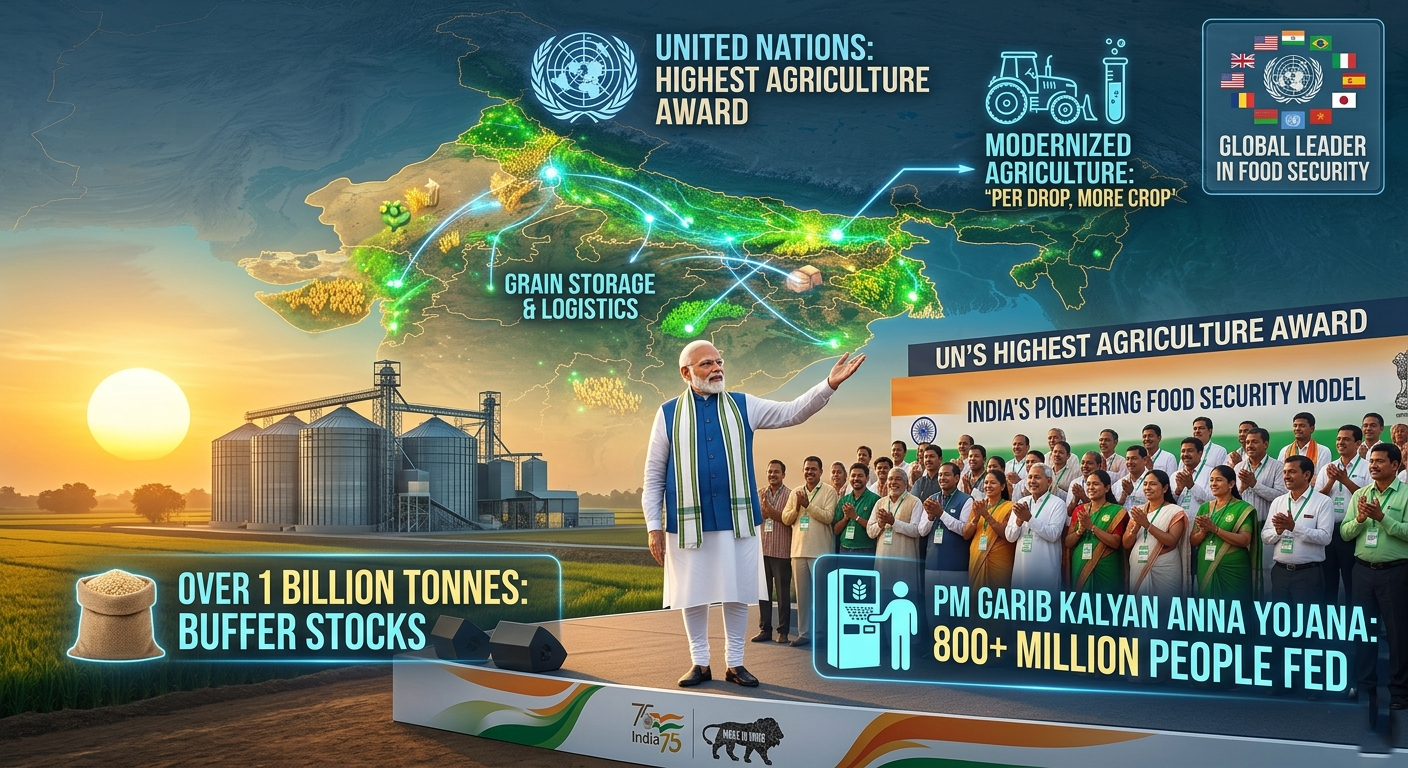
The Food Security Story the World Is Missing: Why Modi Received the UN’s Highest Agriculture Award

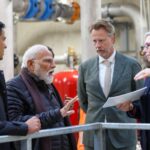
On May 20, 2026, the United Nations FAO presented PM Modi with its most prestigious honour in Rome. Behind the ceremony lies a two-decade transformation of how India feeds 1.4 billion people — a story of extraordinary scale, technology, and quiet determination that deserves far more global attention than it gets.
| On May 20, 2026, in FAO’s historic Plenary Hall in Rome, FAO Director-General Qu Dongyu presented PM Modi with the Agricola Medal — FAO’s most prestigious award. The honour recognised what FAO called Modi’s ‘invaluable contribution and long commitment to the wellbeing of India, and all people.’ Behind the ceremony is a food security story that has unfolded quietly across 1.4 billion lives. This article tells it in full. |
What Is the FAO Agricola Medal — and Why Does It Matter?
The FAO Agricola Medal is the highest honour the Director-General of the United Nations Food and Agriculture Organisation can personally bestow. It is not an annual award — it is given selectively to leaders who have demonstrated exceptional, sustained commitment to FAO’s core mandate: eradicating hunger, reducing poverty, and ensuring food security and nutrition for all people.
The medal is named after Gnaeus Julius Agricola — a Roman general celebrated in antiquity for improving the agricultural conditions of the lands he governed. In the modern context, it recognises leaders whose policies have materially changed the lives of the hungry and the rural poor.
Notable past recipients include King Bhumibol Adulyadej of Thailand, former French President Jacques Chirac, and former Indian PM Manmohan Singh. Modi is now the second Indian Prime Minister to receive the honour — and this visit was the first by an Indian Head of Government to FAO’s headquarters in nearly three decades.
The Ceremony: What Was Said in Rome
FAO Director-General Qu Dongyu presented the medal at the Plenary Hall, before ambassadors, UN agency heads, and Indian nationals serving in Rome-based UN bodies. His words were unambiguous:
| “It is an honour to award the FAO Agricola Medal — the Organisation’s highest award — to His Excellency Prime Minister Narendra Modi, in recognition of his invaluable contribution and long commitment to the wellbeing of India, and all people. During his tenure, he has introduced landmark schemes to enhance agricultural productivity, bolstering food security and improving farmers’ livelihoods.” — QU Dongyu, FAO Director-General, May 20, 2026 |
Modi dedicated the honour not to himself but to every person who grows, processes, and delivers India’s food:
| “I dedicate this honour to India’s Annadatas — our food providers. It is a recognition of the hard work of our farmers, those associated with the world of livestock and fisheries, our agriculture scientists and innovators. It is also an acknowledgement of India’s unwavering commitment to human welfare, food security and sustainable development.” — PM Narendra Modi, FAO Headquarters, Rome, May 20, 2026 |
Five Pillars: What India Actually Did to Earn This Award
The FAO’s recognition was grounded in specific, documented policy achievements. Here are the five pillars of India’s food security transformation, explained plainly.
Pillar 1 — PMGKAY: The World’s Largest Free Food Programme
Pradhan Mantri Garib Kalyan Anna Yojana (PMGKAY) provides 5 kg of free food grains every month to approximately 800 million people — rice, wheat, or millets, at zero cost, over and above existing subsidised rations. Launched during COVID-19 in March 2020, it was extended in January 2024 for a further five years at a committed cost of ₹11.80 lakh crore (approximately $142 billion).
| 🌾 | 800M+ | People receiving free food grains every month under PMGKAY |
| 🌾 | 5 kg | Free grains per person per month (rice, wheat, or millets) |
| 🌾 | 5 yrs | Extension period from January 2024 to December 2028 |
| 💰 | ₹11.8L Cr | Total five-year food subsidy commitment ≈ $142 billion |
For perspective: 800 million people is more than the combined population of Europe and North America. No government in history has delivered free food at this scale, for this duration, with this level of documented reach. That is why FAO highlighted it as a “global model for crisis-time food security.”
Pillar 2 — PM-KISAN: Cash Directly Into Farmers’ Hands
PM-KISAN delivers ₹6,000 per year directly into the bank accounts of over 110 million land-holding farmers, in three instalments of ₹2,000 each. No intermediaries. No paperwork delays. The transfer happens digitally through India’s JAM trinity — Jan Dhan bank accounts, Aadhaar identity numbers, and mobile phones — in real time.
This approach represents a fundamental shift in agricultural support policy: instead of subsidising inputs (seeds, fertiliser, water) and hoping benefits reach farmers, the government sends cash directly to the farmer. Short-term agricultural credit grew by 275% over the decade from FY2013-14 to FY2023-24, reflecting the broader expansion of financial inclusion for Indian farmers.
| The leakage problem — solved digitally: Traditional subsidy programmes in India were notoriously leaky — money intended for farmers diverted at multiple levels. Aadhaar-linked digital transfers have reduced leakages significantly, with documented reductions of 12% in food distribution in states like Tamil Nadu. Direct cash transfers to 110 million farmers apply the same logic: if the money lands in their account, it cannot be intercepted. |
Pillar 3 — Climate-Resilient Crops: Farming in a Warming World
Climate change is the single greatest long-term threat to global food security. India has responded by dramatically accelerating the development of crop varieties that can survive floods, droughts, extreme heat, and soil salinity.
Through the Indian Council of Agricultural Research (ICAR) and agricultural universities, India has developed thousands of improved varieties of cereals, oilseeds, pulses, and fibre crops — including over 1,752 varieties specifically designed for climate resilience, and 87 biofortified varieties enriched in iron, zinc, and vitamins to address micronutrient deficiencies alongside caloric security.
- Flood-tolerant rice varieties for submerged paddy fields during intense monsoon seasons
- Drought-resistant pulses and millets for rain-fed regions in Rajasthan, Maharashtra, and central India
- Heat-tolerant wheat varieties for the Indo-Gangetic Plain, where rising temperatures compress the growing window
- Biofortified varieties delivering nutritional value alongside calories, addressing ‘hidden hunger’
Pillar 4 — ‘Per Drop More Crop’: Micro-Irrigation at Scale
Agriculture consumes around 70% of India’s freshwater. In an era of deepening water stress, how efficiently that water is used is a food security question. The ‘Per Drop More Crop’ component of the Pradhan Mantri Krishi Sinchayee Yojana (PMKSY) has expanded drip irrigation and sprinkler systems across Indian farmland.
Over the past decade, approximately 90 lakh hectares (nine million hectares) of land have been brought under micro-irrigation — systems that deliver water directly to plant roots using 30-70% less water than flood irrigation while boosting crop yields by 20-50%. For a country where groundwater depletion is already critical in key agricultural states, this is not optional — it is existential.
Pillar 5 — Digital Agriculture: Technology Meeting the Farm
Perhaps the least-reported part of India’s agricultural transformation is the scale of digital technology adoption in farming:
- AI-based advisory systems providing crop disease diagnosis, weather forecasts, and market prices in local languages via mobile
- Drone Didis — thousands of women trained to operate drones for precision spraying of fertilisers and pesticides, reducing chemical use and increasing efficiency
- Digital land records giving farmers a unique digital ID for their land, enabling access to credit, insurance, and government schemes without paperwork barriers
- e-NAM (National Agriculture Market) — a digital marketplace connecting farmers directly to buyers across state borders, reducing exploitative intermediaries
- 700+ Krishi Vigyan Kendras (agricultural extension centres) bringing research directly to villages across all states and union territories
The Full Transformation: India’s Food Journey in Numbers and Years
| 1965 | Famine threat; food aid dependency India produces ~72 MT grains annually; depends on emergency US food shipments; famine is a real possibility |
| 1966–70 | Green Revolution begins High-yielding wheat and rice varieties adopted; production begins rising rapidly from a low base |
| 2013 | National Food Security Act Legal entitlement to subsidised food grains extended to ~800 million people under NFSA |
| 2019 | PM-KISAN launched ₹6,000/year direct income support starts for 100 million+ land-holding farmers via Aadhaar-linked transfers |
| 2020 | PMGKAY launched amid COVID-19 800 million people receive free food grains; the world’s largest food safety net activated in weeks |
| 2023 | Global Biofuel Alliance launched India leads a multilateral initiative on biofuels at the G20, attracting 20+ countries |
| 2023–24 | Record 330.5 MT food grain harvest India now a net exporter to 100+ countries; produces more than 4.5x its 1965 output |
| Jan 2024 | PMGKAY extended five years ₹11.80 lakh crore committed for free grains to 800 million people until December 2028 |
| May 2026 | FAO Agricola Medal awarded United Nations formally recognises India’s transformation as a global model for food security at scale |
Why This Story Matters Beyond India
A Model for the Global South
The world faces a deepening food crisis. The WFP describes the current moment as the worst food emergency since World War Two, driven by climate shocks, conflict, supply chain disruptions, and debt. Hundreds of millions of people across Africa, South Asia, and Latin America face chronic food insecurity.
India’s experience — of using digital public infrastructure to deliver food and cash to hundreds of millions with minimal leakage, of developing climate-resilient varieties at industrial scale, of expanding micro-irrigation across a sub-continent — offers a replicable model that is immediately relevant to governments struggling with the same problems on smaller budgets.
FAO’s recognition explicitly cited Modi’s ‘efforts to prioritise agrifood systems transformation’ and advance the UN’s Sustainable Development Goals. This is not diplomatic language; it is an endorsement of Indian methods as globally applicable.
The Global Biofuel Alliance
At the G20 under India’s presidency in 2023, Modi launched the Global Biofuel Alliance — a multilateral initiative promoting biofuels as a clean energy solution for agriculture and transport. During Modi’s Italy visit in May 2026, the Netherlands formally joined the Alliance, taking its membership above 20 countries. This positions India not merely as a food security success story, but as an architect of new global frameworks for sustainable agriculture.
The Honest Picture: What India Still Needs to Address
A full account must acknowledge that significant challenges remain:
- Malnutrition persists alongside food security. India has made dramatic progress in caloric sufficiency, but micronutrient deficiency — low iron, zinc, and vitamin levels, especially among women and children — remains a serious public health challenge. Producing enough calories is not the same as ensuring nutritional adequacy.
- Water stress is deepening. Groundwater depletion in Punjab and Haryana — India’s most productive agricultural states — is severe. The aquifers being drawn down faster than they recharge represent a long-term food security risk that micro-irrigation alone cannot fully address.
- Farmer incomes remain low. Despite PM-KISAN and expanded credit, agricultural incomes remain substantially below urban industrial wages, driving rural-to-urban migration and reducing farming’s appeal to younger generations.
- Distribution gaps persist. While Aadhaar-linked systems have reduced leakage, millions of eligible beneficiaries still face barriers — connectivity issues, migration across states, or documentation problems — that prevent them from accessing their entitlements.
- Climate change is accelerating faster than adaptation. India’s climate-resilient varieties and expanded irrigation are necessary responses, but the pace and severity of climate change continues to outrun even ambitious adaptation programmes.
| The honest verdict: Acknowledging these challenges does not diminish the achievements the FAO medal recognises. India has accomplished something extraordinary in feeding 1.4 billion people with increasing reliability, equity, and technological sophistication. The work is not finished — but the foundation being built is real, documented, and globally significant. |
Frequently Asked Questions
What is the FAO Agricola Medal?
The Agricola Medal is the highest honour the Director-General of the United Nations FAO can personally award. It recognises leaders who have demonstrated exceptional, sustained commitment to eradicating hunger and ensuring food security. Past recipients include Thailand’s King Bhumibol Adulyadej, Jacques Chirac, and former Indian PM Manmohan Singh.
When and where did Modi receive the medal?
PM Modi received the FAO Agricola Medal 2026 on May 20, 2026, at a formal ceremony in the historic Plenary Hall of FAO headquarters in Rome, Italy. The ceremony was part of his five-nation European tour. This was the first visit by an Indian Head of Government to FAO headquarters in nearly three decades.
What is PMGKAY and how many people benefit?
PMGKAY (Pradhan Mantri Garib Kalyan Anna Yojana) provides 5 kg of free food grains per person per month to 800 million people — nearly 57% of India’s population. Extended in January 2024 for five years until December 2028, the government has committed approximately ₹11.80 lakh crore (around $142 billion) to the programme. It is the world’s largest free food programme.
What is PM-KISAN and how many farmers receive it?
PM-KISAN delivers ₹6,000 per year directly into the bank accounts of over 110 million land-holding farmers, in three instalments of ₹2,000. The transfers are made digitally through India’s Aadhaar-linked JAM infrastructure, with no intermediaries and no paperwork required from the farmer.
How much has India’s food grain production grown?
India’s food grain production grew from approximately 72 million tonnes in the mid-1960s — when India depended on US food aid — to a record 330.5 million tonnes in 2023-24. India is now a net exporter of food grains to over 100 countries, while simultaneously running the world’s largest free food programme domestically.
Disclaimer: This article is for informational and educational purposes only. It is based on publicly available reports and policy updates. It should not be considered financial, investment, legal or business advice.