












































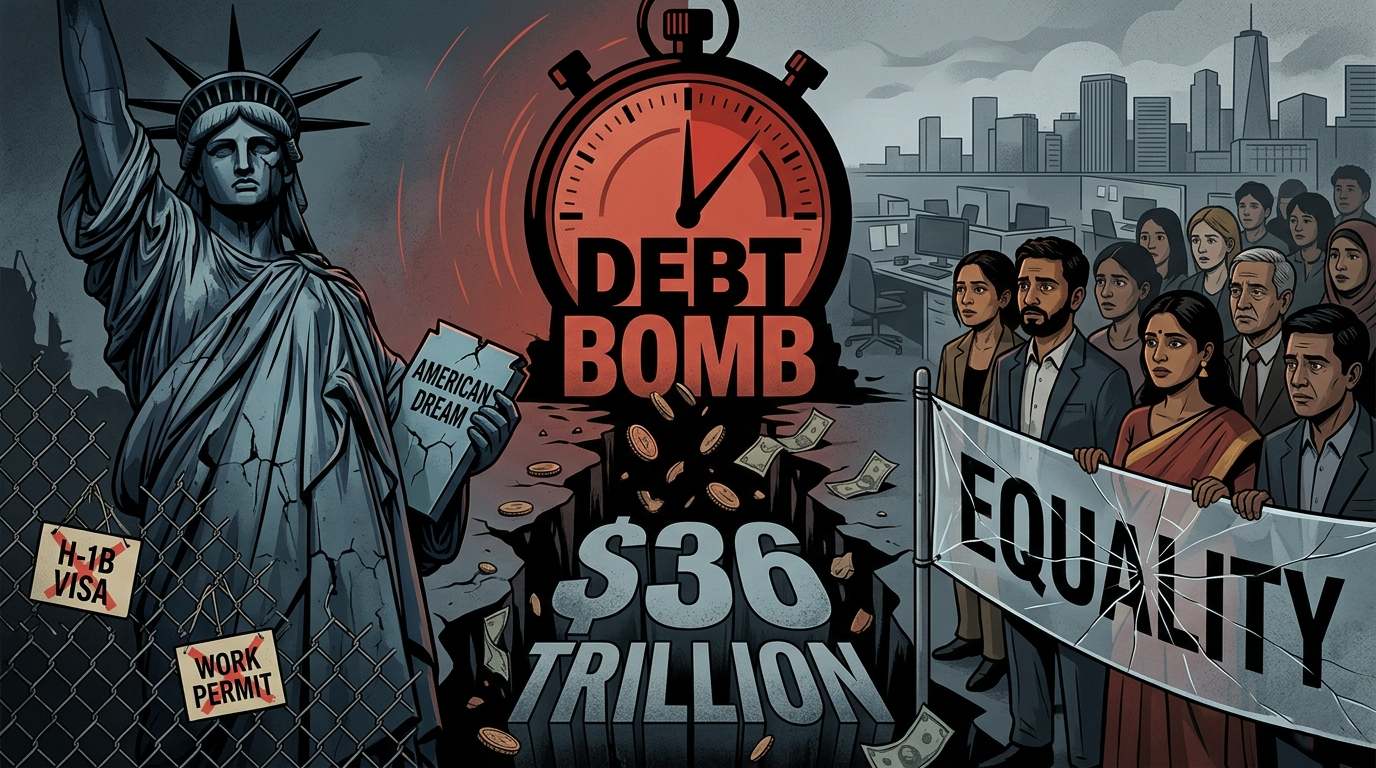
Is the American Dream Ending? H-1B Crisis, Anti-Indian Racism, and a $36 Trillion Debt Bomb — The Hard Truth About America’s Future

Indians built Silicon Valley. They run Fortune 500 companies. They fill America’s hospitals, labs, and universities. Now they’re being told to leave — or are leaving on their own. And the country they’re leaving behind owes more money than any nation in human history. A clear-eyed look at where this is all heading.
| In January 2025, Sriram Krishnan was appointed as the White House’s senior AI policy adviser. Within hours, a wave of anti-Indian hate swept across X, Facebook, and TikTok, calling for visa bans, deportations, and denaturalisations of Indian-Americans. At the same time, H-1B renewal appointments at US consulates were being pushed to 2027. And the US national debt crossed $36 trillion — growing at $5.64 billion every single day. Three stories. One question: what does America’s future actually look like? |
💳 The H-1B Visa: America’s Most Contested Work Permit
The H-1B is a non-immigrant US work visa for skilled foreign workers, valid for three years and renewable to six. Every year, 85,000 H-1B visas are approved — and Indian nationals have accounted for over 70% of all H-1B approvals for more than a decade. IT, engineering, finance, medicine — these are the sectors that run on H-1B talent, and overwhelmingly, that talent is Indian.
| 📊 | 85,000 | H-1B visas approved annually in the United States |
| 🇮🇳 | 70%+ | Share of H-1B approvals going to Indian nationals each year |
| 💰 | $100K | Trump’s proposed annual fee for new H-1B applications |
| 🗓️ | 2027 | Earliest H-1B renewal appointment date at some US consulates |
| 🚫 | FY2026 | EB-2 India green card quota exhausted — months ahead of schedule |
| ⏳ | 140 yrs | Estimated wait time for an Indian in the EB-2 green card queue at current rates |
And then, in early 2026, came the biggest shock yet. Trump’s administration announced a $100,000 annual fee for new H-1B applications. The move was framed as protecting American workers. The reality is more complex: if the fee is applied at the current rate of H-1B approvals, it would add $14 billion in costs to US companies that depend on skilled foreign talent.
Simultaneously, all EB-2 green card visas for India in FY2026 were exhausted early — before the fiscal year even ended. For thousands of Indians already in the US on H-1B visas, this means an even longer wait for permanent residence. Some analysts estimate the effective queue for an Indian EB-2 applicant is now over 140 years. That is not a typo.
| “Some applicants who had been trying to book a visa appointment found the first available slots were in 2027. One social media user described the US visa scheduling website as having ‘turned into a Minecraft game.’ Another urged compatriots: ‘Read between the lines here and plan for your future. Hint — it’s not in the US.’” — South China Morning Post, May 2026 |
😡 The Rising Tide of Anti-Indian Racism in America
The H-1B controversy did not stay in policy circles. It spilled onto the streets — and into social media — in the form of a documented surge in anti-Indian racism that has alarmed researchers, civil rights organisations, and the Indian diaspora alike.
The trigger was partly Sriram Krishnan’s White House appointment and his support for removing country caps on green cards. The reaction was immediate and virulent. A report by the Center for the Study of Organised Hate (CSOH) analysed posts on X between July and September 2025 and found:
- 474 posts (69.7% of the sample) framing Indians as ‘invaders’ or ‘job thieves’ — generating 111.8 million views
- 121 posts using explicit anti-Indian slurs, generating 74.3 million views
- Calls for visa bans, deportation, and denaturalisation of Indian-Americans
- 65% of all posts were US-centred, converging immigration anxiety with economic insecurity
The AAPI Equity Alliance’s Stop AAPI Hate Report found that more than 75% of anti-Asian slurs targeted South Asians between December 2024 and January 2025. Moonshot, a counter-extremism group, found over 44,000 anti-South Asian slurs in extremist online spaces in just two months of 2025.
| The painful irony: Indian-Americans are statistically the highest-earning, best-educated, and most entrepreneurial immigrant group in the United States. They are more likely to start a business, hold a PhD, and pay taxes than native-born Americans. The racism directed at them is not about their performance — it is about fear, economic anxiety, and scapegoating. |
This is not a new story — but it is getting louder
Anti-South Asian violence and discrimination has a long history in the US, from the “Dotbusters” gang attacks in New Jersey in the 1980s to the post-9/11 hate crimes that targeted Sikhs, Hindus, and Muslims indiscriminately. What is new in 2026 is the scale, the mainstreaming, and the explicit connection to immigration policy. When a US government advertisement explicitly singles out “H-1B visa abuse” by India, as the Trump administration did in October 2025, it legitimises a hostile narrative.
Inside tech workplaces, Indian managers and engineers describe a shift that is hard to quantify but impossible to ignore. “Recently, I see so much anger toward Indians in tech. Online, people say we only hire our own, or that we bring the caste system here. It breaks me because I’ve spent my whole career trying to do the opposite,” one Indian senior manager wrote in a widely shared post. The post attracted thousands of responses — both sympathetic and viciously hostile.
🇮🇳 The Reverse Brain Drain: Are Indians Actually Leaving?
Here is where the story becomes genuinely significant for India. The question is not just whether the US is treating Indians badly. The question is whether the talent is starting to go elsewhere — and what that means for both countries.
Karnataka’s IT/BT Minister Priyank Kharge directly confronted this question after the H-1B fee announcement: “While it’s too early to predict if there’ll be reverse brain-drain, do we have the environment? Are you ready to pay $100,000–$1,25,000 for an engineer?” His point: the talent may want to come back, but India must create the conditions that make staying worthwhile.
The signals of a shift are real but still early:
- Indian tech companies, startups, and product firms are actively recruiting Indian engineers in the US — offering salaries that, while lower in absolute terms, go further in India’s cost environment
- Bengaluru, Hyderabad, and Pune are seeing a rise in senior Indian professionals returning from the US to lead product teams at a fraction of Silicon Valley’s compensation
- Platforms like LinkedIn show a measurable uptick in ‘returning to India’ posts by senior Indian tech professionals since early 2025
- The IndiaAI Mission and Dholera semiconductor fab are creating roles that simply did not exist in India five years ago — attracting engineers who previously had no reason to return
| India’s opportunity window: India currently has the world’s second-largest pool of AI and software talent. If even 5% of the 4 million+ Indian-origin tech professionals currently in the US return over the next decade, the impact on India’s innovation economy would be transformative. The question is whether India’s ecosystem — in terms of pay, infrastructure, rule of law, and opportunity — is ready to absorb and reward that talent. |
💸 The $36 Trillion Question: What Does America’s Debt Mean for Its Future?
And here is the elephant in the room that rarely appears in the same conversation as the H-1B debate: the United States is drowning in debt, and the fiscal trajectory is, by the US government’s own assessment, “not sustainable.”
| Year | National Debt | Debt/GDP | What Was Happening |
| 2001 | $5.8 trillion | 55% of GDP | Last year the US ran a budget surplus |
| 2020 | $26.9 trillion | 129% of GDP | COVID stimulus; historic peacetime spending |
| 2025 | $30.3 trillion | 100% of GDP | Post-COVID; CBO confirmed figure |
| 2026 | $31.9 trillion | 102% of GDP | CBO baseline projection; deficit: $1.9 trillion |
| TODAY | $36.2 trillion | 123% of GDP | Growing $234.99M/hour; $5.64B every day |
| 2030 | $40+ trillion | 106%+ of GDP | Will surpass 1946 WWII-era peak |
| 2036 | ~$52 trillion | 120% of GDP | CBO 10-year projection; deficit reaches $3.1T |
| 2035 | $52.1 trillion | 118% of GDP | Projected by Congressional Budget Office |
The debt is growing at $234.99 million every hour — or $5.64 billion every day. To put that number in perspective: $36.21 trillion, if counted in seconds, would take 1.15 million years to count. The numbers are not just large. They are structurally destabilising. The Congressional Budget Office projects that by 2031, the interest rate the government pays on its debt will exceed the economic growth rate — triggering what economists call a debt spiral.
What does this mean practically?
- Interest payments alone will reach $1 trillion in 2026 and $2.1 trillion by 2036 — money that could have gone to education, infrastructure, or healthcare
- Social Security’s Old-Age and Survivors Insurance Trust Fund is projected to be exhausted by 2032 — one year earlier than previously forecast
- The US deficit in FY2026 is $1.9 trillion — at a time when the unemployment rate is below 5%. Running trillion-dollar deficits in good economic times is historically unprecedented and deeply alarming
- The 2025 reconciliation act increases projected deficits by a further $4.7 trillion over the next decade
- Lower immigration — from H-1B restrictions and deportation drives — increases deficits by a further $0.5 trillion, per CBO, because immigrants pay taxes and contribute to Social Security
| The uncomfortable connection: Cutting skilled immigration does not save America money — it costs America money. The CBO explicitly projects that lower immigration increases US deficits because immigrants contribute more in taxes than they consume in government services over their lifetimes. Deporting or deterring the highest-earning immigrant group in the country (Indian-Americans, median household income $135,000+) is not a fiscal strategy. It is a fiscal self-wound. |
🔭 The Future of America: Three Scenarios
Scenario 1: The Managed Transition
The US corrects course. Congress passes meaningful immigration reform that clears the green card backlog, attracts and retains top global talent, and pairs this with fiscal discipline that gradually reduces deficits. The anti-immigration sentiment fades as the economy adjusts. This is the optimistic scenario. Historical precedent: the US has done this before.
Scenario 2: The Slow Erosion
The visa restrictions, anti-immigrant sentiment, and fiscal deterioration continue at their current pace without dramatic crisis. Talent gradually diversifies — India, Canada, the UAE, and the EU attract more of the global skilled workforce. The US retains its edge but with a smaller margin of dominance. Innovation slows. The dollar remains the reserve currency, but its grip weakens. This is the most likely scenario based on current trajectories.
Scenario 3: The Fiscal Crisis
If the debt spiral the CBO warns about in 2031 materialises — where interest costs exceed growth — the US faces a genuine structural crisis: forced spending cuts, tax increases, potential dollar weakening, and loss of global reserve currency status. This is a low-probability, high-consequence scenario. Most economists believe the US has enough resilience to avoid it. But a decade ago, few economists believed the US would run trillion-dollar deficits at full employment. The unthinkable has a habit of arriving unannounced.
| The bottom line: America is at a decision point. The country that built its global dominance on attracting the world’s best talent is now making that talent feel unwelcome. The country that spent decades as the world’s most trusted borrower is spending at a pace that its own budget office calls unsustainable. Neither of these trajectories is locked in. But both require honest acknowledgement before they can be reversed. |
❓ Frequently Asked Questions
What is the H-1B visa and why does it matter to Indians?
The H-1B is the primary work visa for skilled foreign professionals in the US. Annually, 85,000 are approved, and Indian nationals win over 70% of them. It is the pipeline through which hundreds of thousands of Indian engineers, doctors, and finance professionals have built careers in America. Restrictions on H-1B directly impact India’s most educated and highest-earning diaspora.
What is Trump’s $100,000 H-1B visa fee?
The Trump administration announced a $100,000 annual fee on new H-1B visa applications. This would be a one-time charge applicable to fresh applications only. If applied at current approval rates, it would add an estimated $14 billion in costs to US companies that rely on H-1B workers. Critics argue it will push companies to offshore work to India rather than hire in the US.
Are Indians actually leaving the US?
A full-scale reverse brain drain has not yet materialised, but the signals are real. H-1B renewal appointments are being pushed to 2027. All EB-2 Indian green cards for FY2026 were exhausted early. Indian companies are actively recruiting US-based Indian talent. Several senior tech professionals have publicly documented their decisions to return to India. The shift is early but measurable.
What is the US national debt right now?
The US national debt is currently $36.21 trillion, growing at $234.99 million per hour ($5.64 billion per day). The debt-to-GDP ratio is 123.2% — above the post-World War II peak. The Congressional Budget Office projects deficits of $1.9 trillion in FY2026, growing to $3.1 trillion by 2036.
Does cutting immigration increase the US deficit?
According to the Congressional Budget Office: yes. The CBO’s February 2026 projections explicitly state that lower immigration increases US deficits by approximately $0.5 trillion over the budget window because immigrants — particularly skilled professionals — contribute more in taxes over their lifetimes than they consume in government services. Restricting skilled immigration is fiscally counterproductive.
Disclaimer: This article is for informational and educational purposes only. It is based on publicly available reports and policy updates. It should not be considered financial, investment, legal or business advice.