










































BrahMos: How One Missile Changed Global Defence Forever — From Operation Sindoor to a Worldwide Arms Revolution

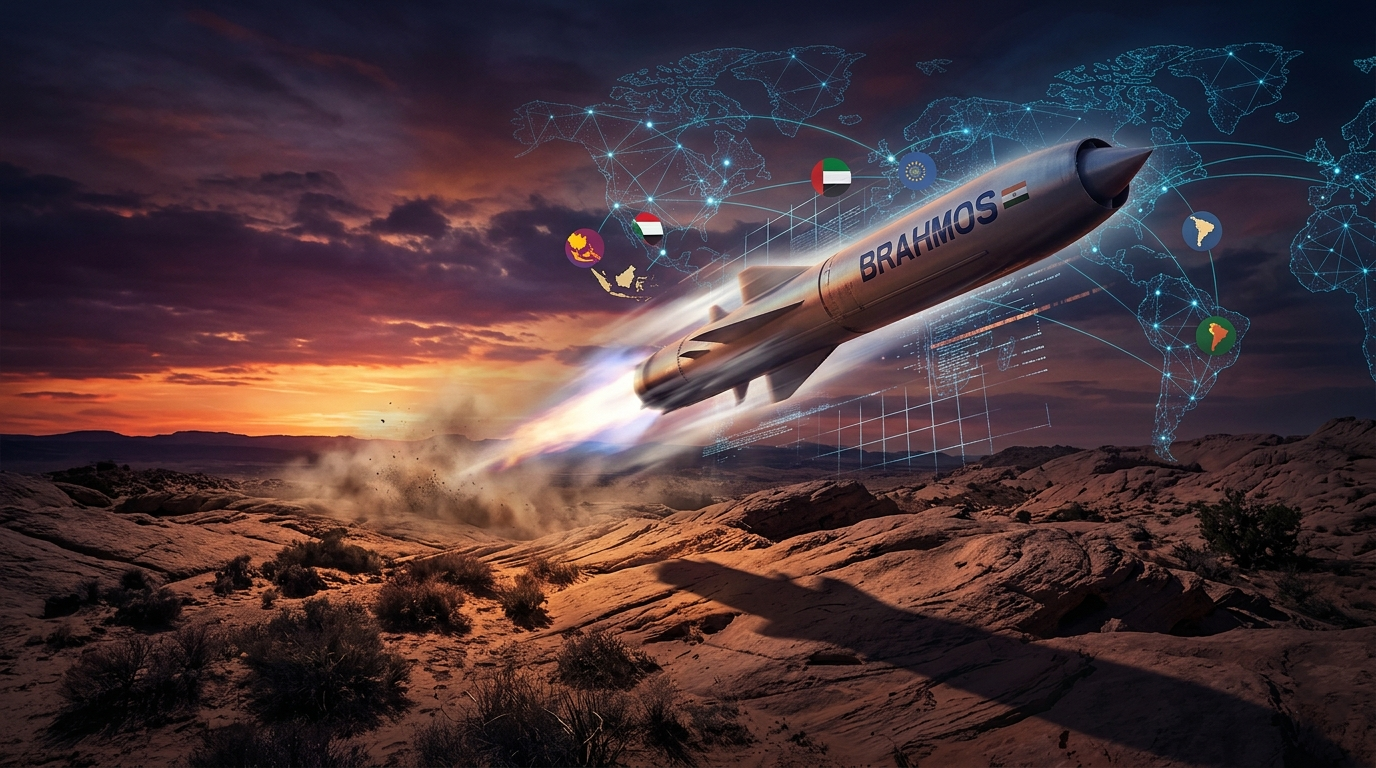
It flies at three times the speed of sound. It hugs the ground at just 10 metres altitude. No air defence system in Pakistan’s arsenal could stop it. On May 10, 2025, the BrahMos supersonic cruise missile didn’t just win a battle — it rewrote the global defence market. Here is the complete story: what happened, why China’s ‘HQ-9 system‘ failed miserably, and why countries from Vietnam to Greece and Chile to Cyprus are now queuing up to buy the world’s fastest cruise missile.
| The date: May 10, 2025. 02:00–05:00 hours. In coordinated waves over three hours, the Indian Air Force launched long-range precision strikes from within Indian airspace. BrahMos missiles flew at Mach 2.8–3.0, hugging the earth at 10–15 metres altitude. In Lahore, Sialkot, Chaklala, Rafiqui, Nur Khan, Murid, Sukkur, Rahimyar Khan, Chunian, and other locations — 11 Pakistani Air Force bases were struck. Pakistan’s Chinese-supplied HQ-9B air defence system, hailed as an S-300 equivalent, failed to intercept a single missile. The world was watching. And the world placed its orders. |
🚀 What Is the BrahMos? The Missile That Changed Everything
The story of BrahMos begins in the aftermath of the 1999 Kargil War. India’s defence establishment recognised a critical gap: the need for a supersonic cruise missile capable of striking deep into enemy territory with surgical precision, from any platform — land, sea, or air. The solution came through an unprecedented joint venture with Russia.
BrahMos Aerospace — a 50.5:49.5 joint venture between India’s DRDO and Russia’s NPO Mashinostroyeniya — was established in 1998. The name is a tribute to the two rivers at the heart of the partnership: Brahmaputra (India) and Moskva (Russia). It became operational in 2005, and what followed was two decades of continuous refinement that produced the most formidable supersonic cruise missile in the world.
The Technical Specifications That Make Armies Nervous
| Specification | BrahMos Performance | Why It Matters |
| Maximum Speed | Mach 2.8–3.0 | ~3,000 km/h — 3x speed of sound. Leaves <5 seconds reaction time at 15km range |
| Range (current) | 800+ km | Originally 290km (MTCR cap). Extended post-India’s MTCR entry in 2016 |
| Flight Altitude | 10 metres | Sea-skimming flight defeats most radar systems. Conventional S-2M radar blind below 20m |
| Warhead | 200–300 kg | Semi-armour-piercing — can pierce 3m of reinforced concrete before detonating |
| Guidance | GPS + INS + GLONASS | Triple-redundant navigation ensures accuracy to within 1 metre CEP |
| Launch Platforms | Land, Sea, Air | Rafale jets, Su-30MKI, Destroyers, Stealth frigates, TEL vehicles |
| Cruise Altitude | 10m to 14,000m | Terrain-hugging for attack; high-altitude for extended range |
| Kill probability | ~96% | In operational use — consistent with simulations. Zero intercepts in combat to date |
The BrahMos is not just fast. Its combination of speed, low-altitude flight, and unpredictable terminal manoeuvres creates what military analysts call a ‘trilemma’ for any air defence system: you need to see it early (the low altitude defeats most radar), calculate its course accurately (the manoeuvres disrupt targeting), and intercept it within a time window of seconds (the speed eliminates reaction time). No existing air defence system in South Asia, Southeast Asia, or the Middle East — other than perhaps India’s own S-400 — can reliably achieve all three.
🎯 Operation Sindoor: The BrahMos Gets Its Combat Credential
Theory is one thing. Combat performance is another. The global arms market does not buy weapons based on brochures. It buys based on documented battlefield results. Operation Sindoor gave BrahMos the most credible combat credential in the world: it worked, under real combat conditions, against a defended adversary, with zero misses.
What the Strikes Actually Hit
According to the official MEA and MOD briefing by Indian Army Colonel Sofiya Qureshi, and corroborated by the January 2026 report from the Centre d’Histoire et de Prospective Militaires (CHPM) in Switzerland — one of Europe’s most credible military research institutions — India’s May 10 strike package hit:
- Nur Khan Air Base (near Islamabad/Rawalpindi) — Pakistan’s most strategically significant airbase, adjacent to military leadership infrastructure. At least one confirmed missile strike.
- Rafiqui Air Base — A key PAF fighter base in Shorkot, Punjab
- Murid Air Base — Combat aircraft base in Chakwal district
- Chaklala (PAF Base Nur Khan) — Air transport and VIP operations
- Sukkur Air Base — Southern Pakistan; key logistics hub
- Rahimyar Khan Air Base — Forward PAF base with training functions
- Chunian Air Base — Radar and surveillance infrastructure
- Pasrur and Sialkot radar sites — Forward air surveillance, critical for early warning
The CHPM report concluded that “by the morning of May 10, the IAF had succeeded in achieving air superiority over a significant portion of Pakistan’s airspace.” It further noted that “the PAF had lost the ability to repeat the operations it had conducted so successfully on May 7, owing to the loss of its forward air-surveillance radars and the threat posed by S-400 systems to its AWACS standoff weapons delivery platforms.”
| The strategic significance: Hitting 11 air bases simultaneously is not just a military achievement. It is an integrated planning, intelligence, and execution feat. India used BrahMos missiles alongside SCALP-EG cruise missiles from Rafale jets and Israeli Harop loitering munitions in a coordinated multi-platform strike package. The BrahMos was the primary long-range strike weapon — its ability to be launched from Indian airspace without entering Pakistani airspace eliminated the risk to Indian pilots. |
🚫 How China’s HQ-9 Failed Spectacularly — and Why It Matters
Pakistan’s primary air defence against the BrahMos was the Chinese-made HQ-9B — the HongQi-9B, marketed by Beijing as a high-altitude, long-range surface-to-air missile system with a stated engagement range of 260 kilometres. China sold it to Pakistan in 2021 as a ‘superior alternative to the Russian S-300’ and positioned it as the backbone of Pakistan’s aerial defence against Indian air power.
The HQ-9B was supposed to be Pakistan’s answer to India’s BrahMos. In May 2025, it failed at every level.
HQ-9 vs BrahMos: The Verdict
| Combat Category | ❌ China HQ-9B (Pakistan) | ✅ BrahMos (India) |
| Intercept record | Zero confirmed intercepts of BrahMos | 100% strike rate on all assigned targets |
| Low-altitude capability | Claimed 10m floor; failed in practice | Flies at 10m; radar-invisible at this altitude |
| Electronic warfare resistance | Software instabilities under jamming confirmed | Dual inertial + GPS + GLONASS navigation |
| Network integration | Fragmented; HQ-9B didn’t integrate with PAF radar | Standalone mission computer; no network dependency |
| Reaction time | 3–8 minutes to deploy and engage | <5 seconds reaction window for defender |
| Physical survivability | HQ-9B unit destroyed in Lahore, May 8 | Launched from mobile TEL; no fixed signature |
| Post-conflict assessment | CHPM, ORF, Meta-Defense confirm failures | Confirmed operational success; zero technical failures |
| Arms market impact | China lost 7 potential export clients | New enquiries from 20+ countries post-Sindoor |
The post-strike debris analysis by multiple international organisations revealed a damning picture. According to Meta-Defense (March 2026): “Operation Sindoor exposed a gap between promises and high-intensity employment, with the HQ-9 family failing to intercept Indian projectiles including BrahMos near Mach 3. Post-strike debris analysis revealed software instabilities in the fire control computers, high exposure to electronic warfare, and failures to integrate with the air defence network.”
US defence analyst Brandon J. Weichert of The National Interest was blunter: “The BrahMos ‘blew out’ Pakistan’s Chinese-made HQ-9B air defence systems. The Chinese systems were junk — they could not stop even drones.”
The Observer Research Foundation (ORF) in New Delhi noted the deeper structural issue: “Chinese air defence platforms failed to protect military installations in Pakistan. This eroding institutional trust has strategic implications. Corruption within the PLA and defence sector risks undermining the quality, reliability, and combat performance of Chinese weapon systems.”
| The global arms market takeaway: The HQ-9’s failure was not just a Pakistan problem. China is the world’s fourth-largest arms exporter, supplying around 65% of Pakistan’s arms imports and selling to dozens of developing nations. When a marquee Chinese air defence system fails publicly against a weapon made by a competitor country, every nation that has bought or is considering buying Chinese defence equipment reassesses. That reassessment is currently driving enquiry forms to BrahMos Aerospace. |
🌍 The BrahMos Export Revolution: A World Map of Buyers and Prospects
Operation Sindoor was the world’s most effective arms trade fair that nobody planned. By October 2025, India had signed $450 million in new BrahMos export contracts — its first new deals since the Philippines signed in 2022. By May 2026, the BrahMos order book was approaching $7 billion. Here is every confirmed buyer and serious prospect:
CONFIRMED DEALS
| Country | Status | Deal Value | Strategic Rationale | |
| 🇵🇭 | Philippines | ✅ DELIVERED | $375 million | First foreign buyer (Jan 2022). 3 coastal defence batteries. 2nd batch delivered Apr 2025. Directly counters Chinese Navy aggression in South China Sea. |
| 🇮🇩 | Indonesia | ✅ SIGNED 2025 | ~$450 million | Inked post-Sindoor. Indonesia watched HQ-9 fail and moved fast. Largest ASEAN defence budget in 2025–26. |
| 🇻🇳 | Vietnam | ✅ CONFIRMED 2026 | ~$700 million | Deal confirmed at Shangri-La Dialogue, May 29–31, 2026. Shore-based coastal defence batteries. Directly targets Chinese PLAN in disputed waters. |
ADVANCED NEGOTIATIONS
| Country | Status | Potential Value | Why They Want It | |
| 🇲🇾 | Malaysia | Advanced talks | ~$300 million | Air-launched variant for Su-30MKM jets and Kedah-class warships. South China Sea territorial disputes with China identical to Philippines. |
| 🇦🇲 | Armenia | In negotiation | TBD | India’s key strategic partner in the Caucasus. Has fought two wars (2016, 2020) against Azerbaijan. Actively replacing Russian equipment with Indian systems. |
| 🇦🇪 | UAE | Active interest | $400M+ | BrahMos Aerospace Co-Director Maksichev confirmed UAE as priority buyer in Nov 2024. Gulf security concerns, Strait of Hormuz importance. |
INTERESTED & IN EARLY DISCUSSIONS
| Country / Region | Interest Level | Strategic Context | Key Motivator | |
| 🇬🇷 | Greece | High interest | Coastal defence | Aegean territorial tensions with Turkey. BrahMos would change Turkey’s naval calculus completely. Greece already buys Rafales. |
| 🇨🇾 | Cyprus | Exploring | Island defence | Small island nation with Turkish threats. BrahMos coastal variant = asymmetric deterrence from a limited budget. |
| 🇧🇷 | Brazil | Exploratory | $500M+ | South America’s largest military. BRICS partner. Wants long-range anti-ship capability for Atlantic coast. Considered ‘friendly nation’ by India. |
| 🇨🇱 | Chile | Active interest | $200M+ | Listed by BrahMos Aerospace as an interested buyer. Pacific coast navy; wants to update ageing Harpoon missiles. |
| 🇦🇷 | Argentina | Interest confirmed | TBD | Falklands history drives demand for long-range anti-ship capability. India willing to extend credit line. |
| 🇸🇦 | Saudi Arabia | Interest | Flagship deal | Middle East’s largest defence budget. Watching Iran closely. Wants non-US, non-Chinese options. |
| 🇪🇬 | Egypt | Exploring | TBD | Red Sea and Suez security concerns. Historically buys Russian; India offers a credible alternative. |
| 🇸🇳 | South Africa | Listed | TBD | Listed by Business Standard as an interested buyer. Indian Ocean maritime security framework. |
🏭 Made in India: The Lucknow Factor and Defence Indigenisation
The scale of BrahMos export demand has driven a major expansion in domestic production capacity. On May 11, 2025 — the day after the Operation Sindoor strikes — Defence Minister Rajnath Singh virtually inaugurated the BrahMos Aerospace Integration and Testing Facility in Lucknow, Uttar Pradesh. Singh called Operation Sindoor “not just a military action, but a symbol of India’s political, social, and strategic will.”
The Lucknow facility is part of India’s broader Aerospace and Defence Manufacturing Corridor that runs through Uttar Pradesh and Tamil Nadu. It will produce the next generation of BrahMos missiles — including the BrahMos-NG (Next Generation), a smaller, lighter variant that can be integrated with lighter fighter aircraft like the LCA Tejas, MiG-29, and Mirage 2000. BrahMos-NG expands the potential buyer pool dramatically, as many air forces in Southeast Asia and the Middle East operate these lighter platforms.
| 🏭 | $7 Billion | Total BrahMos order book (confirmed + in pipeline) as of May 2026 |
| 🚀 | $450M | New export contracts signed Oct 2025 — first new deals since Philippines (2022) |
| 🇵🇭 | $375M | Philippines deal (2022) — India’s first major missile export; landmark achievement |
| 🇻🇳 | $700M | Vietnam deal confirmed at Shangri-La Dialogue, May 29–31, 2026 |
| 🇮🇩 | $450M | Indonesia deal signed 2025 — direct response to HQ-9 failure in Sindoor |
| 🌍 | 20+ | Countries in active or exploratory BrahMos purchase discussions |
| 🈹 | 91% | Share of Indian Army ammunition now indigenised — demonstrating Make in India scale |
🌎 The Geopolitical Earthquake: What BrahMos’s Combat Debut Means for the World
The BrahMos’s combat success has set off a geopolitical chain reaction that extends far beyond the India-Pakistan bilateral. It has reshuffled the global defence equipment market in ways that will play out over the next decade
1. China’s Arms Export Crisis
China is the world’s fourth-largest arms exporter, with Pakistan, Bangladesh, Myanmar, and multiple African and Middle Eastern nations among its key customers. The HQ-9’s failure in Pakistan is China’s equivalent of the Soviet Union’s equipment underperformance in the 1973 Arab-Israeli War — a public, documented failure that arms buyers around the world use as a reference point.
Iran’s experience has compounded the damage: “Chinese HQ-9 and upgraded HQ-9B long-range air defense systems are facing increased scrutiny following reported battlefield outcomes in Iran, Pakistan, and Venezuela. In all three cases, available combat assessments indicate that Chinese-supplied air defence assets were destroyed or rendered inoperable before mounting any effective response to incoming strikes.” (The Defense News, March 2, 2026)
2. India’s Arms Export Transformation
India exported barely $1 billion worth of defence equipment as recently as 2019. By FY2025–26, that figure has crossed ₹21,083 crore ($2.5 billion), driven primarily by BrahMos and the Pinaka multi-barrel rocket system. The government’s target is ₹50,000 crore ($6 billion) by FY2029. BrahMos alone is on track to account for 40–50% of that total.
The strategic logic is reinforcing: every BrahMos sale to a Southeast Asian or Middle Eastern nation deepens that country’s defence relationship with India, creates long-term maintenance and upgrade contracts, and expands India’s footprint in that region’s security architecture.
3. The ASEAN Rebalancing
India’s Defence Minister Rajnath Singh, speaking at the Shangri-La Dialogue on May 29–31, 2026 — the region’s premier security forum — confirmed India’s commitment to ASEAN nations, describing them as ‘friendly foreign countries’ with whom India was prepared to share sophisticated defence technologies. He confirmed the Vietnam deal and noted the Indonesia deal was in its final stages.
The subtext was unmistakable: India is positioning BrahMos as the ASEAN region’s primary deterrent against Chinese naval aggression in the South China Sea. Philippines, Vietnam, Indonesia, and Malaysia — all of whom have territorial disputes with Beijing — are building a BrahMos-armed arc that China’s PLAN must now calculate in every South China Sea operation.
4. The European Dimension: Greece, Cyprus, and Armenia
The BrahMos interest in Europe is newer and driven by different threat calculations. Greece — which already operates Rafale jets and has been in territorial disputes with Turkey over the Aegean and Cyprus — sees BrahMos as a potential game-changer for coastal and maritime defence. A BrahMos-armed Greek coast would fundamentally alter Turkey’s naval threat calculus.
Armenia’s interest is strategic and historical. India has been building its defence relationship with Armenia since 2020, partly as a counterbalance to the Pakistan-Turkey-Azerbaijan ‘Three Brothers Alliance.’ Armenia has already acquired Indian Pinaka rockets and artillery. BrahMos would be the next step — giving Armenia a long-range precision strike capability that changes the Nagorno-Karabakh calculation.
🔬 The BrahMos-NG: The Next Export Wave
The original BrahMos weighs approximately 2,500 kg, limiting it to larger aircraft like the Su-30MKI and Rafale. The BrahMos-NG (Next Generation) weighs just 1,290 kg — nearly half — and is being designed to integrate with lighter fighters including:
- India’s LCA Tejas — opening a combined Tejas + BrahMos-NG export package that could interest 15–20 air forces
- Russia’s MiG-29 — still operated by India, Malaysia, Bangladesh, Algeria, and others
- France’s Mirage 2000 — operated by Brazil, UAE, Greece, Peru, and others
- Saab’s JAS-39 Gripen — operated by Sweden, Brazil, Hungary, Czech Republic, South Africa, and Thailand
This is the massive second wave of BrahMos exports. Every nation that operates any of these platforms is a potential BrahMos-NG customer. The Lucknow facility is being built specifically to support this next-generation production scale.
❓ Frequently Asked Questions: BrahMos Missile
What is the BrahMos missile and who made it?
BrahMos is a supersonic cruise missile jointly developed by India’s DRDO and Russia’s NPO Mashinostroyeniya through BrahMos Aerospace — a 50.5:49.5 joint venture established in 1998. Named after the Brahmaputra and Moskva rivers, it became operational in 2005 and is currently the world’s fastest operational cruise missile at Mach 2.8–3.0, with a range exceeding 800km.
How did BrahMos perform in Operation Sindoor?
During Operation Sindoor on May 10, 2025, BrahMos missiles were used alongside SCALP-EG and Rampage missiles to strike 11 Pakistani Air Force bases in coordinated waves between 02:00 and 05:00. The Centre d’Histoire et de Prospective Militaires (Switzerland) confirmed that all targets were struck with precision, that Pakistan’s HQ-9B air defence failed to intercept any missiles, and that India achieved air superiority over significant Pakistani airspace by morning.
Why did China’s HQ-9 fail to stop the BrahMos?
Post-strike analysis by multiple international organisations identified three primary failure modes: software instabilities in the HQ-9B’s fire control computers under electronic warfare jamming; failure to engage low-altitude targets (BrahMos flew at 10–15 metres, below the HQ-9’s effective engagement floor); and network integration failures preventing the HQ-9B from communicating effectively with Pakistan’s broader air defence picture.
Which countries have bought or are buying BrahMos?
Confirmed buyers: Philippines ($375M, 2022, delivered), Indonesia (signed 2025, ~$450M), Vietnam (confirmed at Shangri-La Dialogue May 2026, ~$700M). Advanced negotiations: Malaysia, Armenia, UAE. Interested: Greece, Cyprus, Brazil, Chile, Argentina, Saudi Arabia, Egypt, South Africa, and others. Total order book approaching $7 billion.
What is BrahMos-NG?
BrahMos Next Generation (BrahMos-NG) is a lighter (1,290 kg vs 2,500 kg) variant currently in development at the new Lucknow facility. It is designed to be integrated with lighter fighter jets including the LCA Tejas, MiG-29, Mirage 2000, and JAS-39 Gripen, dramatically expanding the potential buyer pool to every nation operating these aircraft.
What has been the impact on India’s defence exports?
India’s defence exports have surged from under $1 billion in 2019 to over $2.5 billion in FY2025–26, with the government targeting $6 billion by FY2029. BrahMos is the flagship export product, with its combat-proven performance in Operation Sindoor generating a wave of new international interest that has transformed India’s position from a defence importer to a credible global exporter.
Disclaimer: This article is for informational and educational purposes only. It is based on publicly available reports and policy updates. It should not be considered financial, investment, legal or business advice.