

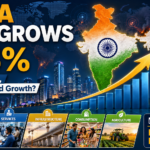




































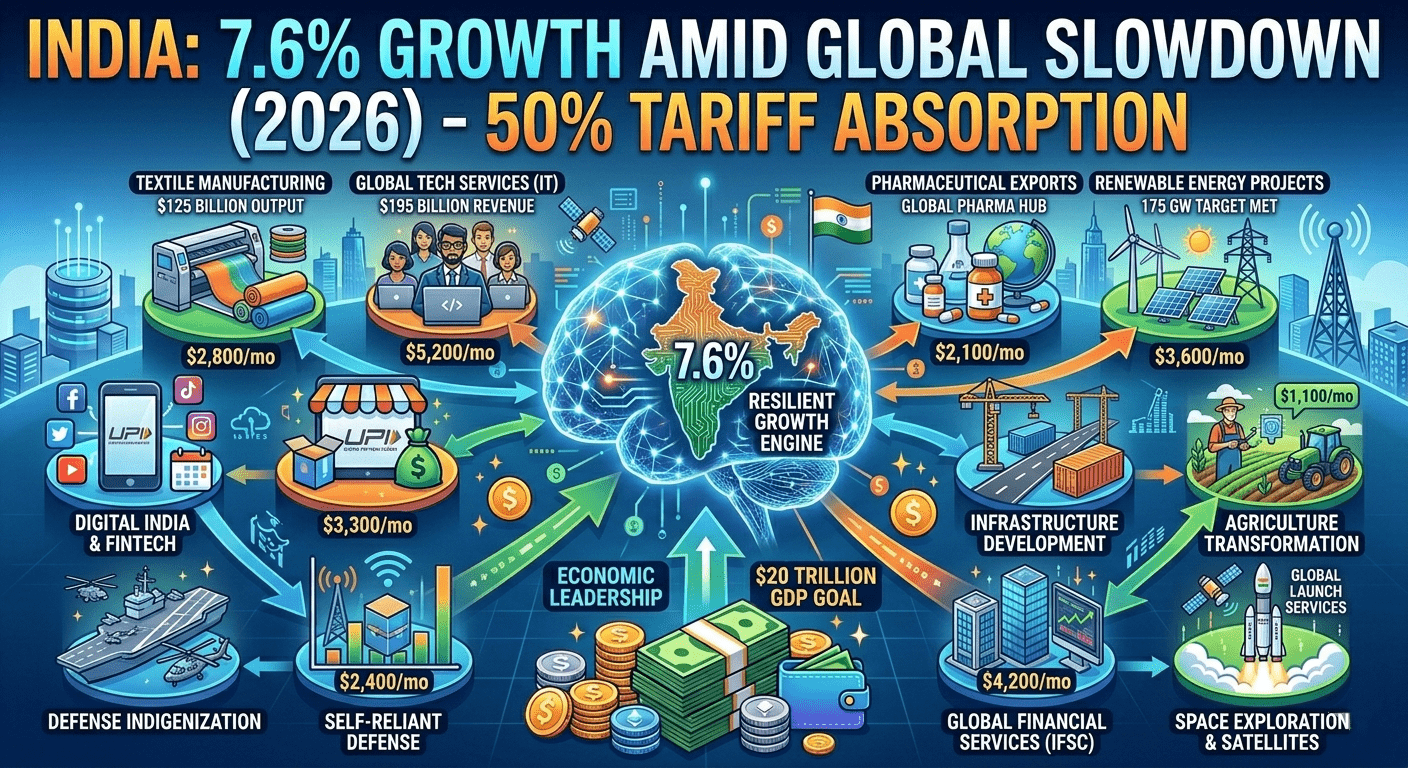
7.6%. 50% Tariffs. Zero Slowdown. India Just Shocked the IMF, the World Bank — and the World

The IMF predicted 6.2%. The World Bank said 6.3%. India grew at 7.6% — while absorbing 50% US tariffs, a global slowdown, and the highest interest rates in decades. Here is the story of an economy that refuses to follow the script.
| Here is what the world’s most respected economic institutions predicted for India in FY2026: the IMF said 6.2%. The World Bank said 6.3%. India’s own NSO initially projected 6.3–6.8%. The actual number: 7.6%. Not close. Not ‘roughly right.’ India grew more than 1.4 percentage points above the IMF’s forecast — while absorbing 50% US tariffs, an Iran-driven oil shock, and a global economy growing at just 3.1%. This is not a good year for India. It is a statement. |
📊 The Numbers That Stunned the Forecasters
The surprise did not come from one strong quarter. It built quarter by quarter in a way that kept confounding every projection. India’s GDP grew 7.8% in the June quarter — the fastest in five quarters. Then 8.2% in the September quarter — the sharpest annual rate since early 2024, later revised to 8.4%. Then 7.8% in the December quarter, even as 50% US tariffs on Indian goods hit their first full quarter of effect.
Each time, the forecasters recalibrated. Each time, India outperformed again. Oxford Economics lead analyst Alexandra Hermann said plainly: “The GDP data exceeded both our and consensus expectations.” The IMF revised India’s FY26 forecast upward three times across the year — from 6.2% in April 2025, to 6.6% in October, to 7.3% in January 2026 — finally landing at 7.6% actual. That revision journey is the story of a country that kept beating the number.
| The comparison that matters: While India grew 7.6%, the US grew 1.8%. China grew 4.0–4.8%. The entire global economy grew 3.1%. India is not just the fastest-growing major economy — it is growing at more than double the global average and more than four times the speed of the United States. |
🚫 The 50% Tariff Test: Why It Didn’t Break India
Since August 2025, India has faced 50% US tariffs on its exports — among the highest imposed on any major trading partner. The US is India’s largest export destination. Every economic textbook would predict a significant growth drag. India’s economy absorbed it and accelerated anyway. Why?
- Domestic demand dominance. India’s growth is not export-led. Private consumption — 700 million Indians buying more — drives approximately 60% of GDP. Tariffs hurt exporters, but they cannot dent a domestic engine of that scale.
- Services exports are tariff-immune. India’s $340 billion services export sector — IT, business process outsourcing, digital services — faces zero tariffs under WTO rules. This sector grew robustly through FY26.
- Diversification of goods exports. Indian exporters shifted trade flows toward Europe, ASEAN, the Middle East and Africa, partially offsetting US market losses. The rupee’s moderate depreciation also made Indian goods more competitive in non-US markets.
- Government capital expenditure. With inflation at a historic low of 2.0%, the RBI cut rates to 5.25% and the government front-loaded infrastructure spending — both acting as accelerants rather than brakes on growth.
| RBI Governor’s assessment: The Reserve Bank of India revised its FY26 GDP forecast upward twice in the year — from 6.8% to 7.3% in December 2025, eventually validated by the 7.6% actual. The RBI cited ‘easing price pressures, robust domestic demand, and strong services exports’ as the triple engine driving outperformance. |
🇮🇳 What Is Actually Driving India’s Growth
Strip away the headline and look at the composition of growth. Three structural forces are doing the work:
1. The consumption supercycle. India’s middle class — now over 300 million and expanding — is entering its peak spending years. GST rationalisation in mid-2025 cut taxes on hundreds of consumer goods, directly boosting purchasing power. Private consumption expanded 7.2% in FY26. During the festive quarter alone, gold and automobile purchases surged.
2. The infrastructure dividend. Ten years of government investment in roads, railways, ports, airports, and digital public infrastructure is now producing returns. Business logistics costs have fallen. Supply chains are faster. New industrial corridors — including the Delhi-Mumbai Industrial Corridor — are attracting manufacturing investment that was previously going to Vietnam and Bangladesh.
3. The FDI surge. Gross FDI grew 19.4% to $51.8 billion in the first half of FY26 vs the same period a year earlier. Net FDI — the number that actually matters — more than doubled, jumping 127.6% to $7.7 billion. India is not just growing. It is attracting capital at an accelerating pace because global investors see the growth as durable, not cyclical.
🔭 The Honest Nuance: What Could Still Go Wrong
An honest assessment cannot ignore the risks. The IMF lowered its FY27 forecast to 6.4% — warning that tariff impacts will gradually weigh on momentum as cyclical factors fade. The US-India trade deal remains unsigned, keeping 50% tariffs in place. Rural wage growth, while improving, has not kept pace with urban income gains. And the global environment — Iran-driven oil volatility, a slowing Chinese economy, and Kevin Warsh’s tighter Fed — provides genuine headwinds.
But here is what the pessimists consistently miss: India’s 7.6% was delivered in an environment that included all of those headwinds simultaneously. A year where the US was at war in the Middle East, global oil prices were elevated, and the world’s two largest economies (US and China) were both slowing. India grew through all of it. That is not luck. That is structural resilience.
| The bottom line: India’s FY26 GDP growth of 7.6% is not a one-quarter fluke or a statistical revision artifact. It reflects a domestic consumption boom, an infrastructure buildout entering its productivity phase, and a services sector that is genuinely world-class and insulated from tariff pressure. The IMF kept revising India upward all year because the data kept forcing them to. In 2026, India is not just the world’s fastest-growing major economy. It is the world economy’s most reliable bright spot. |
❓ Quick FAQs
What was India’s actual GDP growth rate in FY2026?
India’s GDP grew 7.6% in FY2025–26 (the year ending March 2026), according to the National Statistics Office — significantly above the IMF’s initial forecast of 6.2%, the World Bank’s 6.3%, and even the government’s own initial projection of 6.3–6.8%.
Did 50% US tariffs slow India’s economy?
No. Despite 50% US tariffs hitting Indian goods from August 2025, India’s economy grew faster than all forecasts. The IMF explicitly noted that India’s growth was “faster than expected despite the impact of US tariffs”, attributing resilience to domestic demand, services exports (which face no tariffs), and RBI rate cuts made possible by low inflation at 2.0%.
Is India the fastest-growing major economy in the world?
Yes. India is unambiguously the world’s fastest-growing major economy in 2026. At 7.6%, India grew more than double the global average (3.1%), more than four times the US growth rate (1.8%), and significantly faster than China (4.0–4.8%). The IMF, World Bank, and RBI all confirm this status.
Disclaimer: This article is for informational and educational purposes only. It is based on publicly available reports and should not be considered legal, diplomatic, investment or financial advice.