

































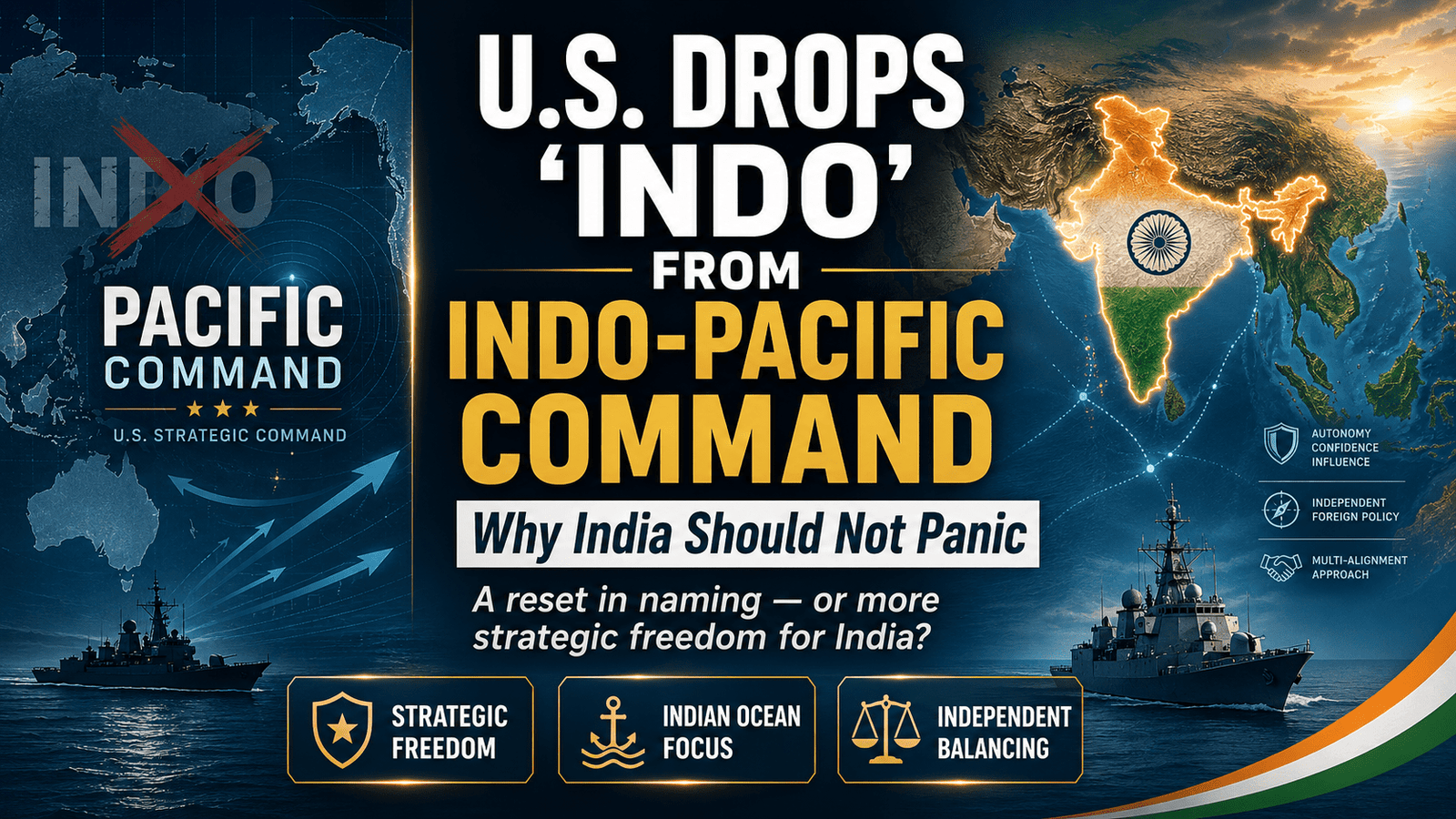
U.S. Drops “Indo” from Indo-Pacific Command: Why India Should Not Panic

The United States has officially restored the name of its military command from U.S. Indo-Pacific Command back to U.S. Pacific Command. Many analysts are calling this a setback for India, arguing that removing “Indo” reduces India’s importance in America’s Asia strategy. But this development can also be seen differently: it may actually be good for India.
In 2018, the U.S. renamed Pacific Command as Indo-Pacific Command to highlight the growing connection between the Indian and Pacific Oceans. At that time, Washington wanted India to play a larger role in balancing China and supporting a wider U.S.-led Indo-Pacific strategy.
Now, by returning to “Pacific Command,” the U.S. appears to be placing stronger focus on its traditional Pacific priorities: China, Taiwan, Japan, South Korea, the Philippines and the South China Sea. Officially, Washington says the command’s area of responsibility, mission and partnerships remain unchanged. But symbolically, the message is clear: the U.S. is narrowing its military language back toward the Pacific.
For India, this is not necessarily bad news.
India has always valued strategic autonomy. New Delhi has joined the Quad, expanded defence cooperation with the U.S., Japan and Australia, and supported a free and open maritime order. But India has never wanted the Quad to become an Asian NATO or a formal military alliance. India’s foreign policy is based on independent decision-making, not alliance pressure.
This is where the U.S. name change may benefit India. If Washington reduces the military symbolism around the “Indo” part of the Indo-Pacific, India may gain more room to shape the Indian Ocean Region on its own terms. The Indian Ocean is India’s natural strategic backyard. From the Arabian Sea and Bay of Bengal to the Andaman and Nicobar Islands, India is geographically placed to be the leading security provider in this region.
This does not mean the U.S. has formally recognized India as the “sole power” in the Indian Ocean. But the shift may reduce the perception of direct American military framing around India’s maritime space. That gives New Delhi more flexibility to build its own partnerships with island nations, Gulf countries, Africa, ASEAN and the Global South.
It also reduces pressure on India to turn the Quad into a military bloc. The Quad can remain useful for maritime domain awareness, supply chains, disaster relief, technology, critical minerals and infrastructure — without becoming a treaty alliance.
India should not see this as abandonment. Instead, it should see it as an opportunity. A less U.S.-dominated Indian Ocean narrative can help India strengthen its own navy, coast guard, port partnerships, defence manufacturing and regional diplomacy.
The real challenge is not the name of an American command. The real challenge is whether India can use this moment to expand its own maritime power.
India should cooperate with the United States where interests match, but it should not depend on American labels to define its role. The Indian Ocean does not need India to be a junior partner in someone else’s strategy. It needs India to act as a confident, independent and responsible maritime power.
So, the U.S. shift from Indo-Pacific Command to Pacific Command is not a reason for panic. It may be a strategic opening. If India plays its cards wisely, this change could strengthen India’s freedom, leadership and long-term influence in the Indian Ocean.
Disclaimer: This article is for informational and educational purposes only. It is based on publicly available reports and strategic analysis and should not be considered diplomatic, legal or defence advice.