

















































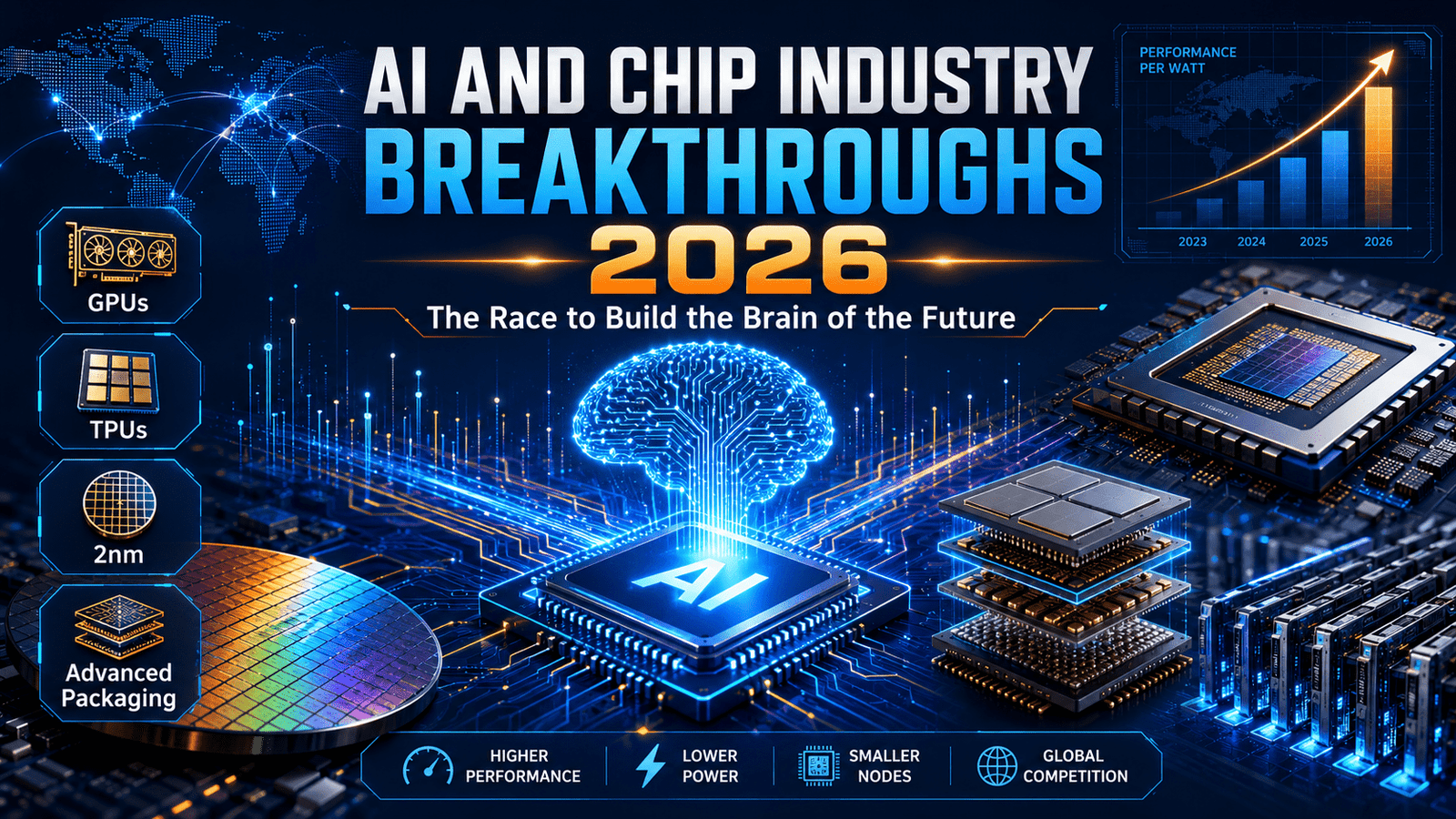
AI and Chip Industry Breakthroughs 2026: The Race to Build the Brain of the Future

The artificial intelligence boom is no longer just about smarter chatbots or faster apps. The real race is happening deep inside data centers, foundries and semiconductor labs, where companies are building the chips that will power the next generation of AI.
In 2026, the AI and chip industry is seeing major breakthroughs across three areas: more powerful AI processors, advanced chip manufacturing and energy-efficient computing. Together, these developments are changing the future of technology, business, defence, healthcare and daily life.
One of the biggest shifts is the move from general-purpose chips to specialized AI accelerators. Nvidia continues to lead the AI GPU race with its next-generation Rubin platform, designed to reduce inference costs and improve performance for advanced AI models and agentic AI systems. This matters because future AI tools will not only answer questions — they will reason, plan, write code, analyze data and operate across multiple tasks.
Google is also pushing hard with its custom Tensor Processing Units, or TPUs. Its eighth-generation TPU chips are designed for the “agentic AI era,” where AI systems need faster training, better inference and lower energy use. This shows that big tech companies no longer want to depend only on outside chip suppliers. They want custom silicon built for their own AI models and cloud platforms.
At the same time, the chip manufacturing world is changing rapidly. TSMC remains at the center of the global AI supply chain, but rising demand has created pressure on advanced manufacturing and packaging capacity. Technologies such as 2nm chips, CoWoS advanced packaging, high-bandwidth memory and chip stacking are becoming just as important as the processor itself.
Why? Because modern AI chips are not single simple chips anymore. They are powerful systems made from processors, memory, networking and packaging technologies working together. The challenge is not only making chips faster, but also making them efficient enough to handle massive AI workloads without consuming unsustainable amounts of power.
Another important trend is supply-chain diversification. Reports suggest Google is exploring Intel and Samsung for future AI chip manufacturing. This could reduce dependence on one supplier and give companies more flexibility as AI demand explodes.
The breakthrough is also moving from data centers to personal devices. New AI PCs and laptops with built-in neural processing units can run AI features locally, improving privacy, speed and offline performance. This means AI will not stay limited to cloud servers; it will increasingly live inside phones, laptops, cars and smart devices.
For India and other emerging economies, this is a major opportunity. Countries that invest in semiconductor manufacturing, AI skills and chip design can become part of the next digital revolution. The winners of the AI era will not only be those who build apps, but those who build the hardware behind intelligence.
However, there is also a warning. The AI chip boom has created high investor expectations, supply shortages and concerns about an AI bubble. Not every company will win. But one thing is clear: chips are now the foundation of global power.
The future of AI will be decided not just by software, but by silicon.
Disclaimer: This article is for informational and educational purposes only. It should not be considered investment, financial or technical advice.