








































China’s Hidden Social Divide: How X Exposed the Other Side of China’s Development Story

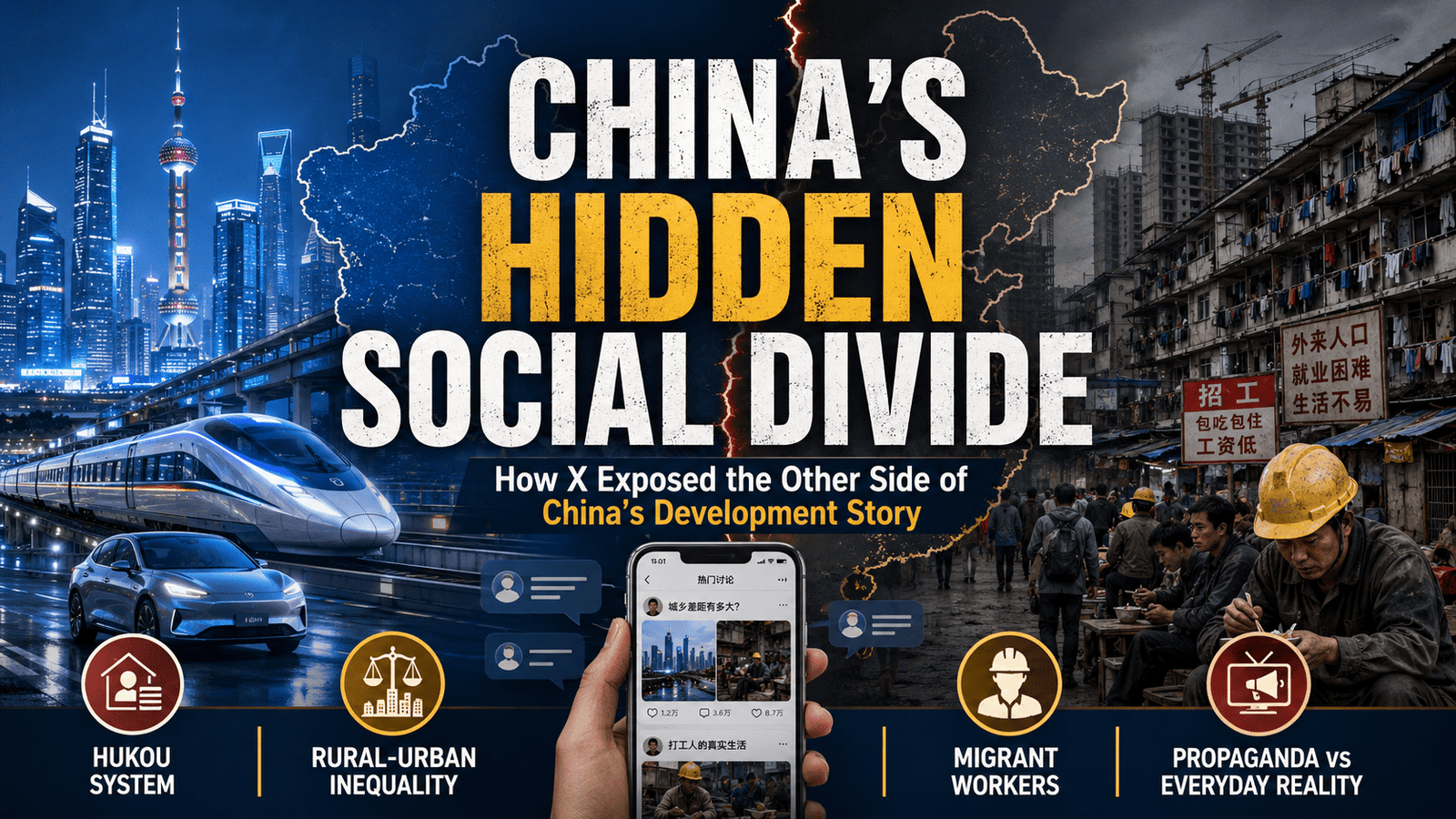
China is often presented to the world as a futuristic superpower filled with bullet trains, glass skyscrapers, electric cars, smart cities and perfectly organized streets. But a growing debate on X has brought attention to another side of China — one that is less polished, less visible and deeply divided.
Indian users and international commentators have recently pushed back against years of online propaganda that mocked India’s poverty, caste issues and sanitation challenges. In response, many users began highlighting China’s own social hierarchy, rural poverty, migrant worker struggles and the country’s household registration system known as hukou.
Some users are calling it China’s “caste-like system.” While hukou is not the same as India’s caste system, the comparison has gone viral because both are seen by critics as systems that can restrict opportunity based on birth.
What Is China’s Hukou System?
The hukou system is China’s household registration system. It links a person’s access to public services such as education, healthcare, housing and social benefits to their official place of registration.
In simple words, a person born in a rural area may move to a big city like Shanghai, Beijing or Shenzhen for work, but may still face difficulty accessing the same services as registered urban residents.
This creates a sharp divide between urban citizens and rural migrants. Millions of workers help build China’s cities, deliver food, clean buildings, work in factories and support the service economy — yet many remain treated as outsiders in the cities where they live.
Why People Are Calling It “Caste-Like”
The viral comparison comes from the idea that hukou can create a birth-based social hierarchy. A child born with urban registration may receive better access to schools, hospitals and welfare. A child born with rural registration may face more obstacles, even if their family works in the city for years.
This is why critics argue that China’s development story is not as equal as its propaganda suggests. The country may have world-class infrastructure, but opportunity is not equally distributed.
China has begun reforming hukou rules, but the fact that reforms are needed itself shows how serious the problem has been.
X Exposes the Gap Between Image and Reality
For years, China’s global image has been shaped by highly curated videos of clean metro stations, advanced cities, beautiful bridges and high-speed trains. These achievements are real and impressive. But they are not the full story.
On X, users have been sharing clips and discussions about rural hardship, crowded migrant housing, poor living conditions, street-level poverty and neglected areas far away from China’s shiny urban centers.
Not every viral video can be independently verified, and social media should always be viewed carefully. But the debate has succeeded in one way: it has challenged the idea that China is a perfect, equal and problem-free society.
The Other Side of China’s Development
China’s biggest cities may look modern, but many rural and migrant communities still face underdevelopment. Some workers live in cramped dormitories or temporary housing near factories and construction zones. Others struggle with limited welfare support, unstable employment and unequal access to education for their children.
This does not mean all of China is poor or unhygienic. China has made major progress in infrastructure and poverty reduction. But it does mean that the country has deep internal inequality that is often hidden behind state-backed image-building.
The problem is not the Chinese people. The problem is a system that can divide citizens based on birthplace and control how much of the country’s reality is shown to the world.
Why This Debate Matters for India
For India, this online debate carries an important lesson. Every country has problems. India has poverty, social inequality, sanitation challenges and caste discrimination. These issues must be addressed honestly. But India should not allow foreign propaganda to present Indian problems as unique while hiding similar or worse inequalities elsewhere.
China’s hukou debate shows that no country has the moral right to lecture others while suppressing its own uncomfortable truths.
India’s strength is open debate. Problems are discussed publicly, reported by media, challenged in courts and debated online. In China, sensitive issues are often censored, controlled or pushed out of public view.
A Propaganda Battle in the Social Media Age
The battle between India and China is no longer only about borders, trade or military power. It is also about perception.
China wants the world to see a disciplined, modern and flawless society. But social media platforms like X make it harder to fully control the narrative. A single viral thread can challenge years of image-building.
The latest debate has shown that propaganda can be powerful, but it is not unbeatable.
Final Thoughts
China is a major global power with impressive achievements, but it is not the perfect society often shown in promotional videos. Behind the shining skyline, there are migrant workers, rural families and underprivileged communities still fighting for equal dignity.
The hukou system exposes a deep social divide in modern China. Whether people call it a caste-like system or a rural-urban class barrier, the reality is clear: birth still affects opportunity.
The X debate has opened a new conversation. China’s development story is real, but so are its inequalities. A truly powerful nation is not one that hides its problems. It is one that has the courage to face them.
Disclaimer: This article is for informational and educational purposes only. It does not target Chinese people, Chinese culture or any ethnic group. It discusses governance, public policy, social inequality and online debate based on publicly available information.