
















































India Deploys Nuclear Warheads for the First Time in History: What SIPRI’s Bombshell Report Actually Means

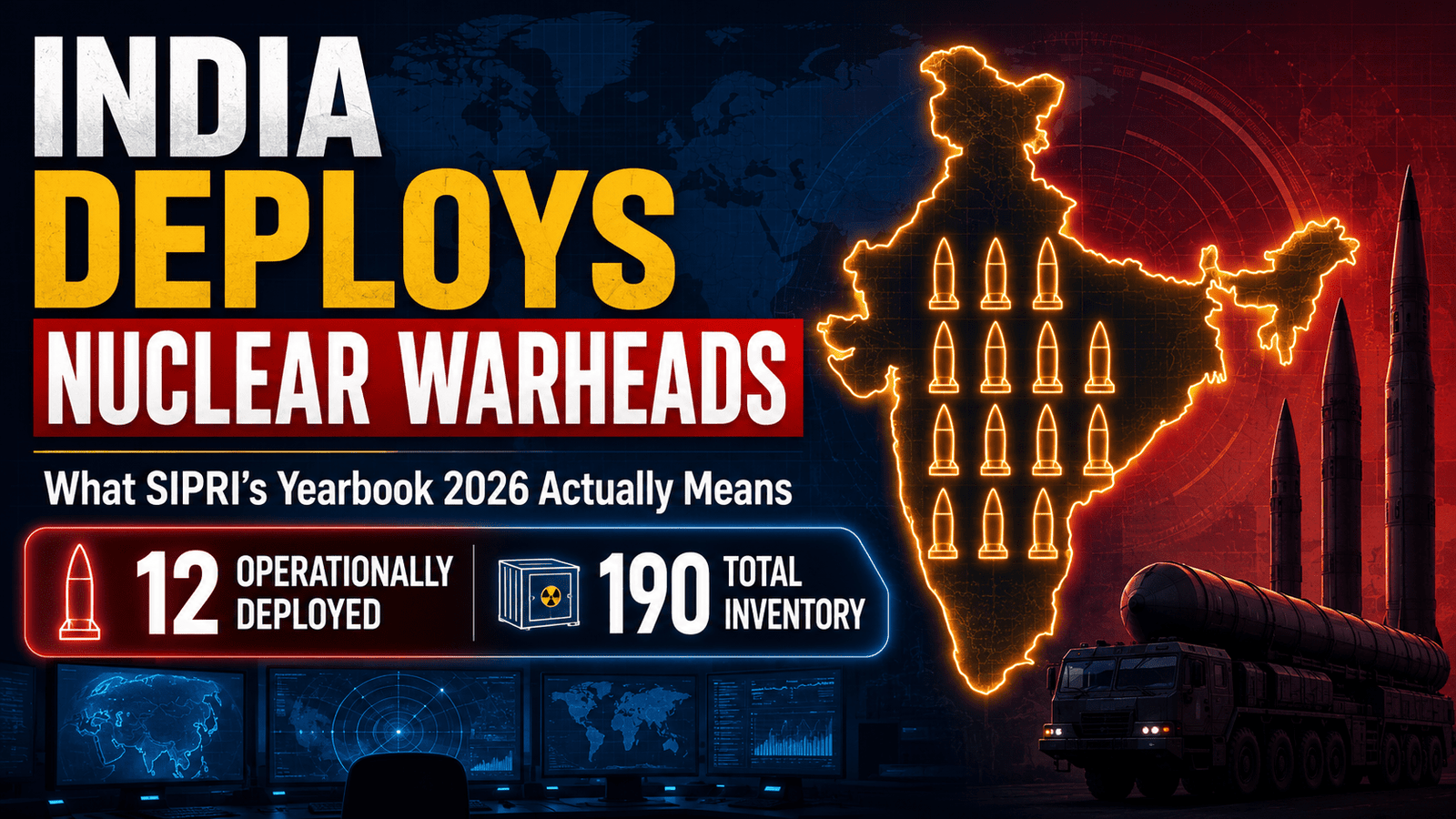
For seven decades, India kept its nuclear warheads locked away — separated from missiles, never on alert. That policy quietly changed. SIPRI’s Yearbook 2026, released today, reveals that 12 Indian warheads are now operationally deployed. Here is what it means, why it happened, and why the world should pay attention.
| The historic shift in one sentence: For the first time since India tested its first nuclear device in 1974, the Stockholm International Peace Research Institute (SIPRI) has assessed that 12 of India’s 190 nuclear warheads are now operationally deployed — mated with delivery systems and ready for use. Until this year, every single Indian warhead was kept in storage, separated from its launcher. That era has ended. |
📊 What SIPRI’s Yearbook 2026 Actually Says
SIPRI — the Stockholm International Peace Research Institute, the world’s most authoritative independent arms monitoring body — published its annual global weapons assessment today, June 9. The findings on India are historically significant
- India’s total nuclear stockpile: 190 warheads (up from 180 in January 2025)
- Operationally deployed warheads: 12 — the first time SIPRI has ever classified any Indian warheads as deployed
- Remaining in storage: 178 warheads
- Nuclear-capable launchers: approximately 152 (88 land-based, 48 air-based, 16 sea-based)
- Submarine fleet: 3 SSBNs operational — INS Arihant, INS Arighaat, and INS Aridhaman (inducted April 2026)
| What ‘operationally deployed’ means in plain language: It means the warhead and its delivery system — the missile or submarine — are together, ready for use, rather than stored separately under locks. A deployed warhead can be launched in minutes. A stored warhead requires assembly before use. India moving 12 warheads from ‘stored’ to ‘deployed’ is a fundamental change in its nuclear readiness posture. |
🚀 Why India Changed Its Policy Now
India’s nuclear doctrine has operated on No First Use (NFU) since 1998 — meaning India pledges never to be the first to use nuclear weapons in a conflict. But NFU is credible only if India can guarantee a second strike — the ability to absorb an attack and still retaliate. That requires survivable nuclear forces, not warheads sitting in bunkers.
Three specific developments have driven the deployment decision:
1. China’s Explosive Nuclear Expansion
SIPRI reports China now has 620 nuclear warheads (up from 500 in 2023) and 34 deployed (up from 24 in 2025). China is loading hundreds of missiles into three major silo fields in northern China and building new ones in the east. India’s nuclear modernisation is explicitly focused on developing longer-range weapons capable of reaching targets throughout China, according to SIPRI.
2. Pakistan’s First-Strike Posture
Pakistan, which has 170 warheads and has never adopted a No First Use doctrine, has historically maintained a posture of threatening nuclear use at much lower thresholds than India. After Operation Sindoor in May 2025 — when India struck 11 Pakistani air bases and China’s HQ-9 failed to intercept a single missile — the nuclear calculus in South Asia shifted permanently
3. INS Aridhaman Changes the Game
India’s third nuclear submarine, INS Aridhaman, was inducted in April 2026. It can carry twice as many missile tubes as INS Arihant. Submarines are the most survivable leg of a nuclear triad because they cannot be pre-emptively destroyed — they are invisible, mobile, and always at sea. Submarine patrols essentially require some warheads to be deployed. INS Aridhaman’s induction likely explains why 12 warheads are now assessed as deployed for the first time.
🌐 The Global Nuclear Landscape: India in Context
India’s 12 deployed warheads, while historically significant for India, remain far below every other major nuclear power:
- Russia: 1,796 deployed warheads (total stockpile: ~4,400)
- United States: 1,770 deployed warheads (total: ~3,700)
- China: 34 deployed warheads (total: 620 — expanding fastest of any nation)
- France: 280 deployed warheads
- United Kingdom: 120 deployed warheads
- India: 12 deployed (NEW) — 178 in storage, 190 total
- Pakistan: 170 warheads (all in storage; no deployed assessed)
| The India-China gap: China’s nuclear arsenal is growing faster than any other nation’s — from 410 warheads in 2023 to 620 in 2026. China has 34 deployed; India now has 12. China’s overall stockpile is over 3x India’s. SIPRI explicitly states India’s modernisation programme is focused on closing this gap with longer-range delivery systems. The 12 deployments are the opening move of a much longer strategic chess game. |
❓ Quick FAQs
Has India changed its No First Use nuclear policy?
No. India’s No First Use (NFU) doctrine remains officially in place. Deploying 12 warheads increases India’s nuclear readiness and ensures a credible second-strike capability — it does not change the policy of never initiating nuclear use. The deployment is about survivability, not aggression.
What are India’s three nuclear submarines?
India operates three nuclear-powered ballistic missile submarines (SSBNs): INS Arihant (operational since 2016), INS Arighaat (operational 2024), and INS Aridhaman (inducted April 2026, with twice the missile capacity of its predecessors). A fourth SSBN is expected to enter service in 2027.
Why does India need deployed nuclear warheads?
For India’s No First Use doctrine to be credible as a deterrent, adversaries must believe India can absorb a first strike and still retaliate. Warheads in storage can theoretically be destroyed before assembly. Warheads deployed on submarines at sea cannot be pre-emptively eliminated. The deployment is about ensuring India’s deterrent survives any first strike, not about initiating conflict.
Disclaimer: This article is for informational and educational purposes only. It is based on publicly available reports and policy updates. It should not be considered financial, investment, legal or business advice.