































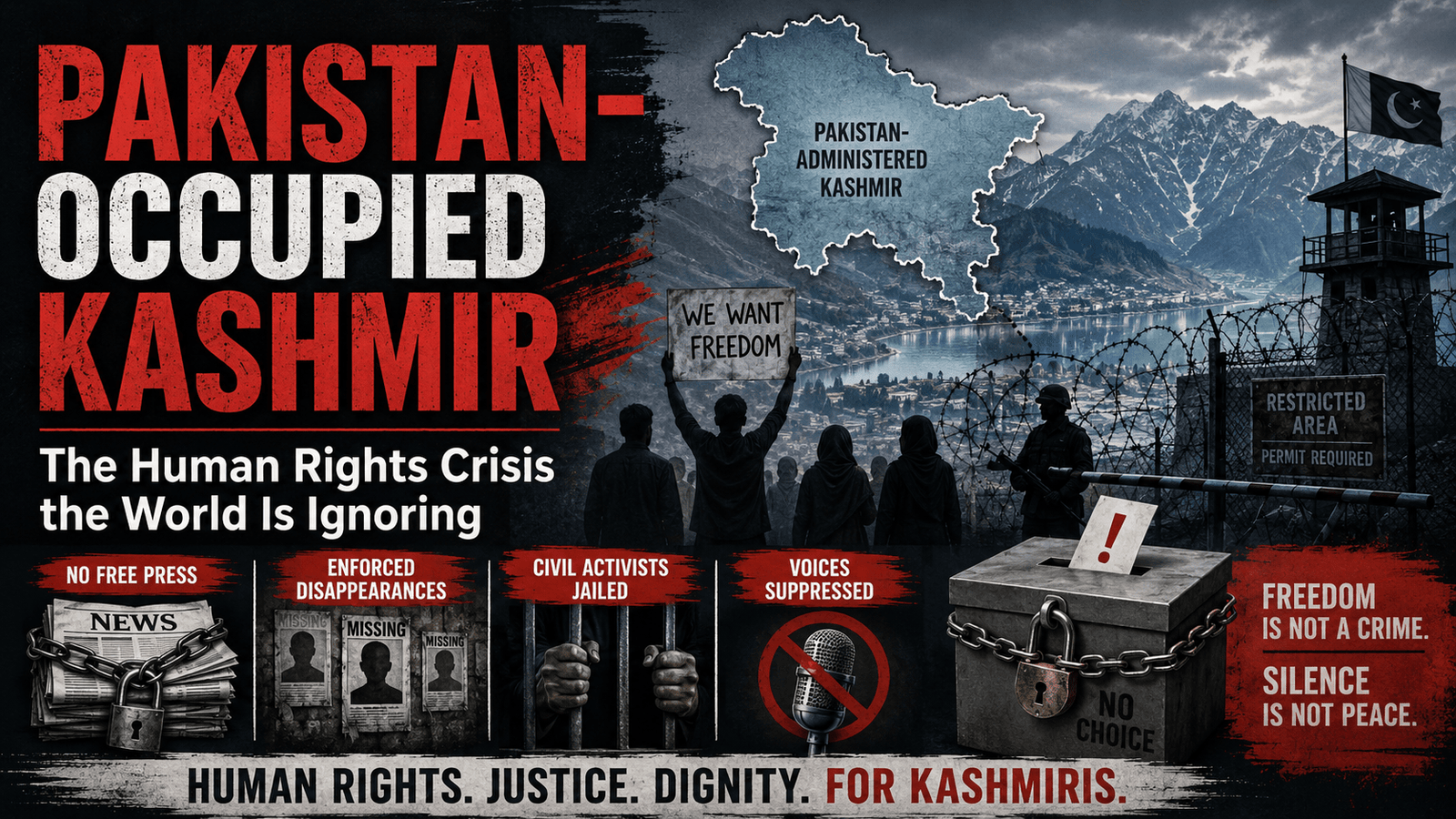
Pakistan-Occupied Kashmir: The Human Rights Crisis the World Is Ignoring

No free elections. No free press. Thousands of enforced disappearances. Civilian activists jailed under anti-terror laws. The United Nations, Amnesty International, Human Rights Watch, and even Pakistan’s own Human Rights Commission have documented systematic abuse in Pakistan-administered Kashmir. Here is the full, sourced story.
| The United Nations Office of the High Commissioner for Human Rights (OHCHR) assessed in its landmark 2019 report — which remains the baseline for all subsequent analysis — that the people of Pakistan-administered Kashmir are “deprived of a number of fundamental human rights,” particularly regarding freedoms of expression, peaceful assembly, and association. Since that report, every major human rights organisation that monitors the region has found conditions unchanged or deteriorating. Here is what they document. |
🗺️ What Is Pakistan-Occupied Kashmir?
Pakistan-Occupied Kashmir (PoK) — referred to by Pakistan as “Azad Kashmir” and “Gilgit-Baltistan” — covers approximately 13,297 square kilometres of the former princely state of Jammu and Kashmir, which India claims in its entirety as per the 1947 Instrument of Accession signed by Maharaja Hari Singh. The region has been under Pakistani military administration since the 1947 tribal invasion backed by the Pakistani army.
Freedom House, the independent US democracy watchdog, consistently classifies PoK as “Not Free” — stating that “any political activity deemed contrary to Pakistan’s policy on Kashmir is restricted.” Citizens of the region have no representation in Pakistan’s national parliament.
🚨 The Documented Abuses: What the Evidence Shows
Enforced Disappearances: Over 8,000 Cases
The Association of Parents of Disappeared Persons (APDP) has documented over 8,000 enforced disappearances across the Kashmir Valley and Pakistan-administered Kashmir over three decades. The UN human rights office specifically noted that victim groups alleged Pakistani intelligence agencies were responsible for disappearances in PoK, targeting journalists, activists, and political opponents.
Pakistan’s own Human Rights Commission of Pakistan (HRCP) — an independent domestic body — documented in its 2025 annual report that enforced disappearances continued to be used as a tool to “silence dissent,” with security forces including the Frontier Corps and intelligence agencies implicated in the majority of abductions.
Civilian Killings and Extrajudicial Violence
The US Congressional Research Service’s assessment of Pakistan’s human rights record, drawing on the US State Department’s Human Rights Report, found: “There were numerous reports the government or its agents committed arbitrary or unlawful killings, including extrajudicial killings.” In PoK specifically, HRCP documented that crackdowns on economic protests in 2023 included “severe human rights violations” including use of live rounds against civilian demonstrators.
Suppression of Free Speech and Press
Media owners in PoK are required to obtain permission from federal government agencies before publishing, according to the US State Department Human Rights Report. Journalists face harassment, arbitrary arrest, and threats for reporting critical of the government or military establishment. Human Rights Watch’s World Report 2026 documented that journalists faced enforced disappearances and physical attacks across Pakistan, with at least three killed in 2025.
The OHCHR report specifically found that in Pakistan-administered Kashmir, anti-terrorism laws are misused to target political opponents and activists, creating a climate of self-censorship that effectively eliminates independent reporting from the region.
Demographic Engineering in Gilgit-Baltistan
Human rights researchers and India’s External Affairs Ministry have documented sustained efforts to alter the demographic character of Gilgit-Baltistan — the northern part of PoK — through settlement of non-Kashmiri populations. This mirrors tactics used in other occupied territories globally and has been raised by Kashmiri diaspora groups at the UN Human Rights Council.
The OHCHR report also documented institutional discrimination against minority groups in PoK, including Shia Muslims (a majority in Gilgit-Baltistan), Hindus, and Sikhs who remained after 1947.
| What Pakistan’s own commission says: The Human Rights Commission of Pakistan — an independent domestic body, not an Indian or Western source — concluded in its 2025 State of Human Rights report that laws are being ‘utilised to erode fundamental rights,’ that enforced disappearances ‘showed no signs of abatement,’ and that civic space has undergone a ‘severe contraction.’ These findings apply to Pakistan broadly — and by extension, with even fewer institutional checks, to PoK. |
🗳️ The Post-Operation Sindoor Situation
Following Operation Sindoor in May 2025, India’s military strikes on Pakistani infrastructure brought renewed international attention to the entire India-Pakistan conflict zone. Indian government officials and strategic affairs experts have pointed to the post-Sindoor period as an opportunity to raise PoK’s human rights crisis at the United Nations and with international bodies, arguing that the conflict cannot be resolved without addressing the rights situation in the territory.
India’s External Affairs Minister S. Jaishankar has consistently stated that all of PoK is Indian territory under illegal Pakistani occupation and that its return remains a non-negotiable element of India’s Kashmir position. The Indian Parliament passed a resolution to this effect as recently as 2023.
🌍 Why the World Looks Away
The human rights crisis in PoK receives a fraction of the international attention given to abuses in Indian-administered Jammu & Kashmir. Researchers and media analysts attribute this to three factors: Pakistan’s restriction of independent journalists and UN monitors from freely accessing the region; the absence of a organised civil society that can reach international media; and the geopolitical utility of Pakistan to Western nations — historically as a US ally and currently as a potential Iran mediator.
The OHCHR’s own 2019 report acknowledged this imbalance, explicitly calling on Pakistan to allow unimpeded access for UN investigators to Pakistan-administered Kashmir — access that has not been granted in the seven years since. Without independent verification, the true scale of abuses remains underdocumented even by the organisations that have tried to track it.
| India’s legal position: India consistently refers to Pakistan-administered territories as ‘Pakistan-Occupied Kashmir’ and considers them an integral part of the Union Territory of Jammu & Kashmir and the Union Territory of Ladakh. India has raised the human rights situation in PoK at the UN Human Rights Council and in bilateral diplomatic contexts with major powers. The Indian Parliament’s 1994 resolution demanding Pakistan’s withdrawal from PoK remains the country’s formal legal position. |
❓ Quick FAQs
What is Pakistan-Occupied Kashmir (PoK)?
Pakistan-Occupied Kashmir (PoK) is the approximately 13,297 sq km of the former princely state of Jammu and Kashmir under Pakistani military administration since 1947. India considers all of this territory — comprising what Pakistan calls ‘Azad Kashmir’ and ‘Gilgit-Baltistan’ — an integral part of India under illegal occupation. Freedom House classifies it as ‘Not Free.’
What has the UN said about human rights in PoK?
The OHCHR’s 2019 report — the last time UN investigators could access the region — found that residents of Pakistan-administered Kashmir are “deprived of fundamental human rights,” particularly freedom of expression, assembly, and association. The UN called on Pakistan to allow unimpeded access for investigators. That access has not been granted.
What are enforced disappearances and how many have occurred?
Enforced disappearances occur when state agents detain, abduct, or otherwise remove a person from society and then deny knowledge of their whereabouts. The APDP has documented over 8,000 such cases in the Kashmir region over three decades. Pakistan’s own HRCP confirmed that the practice continued in 2025 with ‘no signs of abatement.’
Does India commit human rights violations in its part of Kashmir?
India’s record in Jammu & Kashmir has also been criticised by human rights organisations, including in the same 2019 OHCHR report. The Indian government has rejected some of these findings while accepting others and implementing reforms, including the abrogation of Article 370 in 2019 which the government argued would accelerate development and bring the region’s legal framework in line with the rest of India. This article focuses specifically on documented abuses in Pakistani-administered territory; India’s record is a separate and debated subject.
Disclaimer: This article is for informational and educational purposes only. It is based on publicly available reports and policy updates. It should not be considered financial, investment, legal or business advice.