

















































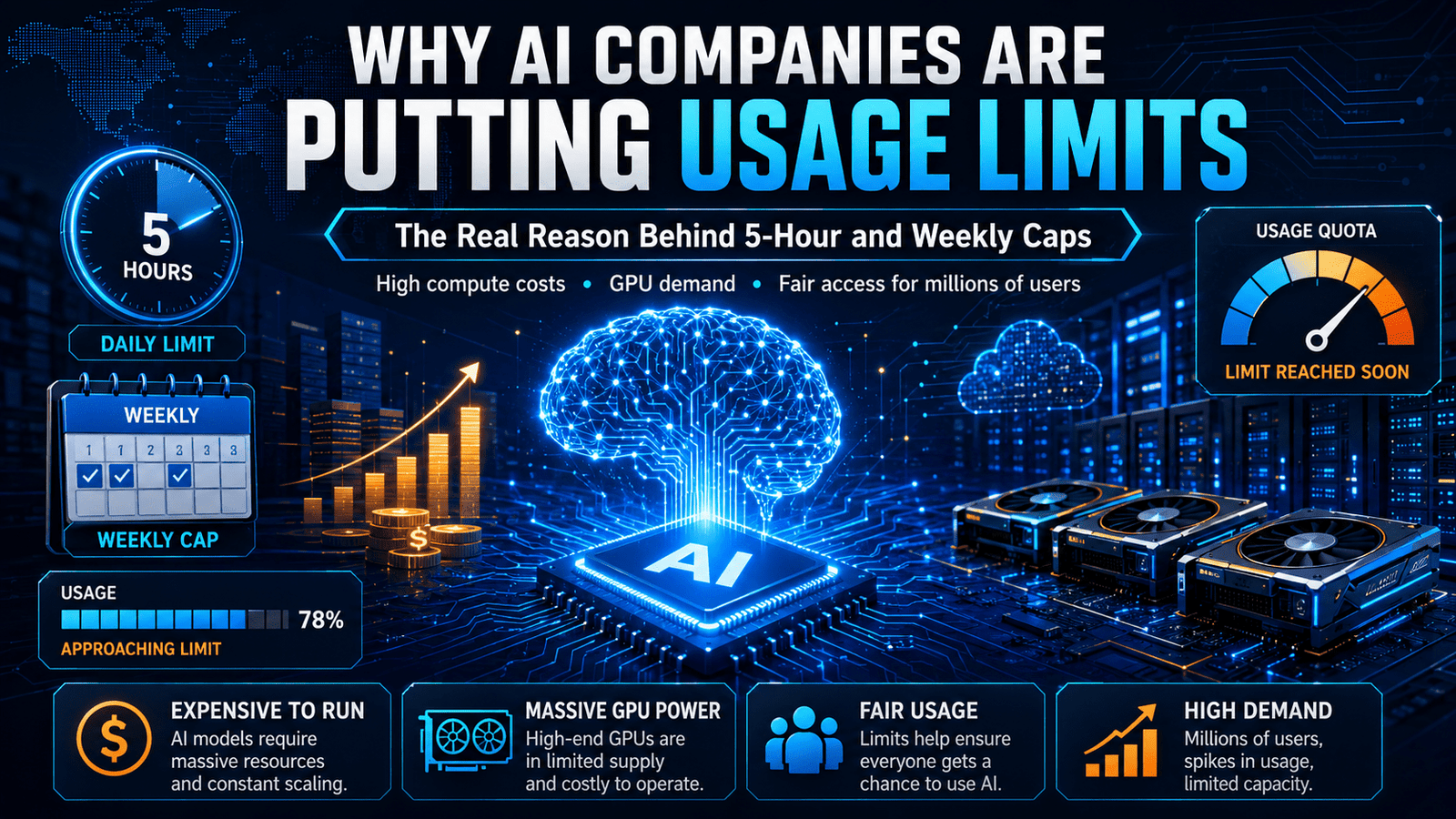
Why AI Companies Are Putting Usage Limits: The Real Reason Behind 5-Hour and Weekly Caps

AI tools are becoming part of daily life. People use ChatGPT, Gemini, Claude and other AI platforms for writing, coding, research, studying, business planning and even personal productivity. But many users are now noticing something frustrating: usage limits.
Some platforms show 5-hour limits. Others have weekly caps. Some switch users to a smaller model after a certain number of messages. This has left many people asking one question: why are AI companies limiting usage when users are already paying?
The simple answer is this: advanced AI is extremely expensive to run.
Every time you send a prompt, the AI model does not simply “search” like Google. It performs heavy mathematical calculations using powerful chips called GPUs or TPUs. These chips are expensive, electricity-hungry and limited in supply. When millions of users send long prompts, upload files, generate images, write code or run deep research tasks, the cost rises quickly.
This is why AI companies use rolling limits such as 3-hour, 5-hour or weekly caps. These limits help control demand, prevent overload and make sure more users get access instead of a small number of heavy users consuming most of the available computing power.
Another reason is fairness. A casual user may ask 20 questions a day, while a power user may run hundreds of prompts, upload large files and ask the model to think deeply for coding or research. Without limits, heavy users could slow down the system for everyone else.
There is also a business reason. AI subscriptions are often priced at affordable monthly rates, but the real cost of serving advanced models can be much higher for users who use them heavily. That is why companies create different tiers: free users get limited access, paid users get higher limits, and enterprise users get larger capacity with stricter rules.
Safety also matters. Usage limits help reduce spam, automated scraping, account sharing and misuse. If someone tries to use a consumer AI account like a commercial API, limits protect the platform and other users.
The newest AI models are also more demanding because they can “think” longer, analyze larger files, generate images, use tools and work like agents. These features are powerful, but they consume more computing resources than simple chatbot replies.
Will AI usage limits disappear in the future? Probably not completely. As chips become faster and data centers expand, limits may become more generous. But tiered access is likely to stay because AI companies must balance cost, speed, safety and reliability.
For users, the best strategy is simple: use advanced models for complex tasks, use lighter models for basic work, keep prompts focused and avoid unnecessary retries. AI is powerful, but it is not unlimited infrastructure.
The message is clear: usage caps are not just a way to push upgrades. They are a sign of how valuable and expensive advanced AI has become. The future of AI will depend not only on smarter models, but also on cheaper chips, more energy-efficient data centers and better ways to serve intelligence at scale.
FAQ
Why do AI apps have 5-hour limits?
Because AI companies use rolling windows to manage high demand and distribute expensive computing power fairly.
Why do paid users also face limits?
Paid plans offer higher limits, but the most advanced models still cost a lot to run, especially for heavy users.
Will AI limits increase in the future?
Yes, limits may improve as AI chips and data centers become more efficient, but some form of cap will likely remain.
Disclaimer: This article is for general informational and educational purposes only. AI plan details and usage limits may change over time, so users should check the official platform pages for the latest updates.