















































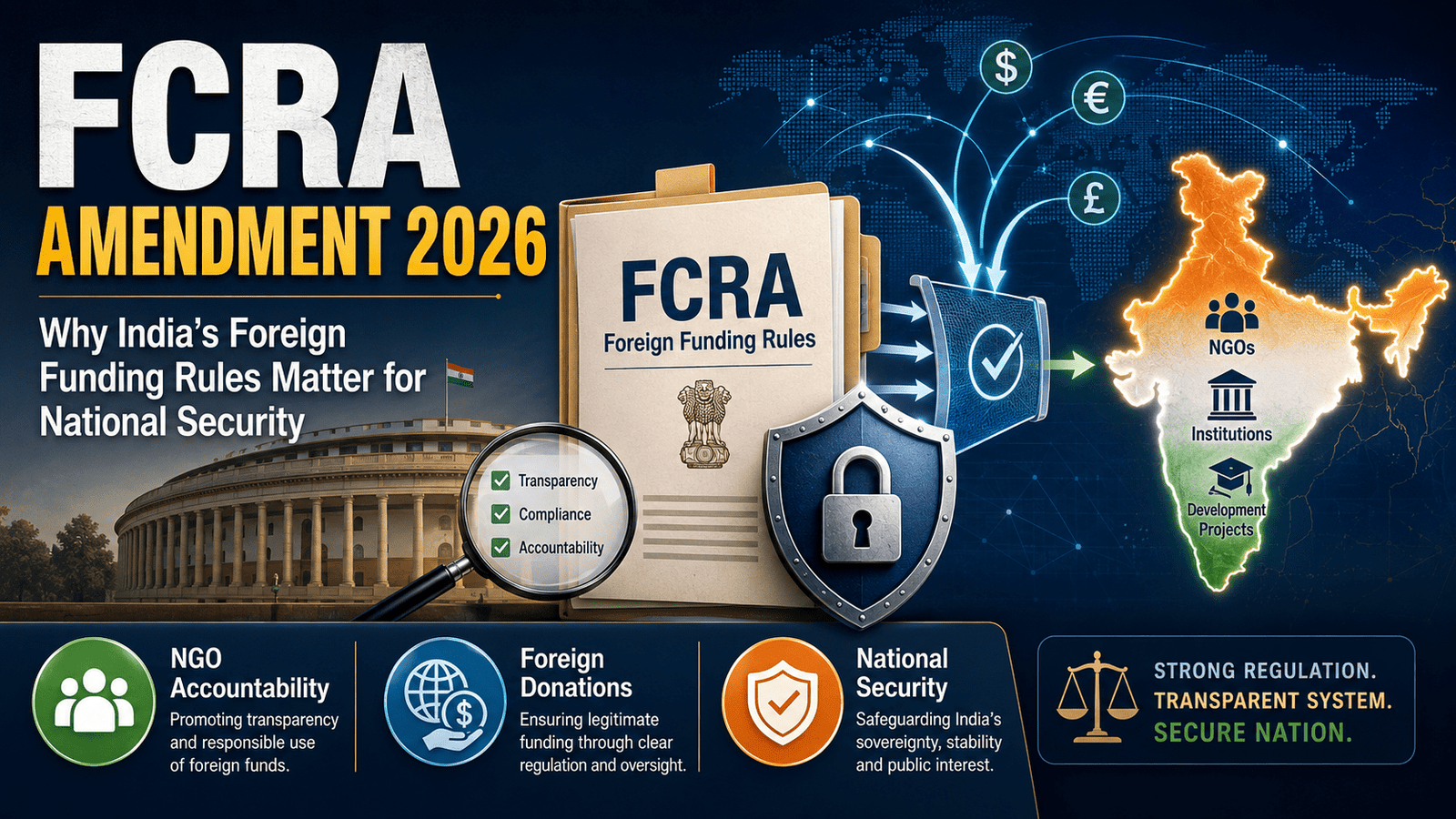
FCRA Amendment 2026: Why India’s Foreign Funding Rules Matter for National Security

India’s Foreign Contribution Regulation Act, better known as FCRA, has again become a major national debate after the government introduced the FCRA Amendment Bill 2026. Supporters say the move is necessary to protect India’s sovereignty, internal security and social harmony. Critics argue it may affect genuine NGOs. But the core question is simple: should foreign money be allowed to influence India’s internal affairs without strict accountability?
The FCRA regulates how individuals, associations and NGOs receive and use foreign donations. Its main purpose is to ensure that overseas funds are not used for activities harmful to India’s national interest. In a country as large, diverse and geopolitically important as India, foreign-funded influence is not a small issue. Money can support charity, education and healthcare — but if misused, it can also shape narratives, fund pressure groups, influence local politics or create social tension.
The 2026 amendment aims to strengthen oversight by creating a clearer system to manage assets created through foreign contributions when an organisation’s FCRA licence is cancelled, surrendered, not renewed or expires. Under the proposed framework, a Designated Authority can temporarily or permanently supervise such assets so they are not sold, transferred or misused after regulatory action.
This is important because foreign funding should not become a shield against accountability. If an NGO receives overseas money in India’s name, builds assets and later loses its licence due to violations, those assets must remain traceable and protected for public purposes.
The government has also argued that the amendment is aimed at organisations accused of misusing foreign funds for forced religious conversions or personal gain. This point has created political controversy. In India, freedom of religion is protected, and genuine charity by any community must be respected. However, forced conversion, fraud, pressure or inducement-based conversion is a serious concern when linked to foreign funding.
Concerns have often been raised around some foreign-funded faith-linked organisations, including missionary-linked groups, where welfare work is alleged to be used as a tool for religious conversion. Many run schools, hospitals and relief work. But if any organisation uses foreign money to change local demographics through pressure, dependency or inducement, the state has a duty to investigate.
National security today is not only about borders, missiles and soldiers. It is also about information, ideology, demography, social stability and financial influence. Foreign donations can become a soft-power tool when there is no transparency.
That is why stricter FCRA rules matter. They help ensure that foreign contributions support genuine development, not political destabilisation, illegal conversion networks, personal enrichment or anti-national activities.
At the same time, the law must be applied fairly. Honest NGOs working in education, health, disaster relief and poverty reduction should not be harassed. India needs strong civil society, but it also needs strong safeguards.
The FCRA Amendment 2026 sends a clear message: charity is welcome, but hidden influence is not. Foreign funds must serve India’s people — not foreign agendas.
Disclaimer: This article is for informational and educational purposes only. It does not target any religion, community or lawful charity. Allegations of misuse should be investigated through due legal process.