

























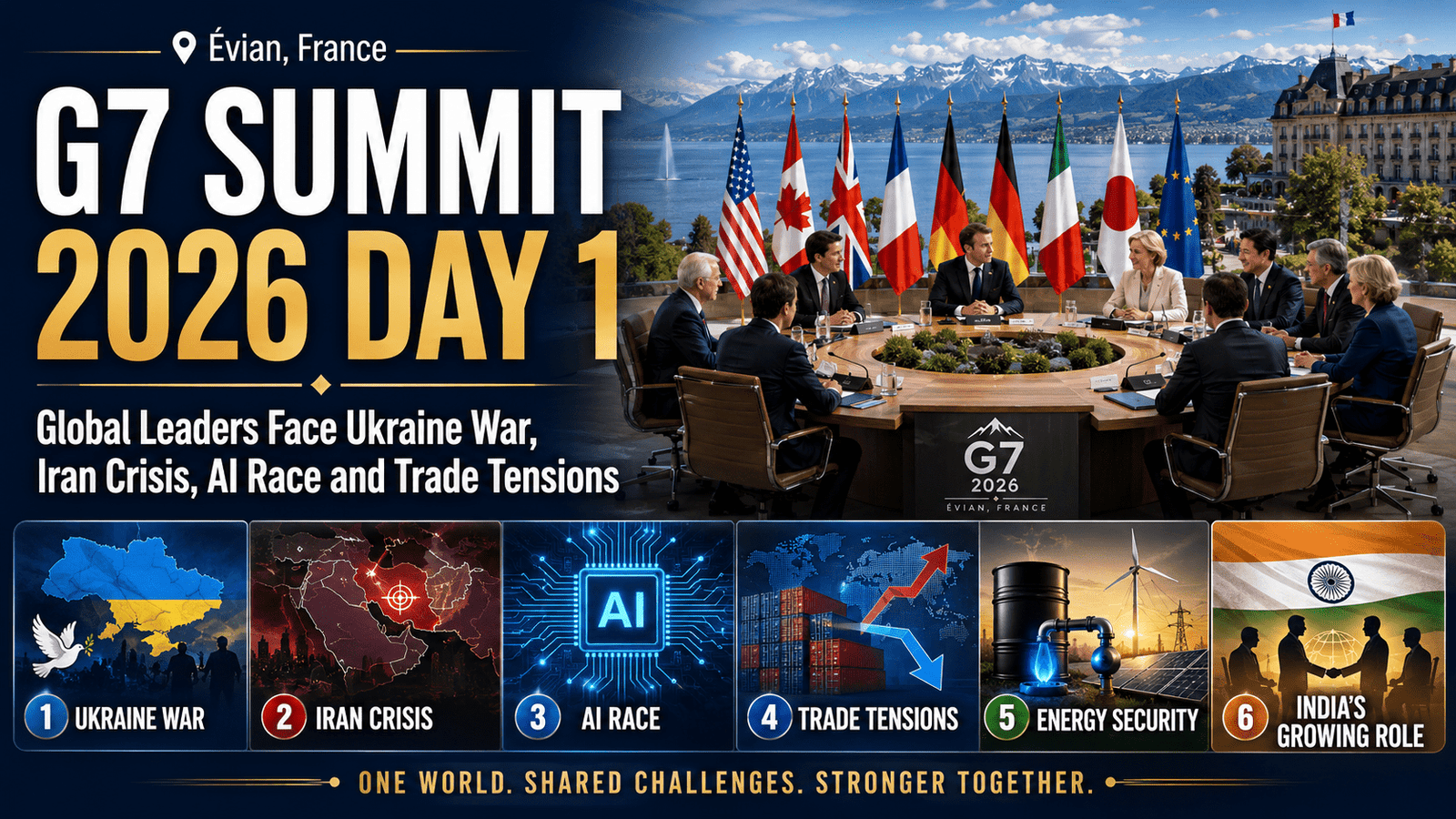
G7 Summit 2026 Day 1: Global Leaders Face Ukraine War, Iran Crisis, AI Race and Trade Tensions

The G7 Summit 2026 opened in Évian-les-Bains, France, at a time when the world is facing multiple crises at once. From the Russia-Ukraine war and Middle East tensions to artificial intelligence, trade disputes, inflation and energy security, Day 1 showed that global leaders have very little room for error.
Hosted under the French G7 Presidency, the summit brought together leaders from Canada, France, Germany, Italy, Japan, the United Kingdom, the United States and the European Union. France also invited key partner countries, including India, Brazil, Kenya and South Korea, showing that the G7 can no longer discuss global problems without major emerging economies.
One of the biggest topics on Day 1 was Ukraine. G7 leaders are under pressure to maintain unity as the war continues and Russia remains a major security concern for Europe. Ukraine’s President Volodymyr Zelenskyy is expected to push for stronger defence support, tougher sanctions and a clearer path toward peace.
The Middle East crisis also dominated discussions. Recent tensions involving Iran, Israel and the United States have made oil markets nervous. The Strait of Hormuz, one of the world’s most important oil routes, remains a key concern. Any disruption there could raise fuel prices, increase inflation and hit countries like India that depend heavily on imported crude oil.
Trade was another sensitive issue. The global economy is already facing pressure from tariffs, supply-chain risks and rising protectionism. G7 leaders are expected to discuss how to create more balanced growth while reducing dependence on risky supply chains, especially in critical minerals and advanced technology.
Artificial intelligence also became a major focus. AI is no longer just a technology topic; it is now linked to jobs, security, privacy, economic power and national competitiveness. Leaders are expected to discuss safe, fast and responsible AI development while keeping innovation open.
For India, the summit is important because Prime Minister Narendra Modi’s participation highlights India’s growing role as a voice of the Global South and a key partner in technology, trade, climate, energy and security. India’s presence also reflects the changing global order, where emerging economies are becoming essential to solving global challenges.
Day 1 did not produce one single dramatic result, but it set the tone: the G7 is trying to prove that democracies can still cooperate in a divided world. The success of this summit will depend on whether leaders can move beyond speeches and deliver practical solutions on war, energy, AI, trade and global stability.
The world is watching Évian closely. What happens at the G7 may affect oil prices, stock markets, technology rules, defence policy and the future of global diplomacy.
Disclaimer: This article is for informational and educational purposes only. It is based on publicly available reports and should not be considered political, diplomatic, financial or legal advice.