












































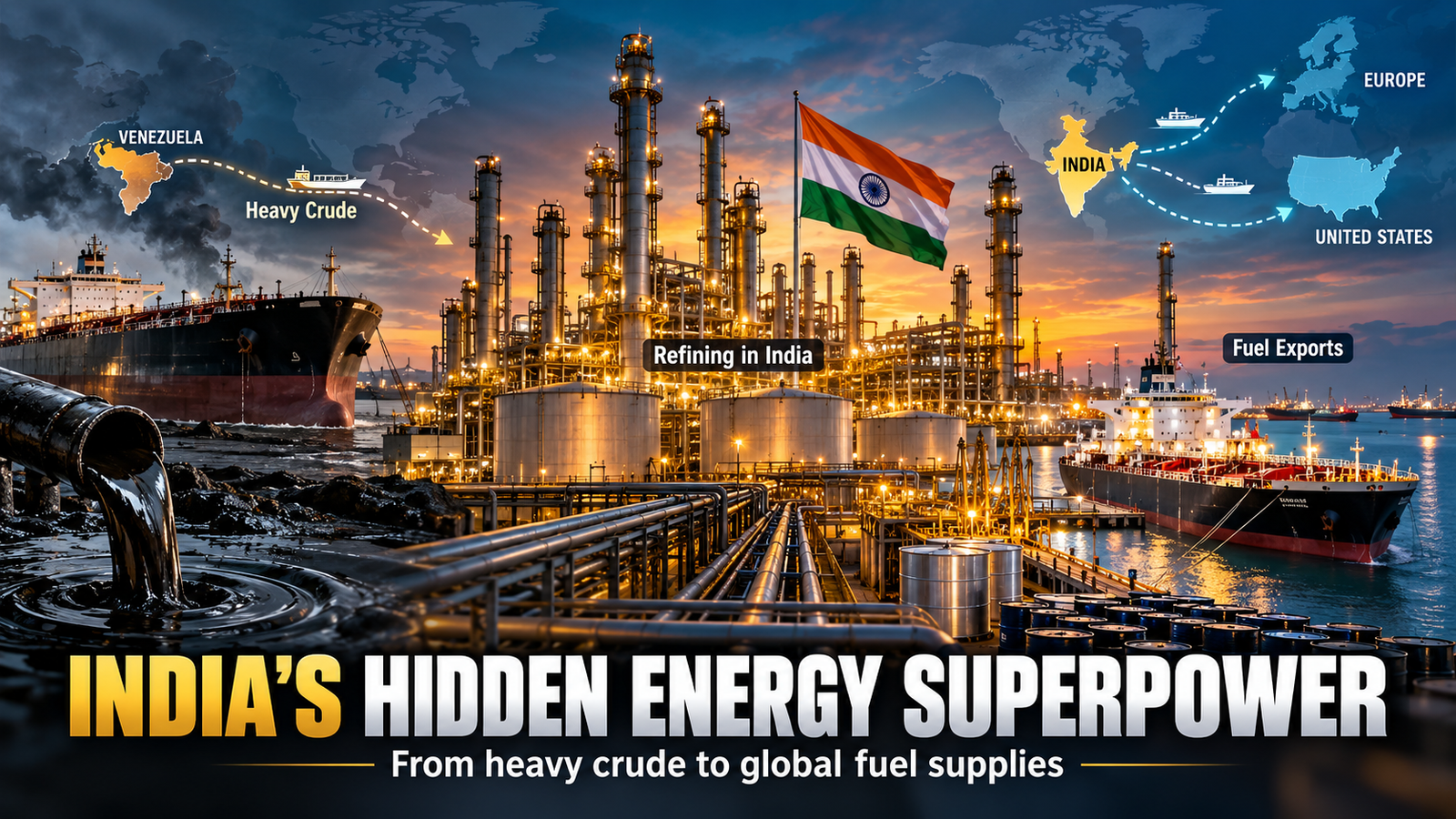
India’s Hidden Energy Superpower: How Its Refineries Turn Venezuelan Heavy Crude Into Fuel the World Needs

The world usually measures energy power by how much oil a country produces.
Saudi Arabia has enormous reserves. Russia exports millions of barrels. The United States is a leading oil producer. Venezuela possesses some of the world’s largest proven petroleum reserves.
But there is another form of energy power that receives far less attention.
The ability to turn difficult crude oil into the petrol, diesel and aviation fuel that modern economies actually need.
And in this industry, India has emerged as a major global player.
India is now the world’s fourth-largest oil-refining country, behind the United States, China and Russia.
Its refineries process crude purchased from multiple regions and export finished petroleum products to international markets.
The significance became especially clear this week when U.S. Secretary of State Marco Rubio encouraged Reliance Industries to process more Venezuelan crude at its giant Jamnagar complex in Gujarat.
Why would America want an Indian company to refine Venezuelan oil?
Because not every refinery can economically process the thick, sulphur-rich crude found in Venezuela.
India possesses industrial capabilities that have become strategically important to the global energy system.
India Is Already a Global Refining Power
According to India’s Petroleum Planning & Analysis Cell, the country had approximately 267.1 million tonnes of annual refining capacity as of April 1, 2026.
That represents a dramatic transformation.
India once struggled to meet its own requirements for refined petroleum products.
Today, it possesses enough refining capacity to supply domestic markets and export substantial quantities abroad.
In FY2025–26, India exported approximately 61.5 million tonnes of petroleum products, according to the Ministry of Petroleum and Natural Gas.
Source: Petroleum Planning & Analysis Cell — Installed Refinery Capacity
The important distinction is that India imports most of its crude oil.
It does not have to produce every barrel itself to become a major refining exporter.
Instead, Indian companies import raw crude, process it using sophisticated equipment and sell higher-value finished products.
That is industrial value addition.
Why Crude Oil Cannot Simply Be Used Directly
Crude oil is not the same as petrol or diesel.
It is a complex mixture of hydrocarbons containing materials of different weights and chemical properties.
Before crude becomes useful to most consumers, it must pass through industrial processing.
Refineries separate and convert crude into products including:
- Petrol for vehicles
- Diesel for trucks, agriculture and industry
- Aviation turbine fuel for aircraft
- LPG and other fuel products
- Naphtha for petrochemical manufacturing
- Feedstocks used in plastics, chemicals and other materials
A country may possess enormous crude reserves and still depend on overseas facilities to produce particular finished fuels economically.
This is why refining capacity matters.
Oil production provides raw energy resources. Refining transforms those resources into commercially usable energy.
Venezuela Has Enormous Oil Reserves—but Its Crude Is Difficult to Process
Venezuela’s crude reserves are extraordinary.
However, a large proportion consists of extra-heavy oil, particularly from the Orinoco Belt.
Grades such as Merey are highly viscous and contain significant sulphur.
They cannot be treated exactly like lighter crude grades.
Heavy crude requires sophisticated processing equipment to produce commercially valuable transportation fuels.
That can include conversion units, hydrogen-processing systems and equipment capable of handling difficult residues.
Not every refinery possesses the necessary configuration.
And even technically capable refineries cannot necessarily process unlimited quantities of Venezuelan crude without modifying their crude mix.
This creates an advantage for complex refineries such as Reliance’s Jamnagar facilities.
Source: S&P Global — India’s Venezuelan Crude Imports and Refining Challenges
Jamnagar: The Industrial Giant Behind India’s Refining Strength
Located in Gujarat, Reliance Industries’ Jamnagar complex is the world’s largest single-site oil-refining complex.
Its two major refineries have combined processing capacity of approximately 1.4 million barrels per day.
The complex is designed to handle diverse crude grades, including difficult heavy and sour crude.
That flexibility is commercially important.
When certain crude grades become cheaper because of sanctions, supply disruptions or market conditions, a refinery capable of processing them may gain access to attractive feedstock.
Jamnagar’s sophisticated configuration allows Reliance to turn challenging crude into marketable products.
This is one reason the complex occupies such an important position in international energy discussions.
During his October 2026 visit, Marco Rubio specifically highlighted India’s capability to process Venezuelan heavy oil and encouraged expanded energy cooperation.
Source: Reuters — Rubio Encourages Reliance to Refine More Venezuelan Oil, October 20, 2026
India Is Already Buying Venezuelan Crude
This is not merely a future possibility.
India has resumed substantial purchases of Venezuelan oil.
Reuters reported in April 2026 that Reliance had begun purchasing heavy crude directly from Venezuela’s state oil company, PDVSA, under applicable U.S. licensing arrangements.
One reported shipment involved approximately 2 million barrels of Merey crude destined for India’s Sikka port.
Source: Reuters — Reliance Purchases Venezuelan Oil Directly From PDVSA
However, this trade is not without limitations.
Transporting Venezuelan oil to India involves long shipping distances.
Heavy crude requires suitable refining equipment.
And Venezuelan barrels must compete with alternative grades from Iraq, Canada and elsewhere.
Therefore, India’s refining capabilities are valuable—but that does not mean every Venezuelan barrel will automatically be profitable to import.
The World Needs Diesel More Than Most People Realize
Consider how many industries depend on diesel.
Freight trucks move food and manufactured goods.
Ships support international trade.
Agricultural machinery supports food production.
Construction equipment builds infrastructure.
Industrial generators provide backup electricity.
Diesel therefore plays a central role in global logistics and production.
A shortage can increase transportation costs, raise food prices and intensify inflation.
Aviation fuel plays a similar role in international travel and air cargo.
That is why refined products are strategically important.
Crude sitting in a storage tank cannot keep an aircraft operating until it is processed into suitable fuel.
Europe’s Dependence on Indian Refined Fuels
Europe’s relationship with Indian refiners changed significantly after Russia’s invasion of Ukraine.
European sanctions reduced access to Russian petroleum products.
As European buyers searched for alternative suppliers, Indian diesel and other refined products became more important.
According to an analysis published by the Council on Foreign Relations, India’s petroleum-product exports to Europe reached approximately 24.73 million tonnes in FY2023–24.
That illustrates how significantly international trade routes shifted.
Source: Council on Foreign Relations — Oil, Energy, India-US Relations and the Russia Conundrum
The relationship continued evolving in 2026.
New European restrictions on fuels produced from Russian-origin crude disrupted certain Indian exports.
Nevertheless, European importers continued seeking eligible supplies from India and other countries.
In September, shipping analysis indicated that Indian refiners supplied approximately 60% of the diesel moving through the Bab-el-Mandeb route toward Europe during August.
That does not mean India provided 60% of Europe’s total diesel imports.
It means India dominated one particular shipping flow during that period.
Source: Business Standard — India Emerges as Key Diesel Supplier to Europe, September 6, 2026
The distinction is important, but the implication remains significant.
Europe increasingly values access to India’s refining capacity when other suppliers face disruption.
What If India Suddenly Stopped Exporting Refined Fuel?
Imagine an extreme scenario.
India suspends large-scale exports of diesel, petrol and aviation fuel.
What happens?
First, countries purchasing Indian products would need alternative suppliers.
Second, traders would attempt to redirect cargoes from the Middle East, the United States, East Asia and other refining centres.
Third, shipping routes could become longer and more expensive.
Fourth, if alternative refineries were already operating near capacity, buyers might have to pay higher premiums for immediately available fuel.
The result could be upward pressure on international refined-product prices.
That pressure could spread into trucking, aviation and industrial costs.
Europe could be especially exposed during periods when Russian supplies remain constrained and other exporters are unable to increase deliveries quickly.
India therefore has genuine influence over the international supply of finished petroleum products.
But that influence is not unlimited.
Could India Destabilize the American Fuel Market?
The United States is a different case.
America possesses enormous domestic refining capacity and is itself a major exporter of petroleum products.
According to the U.S. Energy Information Administration, American petroleum exports remained near record levels in 2025.
The United States is therefore not dependent on Indian refined fuels to the same extent as some other markets.
Source: U.S. Energy Information Administration — US Energy Imports and Exports
American buyers nevertheless participate in interconnected international fuel markets.
The EIA has noted that Indian refining exports reach the U.S. West Coast, where imported products can help supplement regional supplies.
That means disruptions to Indian exports could affect particular American markets or contribute to wider international price movements.
But claiming that India could single-handedly collapse America’s energy system would overstate the evidence.
The more credible argument is that Indian refining contributes to global supply flexibility, and removing that flexibility during an existing shortage could worsen prices and disruptions.
The Refining Business Gives India Strategic Leverage
There is another important dimension.
Countries possessing oil reserves depend on buyers and refiners.
Countries possessing advanced refining infrastructure depend on access to crude.
This creates mutual dependence.
Venezuela needs reliable markets for its heavy crude.
India wants diversified crude suppliers.
Europe needs refined fuels.
The United States wants stable international energy markets.
Indian refining companies sit at the intersection of these commercial interests.
This creates bargaining opportunities in trade, investment and energy diplomacy.
But those opportunities depend on reliable supply relationships.
A country that deliberately stops exporting without a strong justification could damage its reputation, lose customers and sacrifice valuable foreign-exchange earnings.
Strategic influence is often more valuable when trading partners know they can rely on you—not when they fear you will abruptly stop supplying them.
India’s Next Opportunity: Move Further Up the Energy Value Chain
India’s refining industry already demonstrates what investment in industrial infrastructure can achieve.
But the next stage could be even more important.
Future opportunities include expanding complex refining capacity, integrating petrochemicals, developing specialty chemicals, improving energy efficiency and building technologies for lower-emission industrial processes.
India has discussed increasing its refining capacity to approximately 310 million tonnes annually by 2030.
Source: Ministry of Petroleum and Natural Gas — India’s Refining Expansion Plans
The challenge will be balancing this investment with changing global fuel demand and the energy transition.
New capacity creates value only if enough profitable demand exists.
Why This Matters for India’s Strategic Autonomy
India’s experience in refining demonstrates a broader economic principle.
A country does not have to dominate every source of raw material to become globally important.
It can build power through specialized industrial capabilities.
India imports crude but exports finished fuel.
Taiwan imports many raw materials but manufactures advanced semiconductors.
Germany imports energy and industrial inputs but exports sophisticated machinery.
The lesson is that industrial capability can create strategic influence even when natural resources are limited.
India’s refining infrastructure gives it a role that cannot be replaced instantly or without cost.
That capability strengthens India’s position in energy diplomacy.
Conclusion: India’s Power Lies in the Refinery, Not Just the Oil Barrel
The world talks endlessly about who owns oil.
But the global economy also depends on who can refine it.
Venezuela possesses some of the world’s largest reserves.
India possesses advanced refining facilities capable of processing difficult grades of crude.
Europe relies on international suppliers for important refined-fuel requirements.
The United States is itself a major refining power but still participates in global petroleum trade.
And India sits among the countries helping connect these parts of the energy system.
With more than 267 million tonnes of installed annual refining capacity and tens of millions of tonnes of petroleum-product exports, India is a major industrial energy power.
Its role will become particularly important whenever wars, sanctions or shipping disruptions reduce global fuel availability.
If Indian exports suddenly disappeared, certain international markets could experience higher prices and supply difficulties.
But India’s greatest strength is not the ability to create disruption.
It is the ability to keep essential energy products flowing when global supply chains are under pressure.
In a world where energy security has become a major geopolitical concern, that is a form of strategic power worth understanding.
Frequently Asked Questions
Is India the world’s largest oil refiner?
No. India is the world’s fourth-largest refining country, behind the United States, China and Russia.
Can Indian refineries process Venezuelan heavy crude?
Yes. Reliance’s Jamnagar complex and certain other sophisticated Indian refineries can process Venezuelan heavy crude, although technical limits and transport economics restrict the volumes they can handle.
Why is Venezuelan crude difficult to refine?
Many Venezuelan crude grades are highly viscous and sulphur-rich, requiring specialized processing equipment and suitable blending arrangements.
Does Europe depend on Indian diesel?
India is an important supplier of refined fuels to Europe, particularly when Russian and other international supplies are disrupted. The level of dependence varies by product, country and period.
Does America import refined fuel from India?
Yes. Indian petroleum products reach certain American markets, including the West Coast, although the United States has very large domestic refining capacity.
What happens if India stops petroleum-product exports?
International buyers would seek alternative supplies. Depending on market conditions, that could increase prices, shipping costs and supply disruption risks. The severity would vary across regions.
Is refining more important than crude-oil production?
Both are essential. Crude production supplies raw petroleum, while refining converts it into the products needed by transport, industry and consumers.
Editorial Disclaimer: This article analyses India’s refining capabilities and international supply-chain influence using publicly available industry and government information as of October 22, 2026. Scenarios involving a sudden halt in Indian petroleum exports are hypothetical, not forecasts or policy announcements.
