














































India Makes History in Space Technology: Hyderabad Opens First Private Space Debris Removal Facility

India has achieved another exciting milestone in its rapidly growing space technology industry.
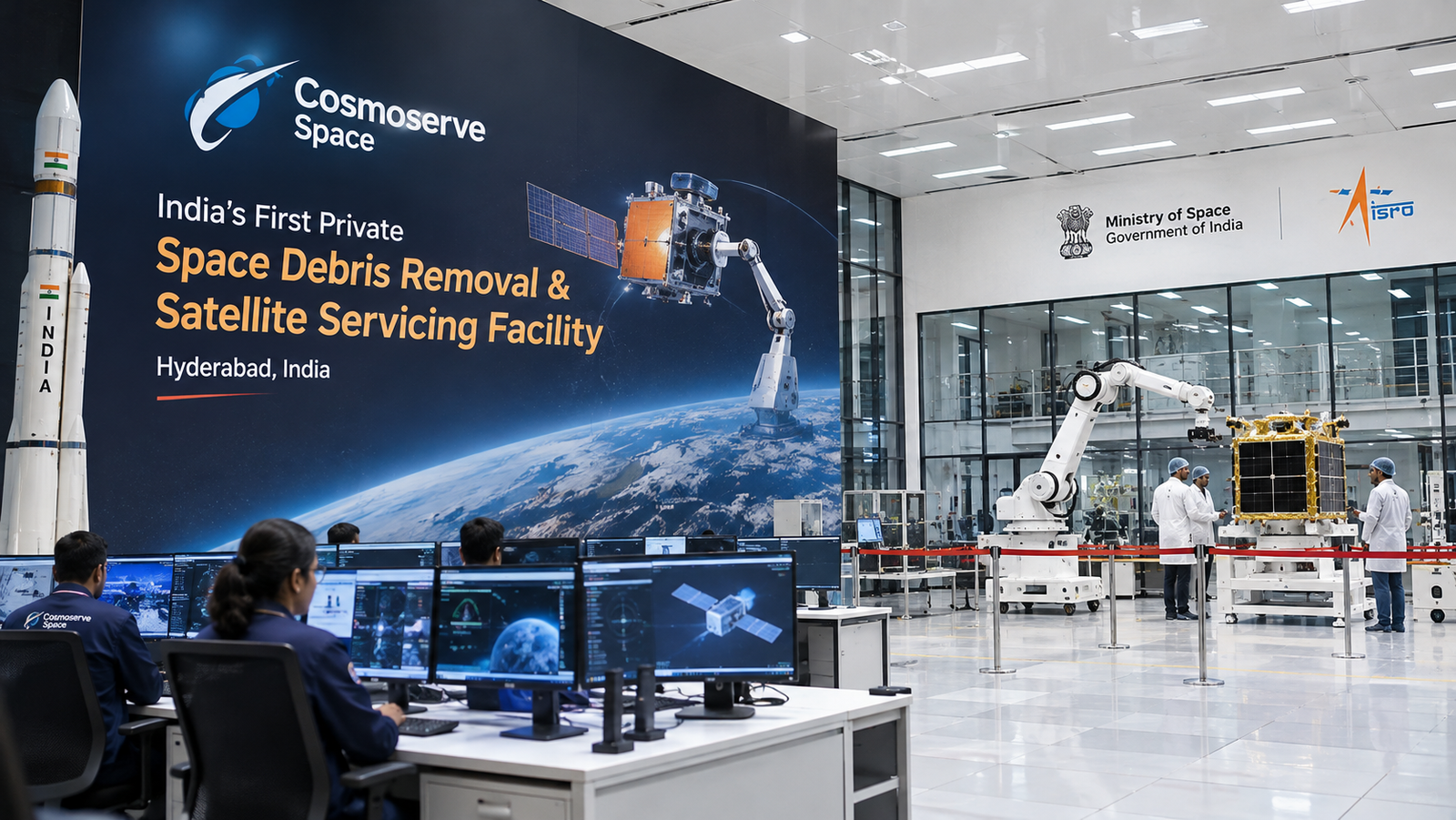
On November 5, 2026, Hyderabad-based startup Cosmoserve Space inaugurated Base 1, India’s first private integrated facility dedicated to developing technologies for space debris removal and satellite servicing.
The facility represents a new chapter in India’s space ambitions.
For decades, India’s space programme has focused on launching satellites, exploring the Moon and developing advanced launch vehicles.
Now, Indian companies are preparing to tackle another challenge: repairing satellites, extending their operational life and removing dangerous debris from Earth’s orbit.
And the opportunities could be enormous.
1. What Has India Achieved?
Cosmoserve Space’s new Base 1 facility is located at VSD Tech Park in Gachibowli, Hyderabad.
Spread across approximately 14,800 square feet, it brings several advanced capabilities together.
These include space robotics laboratories, satellite integration facilities, orbital rendezvous and capture testing systems, and mission simulation infrastructure.
Union Minister Dr. Jitendra Singh inaugurated the facility virtually, while Telangana’s IT and Industries Minister D. Sridhar Babu attended the ceremony in Hyderabad.
The facility will allow engineers to design, build and test technologies required for future space-cleanup and satellite-servicing missions.
Source: Press Information Bureau — India Advances Space Debris Removal Technology, November 5, 2026
2. Why Is Space Debris Becoming a Global Problem?
Thousands of satellites orbit Earth.
Some provide internet connectivity, weather forecasts, navigation and communications.
Others have stopped functioning but remain in orbit.
Old rocket components and fragments from collisions add to the growing amount of space debris.
Even tiny fragments can damage spacecraft because objects in orbit move at extremely high speeds.
As more companies launch satellites, the challenge of keeping Earth’s orbital environment safe becomes increasingly important.
This creates demand for technologies capable of identifying, approaching and removing dangerous debris.
India’s new facility aims to help develop solutions to this growing international problem.
3. Indian Robots Could One Day Repair Satellites in Space
One of the most exciting applications is satellite servicing.
Today, when a satellite experiences certain technical problems or runs out of fuel, repairing it can be extremely difficult.
Replacing it may require manufacturing and launching another spacecraft.
Cosmoserve is developing robotic technologies intended to approach satellites and potentially perform operations such as inspection, docking, refuelling and repair.
The company has proposed a system involving a larger orbital servicing station and smaller autonomous servicing vehicles.
Its goal is to make servicing multiple satellites more economical than launching a dedicated mission for every spacecraft.
These capabilities are still under development, and commercial performance remains to be demonstrated.
Nevertheless, they represent a significant direction for future space technology.
4. A $6 Million Investment Boosts India’s Space Startup Ecosystem
The inauguration coincided with another encouraging development.
Cosmoserve announced $6 million in seed funding, bringing its total reported funding to more than $9 million.
Investors include Japan-based Rebright Partners and Indian investment firms.
The funding will support technology development, testing and future space missions.
The company is targeting additional demonstrations during 2027 and commercial operations in 2028, subject to technical and regulatory progress.
Source: Business Standard — Cosmoserve Opens Hyderabad Facility and Raises $6 Million
The development demonstrates growing investor interest in India’s private space industry.
5. How Could This Create Jobs and Economic Opportunities?
A growing satellite-servicing industry requires expertise across several fields.
These include robotics, artificial intelligence, aerospace engineering, electronics, sensors, propulsion systems and advanced manufacturing.
Facilities such as Base 1 can create opportunities for engineers, researchers, technicians and specialized suppliers.
Indian startups may also benefit from developing components and services for future missions.
Cosmoserve says it already sources approximately 60% of its mission components locally.
Increasing domestic manufacturing could support additional business activity and reduce dependence on selected imported technologies.
However, actual employment and export growth will depend on the company’s ability to successfully commercialize its systems.
6. Hyderabad Is Becoming an Important Space Technology Hub
Hyderabad already has a strong aerospace, defence and technology ecosystem.
The addition of specialized facilities such as Base 1 could strengthen this industrial base.
According to Telangana’s IT Minister, the city now hosts more than 30 space technology companies.
The state is also considering a dedicated Space City within its proposed Bharat Future City development.
This could provide further opportunities for research, manufacturing and collaboration between startups and larger companies.
Source: Telangana Today — Cosmoserve Opens Integrated Space Debris Removal Facility
7. India’s Space Economy Could Grow Significantly
At the inauguration, Dr. Jitendra Singh said India’s space economy had reached nearly $9 billion.
He also outlined a government ambition for the industry to reach approximately $40–45 billion over the coming decade.
According to his remarks, India’s space startup ecosystem has expanded to nearly 450 companies.
These figures reflect the government’s broader expectations for private-sector participation.
The space economy includes much more than rocket launches.
Satellite manufacturing, communications, Earth observation, navigation, data services and orbital maintenance could all contribute to future growth.
Space debris removal adds another emerging area of commercial activity.
The projected growth is an ambition, not a guaranteed economic outcome.
8. India’s Next Step: Becoming a Provider of Global Space Services
India has already demonstrated capabilities in satellite launches and space exploration.
Developing satellite-servicing and debris-removal technologies could help Indian businesses expand into new international markets.
Such services may become increasingly valuable as commercial satellite constellations grow.
Successful robotic servicing could potentially extend satellite life and reduce the need for some replacement launches.
Reducing space debris could also improve orbital safety for future missions.
The challenge will be proving that these systems work reliably and economically in orbit.
But India’s private space companies are beginning to invest in the expertise and facilities needed to compete.
Conclusion: India Is Preparing for the Next Generation of Space Technology
The inauguration of Cosmoserve Space’s Base 1 facility is encouraging news for India’s technology sector.
It demonstrates how Indian startups are moving into specialized fields once dominated by a relatively small number of international organizations.
The new Hyderabad facility brings together robotics, advanced engineering and satellite-servicing research.
It has attracted international and domestic investment.
And it could create future opportunities for Indian manufacturing, skilled employment and technology exports.
The company has not yet begun routine commercial debris-removal operations.
But the foundation for future development is being built.
India’s next space success may not simply involve launching another satellite—it could involve building the technology that keeps thousands of satellites working safely for longer.
That is an exciting opportunity for India’s scientists, engineers and entrepreneurs.
Frequently Asked Questions
What is India’s new space debris removal facility?
Base 1 is a private space robotics and satellite-servicing development facility inaugurated by Cosmoserve Space in Hyderabad on November 5, 2026.
Is it India’s first facility of its kind?
It has been described as India’s first private integrated facility dedicated to active space debris removal and in-orbit satellite servicing.
Can India already remove space debris commercially?
Cosmoserve is developing and testing the required technologies. Routine commercial debris-removal services have not yet been established.
How will this benefit India’s economy?
The industry could create opportunities in aerospace engineering, robotics, electronics, manufacturing and international satellite services.
When will Cosmoserve begin commercial operations?
The company is targeting 2028, depending on the success of its planned technology demonstrations and other requirements.
Editorial Note: This article describes a newly inaugurated development and testing facility. Planned satellite repair and debris-removal services are future capabilities and should not be confused with completed commercial missions.
