











































UAE Eyes India’s BrahMos and Akashteer: How India’s Defence Exports Are Entering a New Era

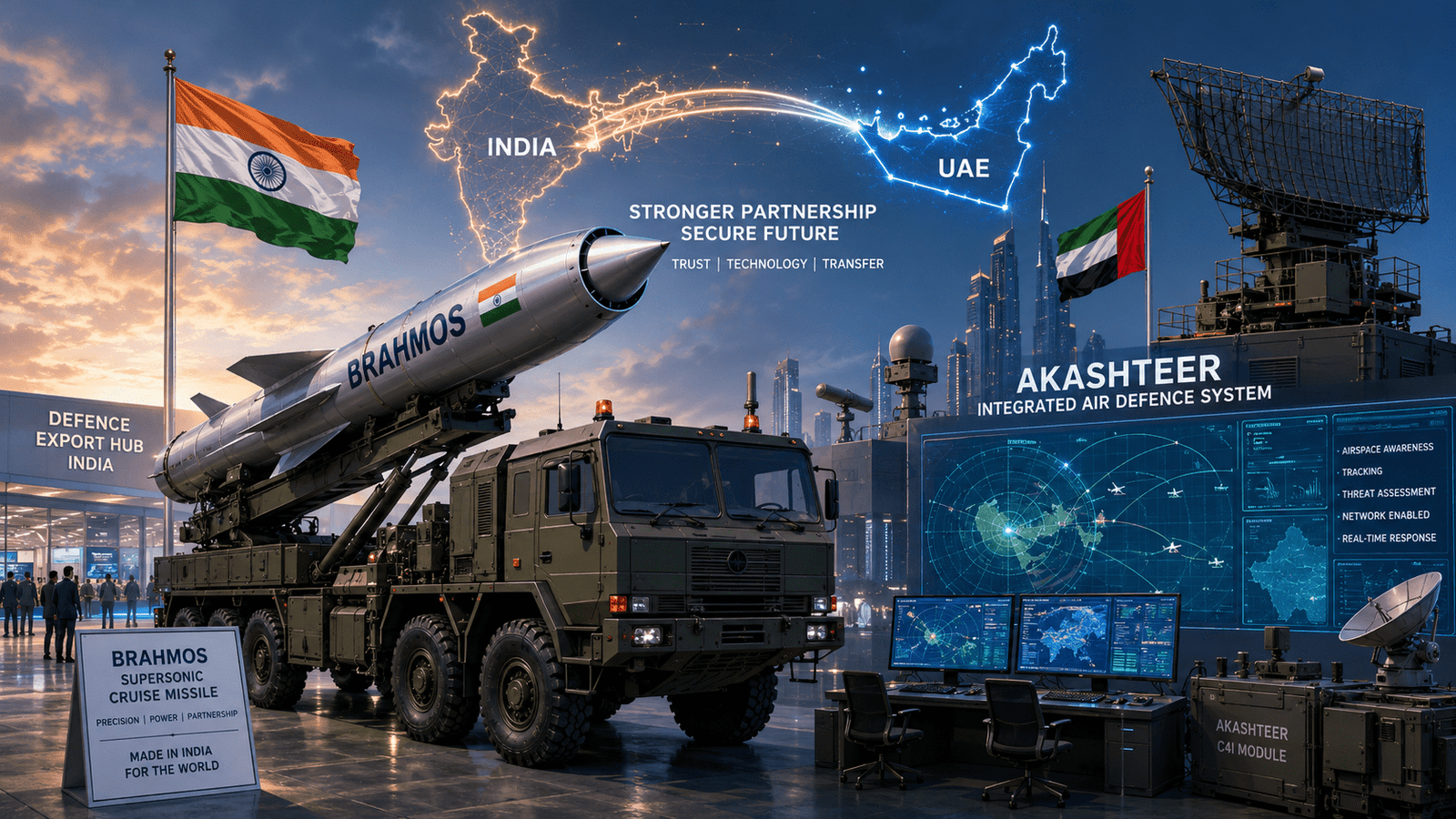
India’s defence industry may be entering one of its most important moments yet. According to recent reports, the United Arab Emirates is in talks with India for the possible purchase of two major Indian defence systems: the BrahMos supersonic cruise missile and the Akashteer air-defence command and control system.
If the talks move forward, this could become more than just another defence deal. It would be a powerful signal that India is no longer seen only as a buyer of foreign weapons. India is now being viewed as a serious defence technology exporter.
For decades, India depended heavily on imported military systems. Today, the story is changing. Under Make in India and Atmanirbhar Bharat, India is building, testing and exporting platforms that other countries are beginning to trust.
Why the UAE Is Interested
The UAE is one of the most important military buyers in the Middle East. Traditionally, it has purchased advanced weapons from the United States and other Western suppliers. But the Gulf region is changing quickly. Regional tensions, drone attacks, missile threats and the need to protect energy routes have pushed countries like the UAE to diversify their defence partnerships.
This is where India becomes important.
BrahMos gives the UAE a powerful strike capability, while Akashteer offers a modern air-defence coordination system. Together, they represent a “strike and shield” combination — one system for deterrence, the other for protection.
The UAE also has to safeguard vital energy routes, including the Strait of Hormuz. Any instability in this region can affect global oil markets, shipping and energy security. A stronger defence network helps the UAE reduce vulnerability in a tense region.
What Makes BrahMos Special?
BrahMos is one of India’s most recognized defence exports. Jointly developed by India and Russia, it is known for its supersonic speed, precision and ability to be launched from land, sea and air platforms.
For any country looking for fast-response strike capability, BrahMos is attractive because it is difficult to intercept and can be used for coastal defence, deterrence and strategic security.
India’s earlier BrahMos export to the Philippines already proved that New Delhi can deliver complex missile systems to foreign partners. Interest from the UAE would expand BrahMos from Southeast Asia into the Middle East, opening a much bigger defence market for India.
Akashteer: India’s New Defensive Export Star
While BrahMos gets most of the headlines, Akashteer may become equally important.
Akashteer is not just a missile. It is an automated air-defence command and reporting system. In simple words, it helps connect radars, sensors, command posts and weapons into one coordinated network.
Modern warfare is no longer only about having missiles. It is about detecting threats quickly, sharing information in real time and responding before damage is done. Drones, cruise missiles and air attacks can come fast and from multiple directions. A system like Akashteer helps manage that battlefield picture.
This makes Akashteer highly relevant for countries facing missile and drone threats. If exported successfully, it could become one of India’s most important defence technology products.
What This Means for India-UAE Relations
India and the UAE already have strong ties in trade, energy, investment and diaspora relations. Millions of Indians live and work in the UAE, and the two countries have built deep economic connections.
A defence deal involving BrahMos and Akashteer would add a new strategic layer to this relationship. It would show that India is not just a labour, trade or energy partner. India can also be a security and defence technology partner.
For the UAE, buying from India helps diversify suppliers. For India, selling to the UAE opens the door to the wider Gulf market.
India’s Defence Exports Are Rising Fast
The possible UAE interest comes at a time when India’s defence exports are already rising sharply. India’s defence exports touched a record high of ₹38,424 crore in FY 2025-26, showing strong global acceptance of Indian-made defence products.
This growth is not accidental. It is the result of policy reforms, private sector participation, defence corridors, export approvals, indigenous production and a push to reduce import dependence.
India’s annual defence production has also reached a record ₹1.78 lakh crore. This shows that India is building the industrial base needed to support both domestic needs and exports.
Why This Is a Big Shift
India was once known as one of the world’s largest arms importers. That image is now changing.
Defence exports are important for three reasons.
First, they create confidence in Indian technology. When foreign countries buy Indian systems, it proves that Indian platforms are no longer just for domestic use.
Second, exports support India’s defence industry. Bigger production numbers reduce costs, improve supply chains and create jobs in public and private companies.
Third, defence exports increase India’s geopolitical influence. Countries that buy Indian defence systems build long-term training, maintenance, logistics and strategic relationships with India.
This is how defence manufacturing becomes foreign policy.
Challenges Still Remain
India should celebrate this progress, but it should also remain realistic. Defence deals take time. They involve testing, pricing, financing, training, approvals, geopolitics and long negotiations.
In the case of BrahMos, any export also requires coordination because it is jointly developed with Russia. That does not mean the deal cannot happen, but it does add another layer to the process.
India must also ensure timely delivery, after-sales support, spare parts, training and reliability. A defence export reputation is not built only by signing deals. It is built by delivering systems that work when needed.
The Bigger Message: India Is Becoming a Defence Power
The UAE’s interest in BrahMos and Akashteer sends a clear message: the world is taking Indian defence technology more seriously.
India is no longer only talking about self-reliance. It is slowly building the systems, production capacity and export confidence needed to become a global defence manufacturing hub.
From missiles to air defence networks, from naval platforms to electronic warfare systems, India’s defence industry is expanding beyond old expectations.
Final Thoughts
The reported UAE interest in BrahMos and Akashteer could become a major milestone for India’s defence export journey. It shows that Indian systems are being watched not only in Asia, but also in the Middle East.
For India, this is about more than money. It is about strategic confidence, industrial growth, national security and global influence.
A country that once imported most of its defence equipment is now preparing to export advanced systems to important partners. That is the real meaning of Atmanirbhar Bharat.
India is no longer only buying security from the world. India is beginning to supply security to the world.
Disclaimer: This article is for informational and educational purposes only. It is based on publicly available reports and should not be considered defence, diplomatic, financial or investment advice.